
Georgia’s Economic Development Strategy Supports Long-Term Growth
For more than a decade, Georgia’s economic development strategy has been driven by consistency, collaboration, and competitiveness. These principles have helped sustain a diversified economy that includes advanced manufacturing, logistics, aerospace, life sciences, technology, agribusiness, and corporate functions.
The state maintains a steady approach to economic development, anchored by disciplined fiscal policy, targeted infrastructure and workforce investment, and a clear focus on maintaining a business climate that benefits existing employers, new investors, and taxpayers alike.
“Over the past four decades and with the support of the Columbus community, state, and Governor, Pratt & Whitney’s presence in Georgia has grown from a small manufacturing facility to a state-of-the-art manufacturing and overhaul center,” said Pratt & Whitney President Shane Eddy as the company announced a $200 million expansion on the heels of a prior expansion that added 400 new jobs and 81,000 square feet to Pratt & Whitney’s Columbus Engine Center.
Companies select Georgia for its connectivity, workforce, and speed-to-market solutions. They stay for the partnerships that support long-term success.

A Consistent, Pro-Business Foundation Shaped Over Time
Georgia’s competitive standing remains rooted in a long-standing commitment to a predictable business climate. For 12 consecutive years, the state has been ranked the No. 1 state for business, demonstrating sustained leadership across overall economic performance, workforce development, and fiscal management.
That consistency highlights decades of policy decisions designed to encourage investment and job creation. State leadership prioritizes a framework that enhances competitiveness, facilitates expansion, and provides clarity for companies evaluating future operations in Georgia.
Robert Low, CEO and Founder of Prime Inc., described how the company selected “a state renowned for its strong work ethic” that aligned “perfectly with our company’s values of dedication and excellence.”
Over time, disciplined fiscal management and a pro-growth tax structure have returned value to taxpayers while elevating Georgia’s role as a leading destination for business activity.
During the most recent legislative session, state leaders approved legislation reducing Georgia’s corporate income tax rate to 4.99 percent, retroactive to January 1, 2026. The legislation also establishes a structured pathway for annual reductions of 0.125 percent until the rate reaches 3.99 percent.
This framework gives companies added visibility when evaluating capital investment, expansion, or relocation decisions. Combined with existing tools such as the Job Tax Credit and other performance-based incentives, these policies enhance Georgia’s competitiveness for business investment.
Together, these measures sustain a climate defined by stability, predictability, and long-term competitiveness across industry sectors.
Energy Reliability and Cost Stability Support Business Growth
Georgia’s economic environment is supported by a reliable and evolving energy infrastructure. Utility providers across the state are expanding generation capacity, transmission systems, and grid modernization efforts to meet rising demand from both new and existing industries.
Georgia Power’s Integrated Resource Plan supports the state’s ability to meet projected growth of 8,500 megawatts by 2030, helping accommodate expansion for major corporate hubs and energy-intensive industries.
Georgia’s utilities are also diversifying the state’s energy mix. Investments in solar capacity, storage, and Plant Vogtle — the first new nuclear plant to open in the United States in three decades — provide companies with carbon-neutral and renewable energy solutions.
This balanced energy portfolio supports growth while reducing risk. Reliability is matched by cost stability, a key factor for manufacturers and other energy-intensive sectors evaluating site decisions.
The combination of reliability, affordability, and energy diversity helps differentiate Georgia for companies making location decisions.
Investment Across Key Georgia Industries
Investment across Georgia reflects both global-scale commitments and sustained expansion by companies already operating in the state. These projects represent some of the most significant economic wins of the past year.
Earlier this year, global biopharmaceutical company UCB announced a $2 billion investment in a new manufacturing facility in Georgia, creating 330 jobs. The project ranks among the largest life sciences commitments in state history and accelerates Georgia’s momentum in pharmaceutical manufacturing and innovation.
It also shines a spotlight on the state’s depth of talent and established production ecosystem.
“By investing in Georgia, where our U.S. headquarters have been based for more than three decades, we are strengthening our biologics manufacturing capabilities, supporting our innovation pipeline, and creating high-quality jobs in a state that offers outstanding talent, a strong manufacturing tradition, and an ecosystem designed for sustainable, long-term success,” said Jean-Christophe Tellier, CEO of UCB.

Georgia-based manufacturing expansion is further evidenced by Unified Legacy, a homegrown industrial and consumer products manufacturer. The company announced a $125 million investment in Macon-Bibb County, which will create 500 new jobs.
The project highlights continued expansion by companies with existing operations in Georgia and underscores the state’s ability to accommodate industrial development across multiple regions.
In northwest Georgia, Qcells is expanding its solar manufacturing footprint, strengthening Georgia’s role in the clean energy supply chain. The company’s ongoing investment activity advances growth in domestic solar production and deepens the state’s advanced manufacturing sector.
The state also remains a top contender for companies establishing, relocating, or re-evaluating their corporate footprints.
“Atlanta has always been a cornerstone of Salesforce’s growth story,” said Tanya Counter, Site Lead for Salesforce Atlanta. Counter added that the city’s “extraordinary” local talent helps the company thrive, sharing excitement for Salesforce “to continue growing here and deepening our investment in a city we call home.”
Taken together, these investments demonstrate the depth and diversity of Georgia’s economy.
Innovation and Corporate Growth Strengthen Georgia’s Business Environment
Companies of all sizes and at every stage of growth benefit from being in Georgia.
“Georgia was the clear winner of our selection process for the growth stage of our company due to its favorable business environment, world-class global connectivity, and high quality of living for our employees,” said Glytec CEO Patrick Cua.
Rather than functioning solely as a production hub, Georgia operates as an integrated business environment where companies can align design, research, engineering, and manufacturing within a single operational footprint.
Duracell’s decision to locate its global research and development headquarters in Atlanta reflects the state’s expanding role in advanced business operations, engineering, and product development.
The project enhances Georgia’s presence in innovation-driven industries and complements its established manufacturing base.

Workforce Development Aligned with Industry Needs
Georgia’s workforce system remains a central competitive advantage, supported by coordination across education, training, and industry partnerships.
The state’s technical college network, university system, and private sector collaboration form a layered talent pipeline spanning entry-level preparation through advanced technical and professional roles.
This structure provides employers with flexible workforce solutions aligned to operational complexity and expansion needs.
“From day one, the dedication of our Georgia-based team, along with the support of workforce partners including Georgia Quick Start, the Technical College System of Georgia, and the Choose Columbus retention program, has played a vital role in our success,” said Michael Holley, CEO of HK USA.
Georgia Quick Start serves as a cornerstone of this system. Recognized by Area Development magazine as the No. 1 workforce training program for 14 consecutive years, Quick Start delivers customized training developed in direct partnership with employers, the Technical College System of Georgia, and educational institutions statewide.
The General Assembly further advanced workforce alignment through passage of the Education and Workforce Strategy Act, HB 1302. The legislation strengthens coordination across agencies and education partners, aligns workforce planning with employer demand, and expands apprenticeship pathways through the Technical College System of Georgia.
Infrastructure and Site Readiness Support Georgia’s Growth
Georgia’s infrastructure network is central to its economic competitiveness, providing integrated access to global and domestic markets through the Ports of Savannah and Brunswick, Hartsfield-Jackson Atlanta International Airport, and an extensive interstate and rail system.
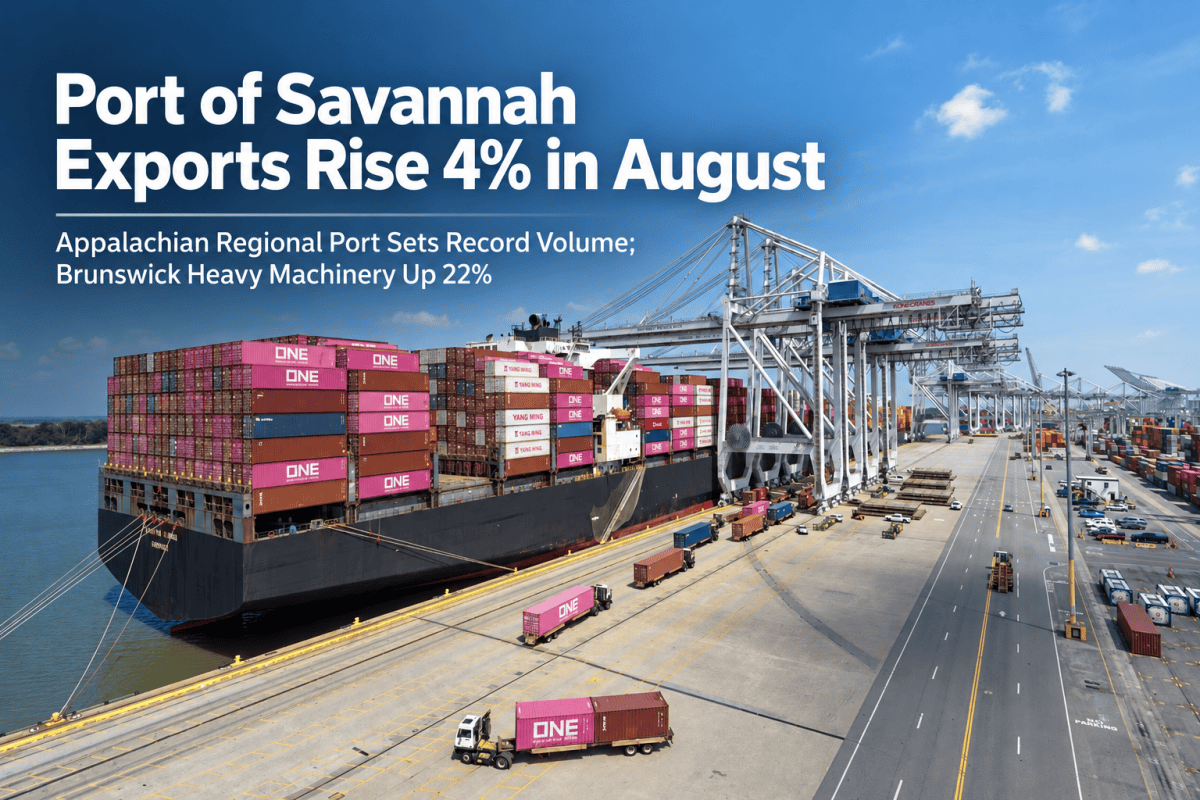
The Port of Savannah operates as a major gateway for international trade, handling high volumes of container traffic and connecting Georgia manufacturers to global markets through an efficient intermodal network.
A study by Georgia Tech, released in April, found that the Port of Savannah saves shippers more than $1,000 per container to Atlanta, Memphis, and Nashville compared to West Coast gateways. Independent research conducted by Georgia Tech’s Supply Chain and Logistics Institute estimated that shipping through Savannah offers a 32 percent cost savings over the West Coast.
The findings showed that Savannah compensates for longer ocean routes with highly reliable port processing and inland transport, eliminating the high variance and congestion risks associated with West Coast routes.
Hartsfield-Jackson Atlanta International Airport continues expanding global connectivity, enabling time-sensitive cargo movement and reinforcing Georgia’s role as a logistics hub for high-value industries.
The latest estimates show that Atlanta’s airport connects the state to more than 80 international and 160 domestic destinations via nonstop service.
Site readiness remains a priority through the Georgia Ready for Accelerated Development program, known as GRAD, and the Rural Site Development Initiative, known as RSDI.
These initiatives prepare industrial sites in advance of project demand, reduce development timelines, and expand access to development-ready locations across both urban and rural communities.
The programs also produce tangible results. Earlier this year, manufacturer Preciball USA announced its first major move to scale up production in coastal Georgia.
Its chosen site had multiple advantages, including proximity to Savannah, access to the ports, a well-trained and available labor pool, and synergies with nearby businesses. Most importantly, the site offered cost and time savings.
Using RSDI funding on the GRAD-certified site, the local economic development authority had pre-built a spec building that ultimately fit the company’s parameters, shaving months off the development timeline.
Looking Ahead: Georgia’s Economic Momentum Continues
As Georgia moves further into 2026, the state’s economic trajectory remains shaped by stability, workforce capacity, infrastructure investment, and sustained competitiveness.
Looking ahead, Georgia is poised to compete across advanced manufacturing, life sciences, logistics, technology, and other high-growth sectors.
Continued collaboration between state, regional, and local partners ensures companies maintain access to talent, infrastructure, and operational conditions that support long-term planning and expansion.
At its core, Georgia’s economic performance is defined by consistency, partnership, and a sustained commitment to creating an environment where businesses, communities, and citizens can advance and thrive together.