
Following a $250 million renovation, the arena has reemerged as a national touring and events destination, driving increased visitation, economic activity, and year round entertainment programming. Photo Credit: CFG Bank Arena
From major sports venues and cultural anchors to makerspaces and creative campuses, new analysis shows Baltimore building a national-scale creative economy
BALTIMORE — Jan. 28, 2026 — The Greater Baltimore Committee (GBC) today announced that nearly $2 billion in public and private investment—including completed projects and developments in the pipeline—has been committed to arts, culture, sports and entertainment projects across the Baltimore region.
According to a new GBC analysis, these investments are accelerating Baltimore’s emergence as a national center for cultural innovation, creative talent, and destination-driven economic growth, anchored by marquee venues such as Oriole Park at Camden Yards, M&T Bank Stadium, CFG Bank Arena, and the Pimlico Racecourse.
The new capital builds on an already robust arts and culture sector that generates a combined annual economic impact of $225.5 million and attracts more than 1.2 million visitors each year. A 2024 study by Resonance Consultancy Ltd. and GBC ranks the Baltimore region No. 1 among peer regions for cultural institution density, underscoring the region’s depth and competitive advantage.
Major Sports & Entertainment Anchors
-
Oriole Park at Camden Yards: A $135 million state-approved, multi-phase renovation is modernizing Baltimore’s MLB stadium with new premium clubs, upgraded video and sound systems, enhanced concourses, and expanded fan amenities. The project is funded by the Maryland Stadium Authority and the Baltimore Orioles.
-
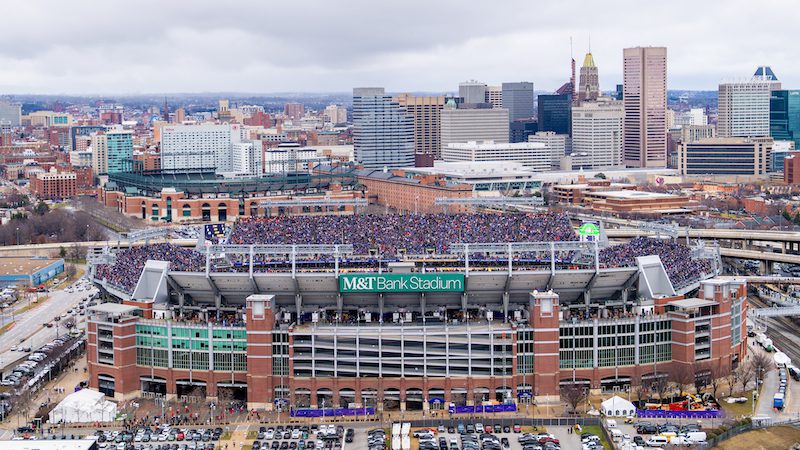
M&T Bank Stadium: Nearly $490 million is being invested to modernize the home of the Baltimore Ravens, including new premium club spaces, upgraded retail, and a three-level open-air entertainment district featuring a main stage and sports bar. Funding is provided by the Maryland Stadium Authority and the Baltimore Ravens.
-
CFG Bank Arena: Following a $250 million renovation, the arena has re-emerged as a premier national touring and live-events destination, driving increased visitation, year-round programming, and regional economic activity.
-
Pimlico Racecourse Redevelopment: A $500 million state-led investment is transforming Pimlico into a modern, year-round racing and events complex. The project includes upgraded facilities, new community space, and an 800-stall training center at Shamrock Farm, supported by $400 million in state bonds and $100 million from the Racing and Community Development Financing Fund.
Arts, Cultural and Creative Infrastructure
-
The Pikesville Armory: A $95+ million planned, multi-year redevelopment—$54 million secured to date—is converting the 120-year-old historic armory into a 14-acre arts and recreation campus with artist studios, performance venues, indoor sports facilities, public art, outdoor athletic fields, and community amenities. The project is led by the Pikesville Armory Foundation.
-
B&O Railroad Museum: A $25 million redevelopment is underway at the historic museum, supported by $16.9 million in private investment and $8.1 million in public funding.
-
The Performing Arts Center at Toby’s (Columbia, Md.): A $68 million mixed-use development is in progress, featuring a 340-seat dinner theater, children’s theater, black box theater, classrooms, and 174 mixed-income housing units.
-
Baltimore-Area Maker Spaces: Significant investments are activating creative manufacturing and maker ecosystems, including:
-
A $20 million conversion of the 17-acre Crown Industrial Park into a mixed-use community hub in East Baltimore;
-
A $25 million redevelopment of the former Detrick & Harvey Machine Works factory in Johnston Square; and
-
A $4 million collaboration among Open Works, Coppin State University, and Baltimore Arts Realty Corporation to develop a second Open Works makerspace.
-

National Cultural Proof Points
Baltimore’s growing cultural influence is reinforced by high-profile milestones, including Amy Sherald’s decision to house her career retrospective at the Baltimore Museum of Art, the three-year extension of Jonathan Heyward’s tenure at the Baltimore Symphony Orchestra, and Carmelo Anthony’s “House of Melo” exhibition at the Enoch Pratt Free Library.
The region is also home to Artscape, the nation’s largest free outdoor arts festival, which relocated to downtown Baltimore as part of the Downtown RISE initiative. The festival generates tens of millions of dollars annually for local artists, small businesses, and the hospitality sector while positioning arts and culture as a catalyst for downtown revitalization and talent attraction.
What’s Next
Looking ahead, Baltimore plans to modernize and expand the Baltimore Convention Center and develop a 7,500-seat MLS Next Pro stadium to support D.C. United’s player development pipeline, according to a Maryland Stadium Authority study. The city will also welcome a professional women’s basketball team in the Upshot League in 2027.
“What’s happening in Baltimore is not a collection of isolated projects—it’s the emergence of a full creative ecosystem at national scale,” said Mark Anthony Thomas, President and CEO of the Greater Baltimore Committee. “Billions of dollars are flowing across sports, arts, makerspaces, and cultural institutions. This momentum reflects growing investor confidence in Baltimore’s creative economy and its power to drive population growth, visitation, and long-term economic vitality.”
Arts and culture investments are part of a broader transformation underway in Baltimore. The city is advancing the nation’s largest housing redevelopment initiative, backed by $1.2 billion in public funding and designed to attract $5 billion in private investment over 15 years, revitalizing more than 37,000 vacant or at-risk properties. At the same time, Baltimore’s historic waterfront is undergoing a $3 billion redevelopment.
About the Greater Baltimore Committee
The Greater Baltimore Committee (GBC) is the leading economic and civic organization for the Baltimore Region, providing insight-driven leadership to advance collective impact. Powered by more than 300 private-sector partners, GBC represents companies, nonprofits, foundations, and educational and healthcare institutions committed to the region’s prosperity. Founded in 1955, GBC merged in 2022 with the Economic Alliance of Greater Baltimore and launched the “Bold Moves” economic brand in 2024 to showcase Greater Baltimore’s ambition, innovation, and momentum in attracting business and talent.