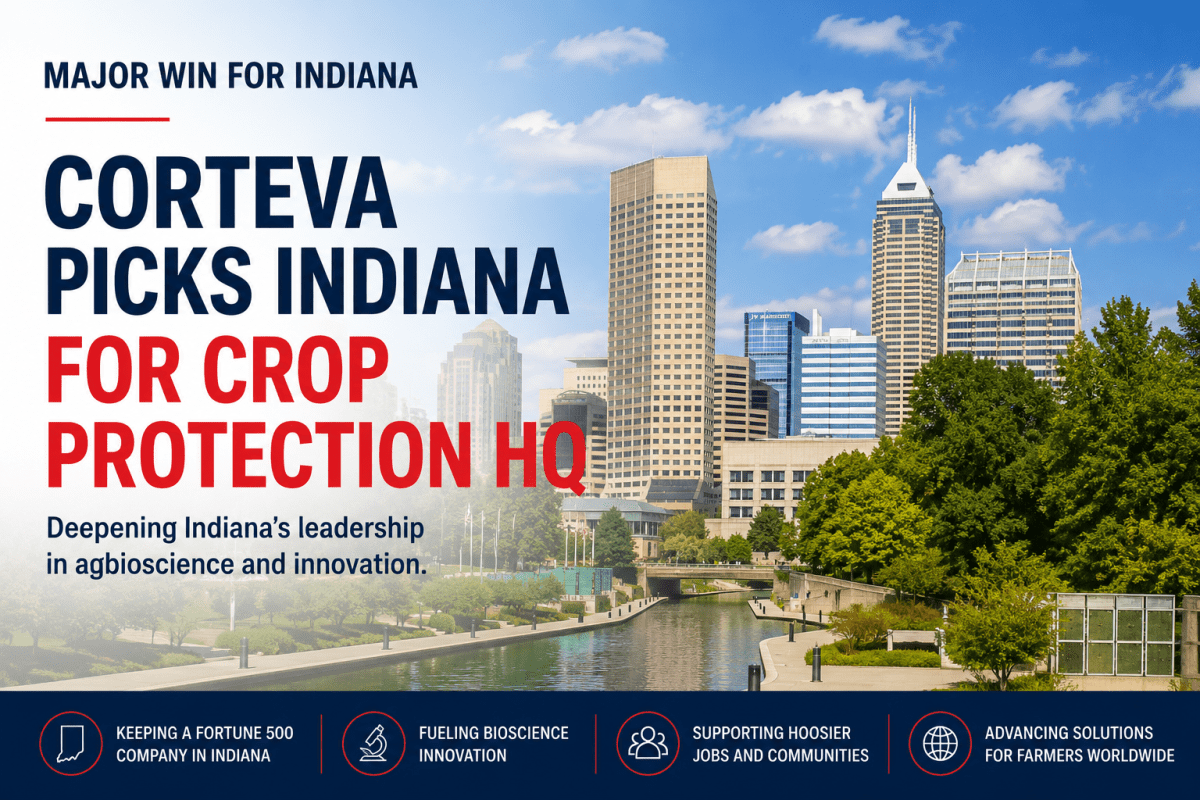
Indianapolis, Ind. (May 18, 2026) — Corteva has selected Indianapolis as the global headquarters for its new crop protection and nature-inspired technologies company, reinforcing Indiana’s position as a leading destination for agricultural innovation, bioscience research and corporate investment.
The decision comes as Corteva moves forward with plans to separate into two publicly traded companies later this year, with its crop protection business retaining the Corteva name. The move keeps a Fortune 500 operation anchored in Indiana and further expands the state’s role in global agricultural technology development.
State leaders called the announcement another major win for Indiana’s growing bioscience economy.
Gov. Mike Braun, said: “Indiana is a global leader in agbioscience – and today’s announcement is just more proof. Corteva’s decision to base its global headquarters here reinforces our national reputation as an innovation corridor, nurturing a world-leading bioscience industry that supports hundreds of thousands of Hoosier jobs and generates billions of dollars for the state’s economy.”
Corteva’s roots in Indiana extend back to 1989, and company leaders said the new headquarters structure will further strengthen research, development and innovation efforts centered in the state.
The Indianapolis headquarters will serve as the company’s primary research and development hub, supporting synthetic, biological and natural-product innovation aimed at helping growers address evolving agricultural challenges.
Indiana’s bioscience industry contributes more than $125 billion annually to the state economy and supports one of the nation’s strongest ecosystems for plant science, agriculture and life sciences research.
Greg Page, Chair of Corteva and future Chair of the separated company, said: “Corteva has long, proud roots in the state of Indiana, and the employees and management team are pleased to continue to be able to call Indiana home for their groundbreaking innovation.”
Page added: “The Hoosier state is an established leader in global biosciences innovation and the Corteva headquarters will serve as the company’s core research and development hub, driving its impressive pipeline of synthetic, biological and natural product innovation.”
The company’s strategy moving forward places significant emphasis on biological and nature-inspired technologies, areas increasingly viewed as major growth opportunities within agriculture and crop science.
Local officials noted the announcement reinforces Indianapolis’ role as a center for innovation and advanced industry growth.
Joe Hogsett, Mayor of Indianapolis, said: “Indianapolis continues to prove we are a city where innovative companies can grow and lead. Corteva’s continued investment reflects the strength of our talent base and our growing agriculture and innovation ecosystem.”
The announcement also aligns with Gov. Braun’s recently unveiled $1 billion, 10-year life sciences initiative designed to create 100,000 new jobs across plant, animal and human health industries.
Economic development leaders across the state pointed to Corteva’s decision as further validation of Indiana’s workforce, business climate and innovation ecosystem.
Don Lamb, State Director of the Indiana Department of Agriculture, said: “Corteva’s decision to reaffirm Indiana as its global headquarters is a tremendous vote of confidence in our state’s workforce, research ecosystem and long-standing leadership in agriculture and agbioscience.”
Andrea Richter-Garry, Interim CEO and President of Indy Economic Development, added: “This announcement reflects the strength of a long-standing partnership, the momentum of our growing agriculture and innovation ecosystem and the confidence global companies continue to place in Indianapolis.”
Matt Mindrum, President and CEO of Indy Chamber, said: “Corteva’s decision to keep and grow its headquarters in Indianapolis is a powerful affirmation of Indy’s position as a global leader in bioscience innovation.”
The announcement further strengthens Indiana’s standing as a major center for agricultural technology and life sciences investment as states continue competing for innovation-driven industries and headquarters operations.