
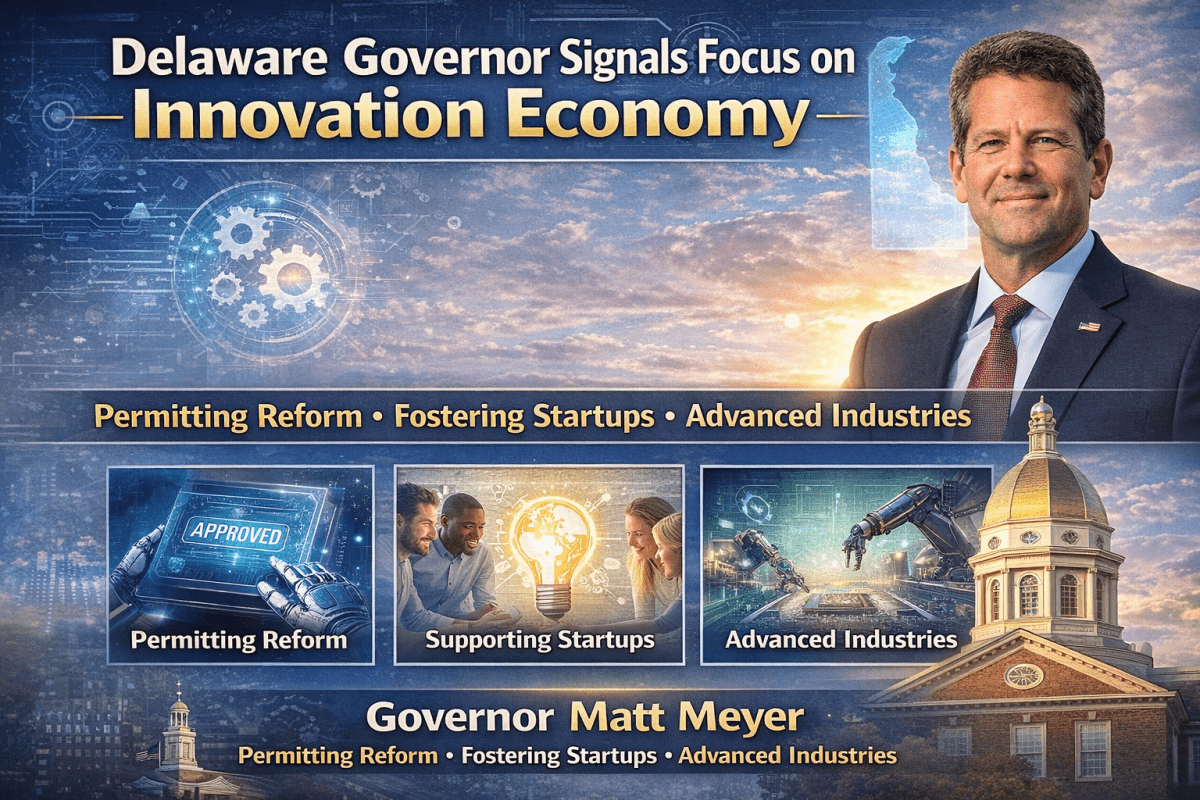
WILMINGTON, Del. — Delaware Governor Matt Meyer outlined a strategic shift in the state’s economic development priorities, signaling a renewed focus on innovation-driven growth, regulatory reform, and startup scalability during his annual address to the Delaware State Chamber of Commerce.
Speaking before more than 1,000 business leaders, Governor Meyer emphasized that Delaware’s next phase of economic expansion will be driven by innovation, entrepreneurship, and a faster, more accountable state permitting process—while maintaining a balanced approach to business attraction and retention.
“The next wave of growth in Delaware is coming from innovation,” Meyer said. “We want good ideas to create jobs and to scale faster than anywhere else in the country.”
Innovation and Regulatory Reform Take Center Stage
Governor Meyer announced plans for a statewide push to modernize and streamline permitting, including reducing duplicative paperwork and launching a digital, multi-agency permitting interface. The initiative is designed to shorten project timelines and improve transparency—an issue long cited by business leaders as a competitive challenge.
“If a permit takes too long, we should know exactly why, and the state government should own fixing it,” Meyer said. “Delaware state government must be faster, clearer, and more accountable.”
The governor’s remarks were met with strong support from business leaders, particularly those advocating for faster site readiness and development approvals.
Evolving Role of the Delaware Prosperity Partnership
Meyer also highlighted changes underway at the Delaware Prosperity Partnership (DPP), the state’s public-private economic development organization. While DPP will continue to recruit and retain major employers, the governor said its mission is being sharpened to place greater emphasis on helping startups and emerging companies become investment-ready.
“Recruiting and retaining big businesses are still important,” Meyer said. “But we also want to help promising startups scale faster and create jobs right here in Delaware.”
Since its launch, DPP has supported more than $2 billion in investment across 75 projects, contributing to the creation or retention of approximately 10,000 jobs statewide.
Recent governance changes reflect the administration’s innovation-first strategy. In August, Meyer appointed entrepreneur Rob Herrera as a co-chair of DPP and expanded the organization’s board to include additional entrepreneurs and small business owners. A national search is underway for new leadership following the departure of DPP President Kurt Foreman.
Balancing Innovation with Major Investment
While campaigning, Governor Meyer had voiced skepticism toward incentive-driven megaproject recruitment. However, his administration has taken a more measured approach in office, including approval of a $30 million state grant supporting a $1 billion biopharmaceutical campus investment by Merck near Wilmington.
The governor emphasized that Delaware’s strategy is not an either-or choice between large employers and startups, but rather a coordinated effort to build an ecosystem where innovation, workforce development, and capital investment reinforce one another.
Positioning Delaware for Long-Term Competitiveness
Business leaders across construction, biotechnology, and advanced industries welcomed the administration’s emphasis on cutting red tape, digitizing government processes, and strengthening early-stage innovation infrastructure. Industry groups noted that these reforms could improve Delaware’s competitiveness for high-growth sectors such as life sciences, biotechnology, and technology-driven manufacturing.
“Make Delaware a great place to do business,” Meyer concluded. “That’s how we build a stronger, more innovative economy for the long term.”


