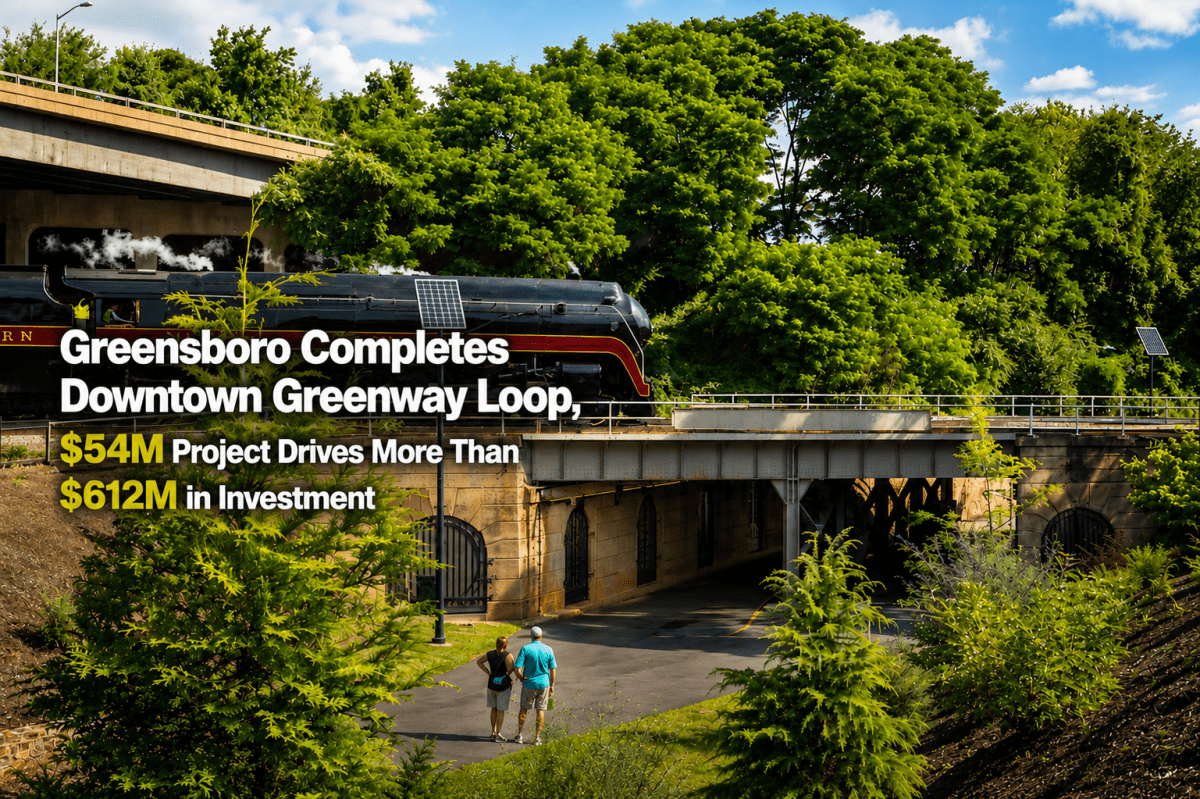
Greensboro, N.C. (May 18, 2026) — After more than two decades of planning, investment and community collaboration, Greensboro has completed construction on its 4-mile Downtown Greenway, a transformative infrastructure project designed to enhance connectivity, mobility and quality of life while generating significant economic activity throughout the city’s urban core.
City leaders and community stakeholders will officially celebrate completion of the final segment during a ribbon-cutting event scheduled for May 16, marking the culmination of a project first envisioned in Greensboro’s 2001 Center City Master Plan.
The multi-use loop, developed through a long-term partnership between the City of Greensboro and Action Greensboro, represents a $54 million investment that has already generated more than $612 million in completed and planned private development along the corridor — translating to an estimated return exceeding $15 for every public dollar invested.
Mayor Marikay Abuzuaiter, said: “The completion of the Downtown Greenway represents years of collaboration and a collective community vision coming to life, creating a place where residents, visitors and businesses can connect in new and meaningful ways.”
Designed to support walking, biking and public gathering spaces, the Downtown Greenway links eight neighborhoods to Greensboro’s downtown core while serving as a central connection point within larger regional and national trail systems, including the Mountains-to-Sea Trail and East Coast Greenway.
Economic development leaders say the project has become a catalyst for investment and redevelopment, attracting residential growth, commercial activity and community-focused development throughout adjacent districts.
Since construction began in phases in 2009, residential communities, local businesses, educational institutions and nonprofit organizations have increasingly clustered around the corridor, driven by demand for walkable, connected urban environments.
Former Mayor Nancy Vaughan, who helped champion the project across multiple phases, said: “What began as a long-term idea in a decades-old master plan has become one of the most important investments in Greensboro’s future. The Downtown Greenway reflects our commitment to building a more connected, vibrant and inclusive city.”
Beyond mobility and economic impact, project leaders emphasized the Downtown Greenway’s role as a cultural and environmental asset.
Dabney Sanders, Project Manager for the Downtown Greenway, said: “The Downtown Greenway is more than a trail — it’s an experience. Every section was designed to connect people not only to places, but to Greensboro’s story through art, landscape and shared public space.”
Featuring more than 40 public art installations integrated into trails, bridges and gathering spaces, the greenway serves as a continuous arts corridor highlighting local history and community identity.
The project also incorporates environmental restoration initiatives focused on sustainability, improved water quality and resilient urban design strategies.
Community engagement has remained central throughout the initiative’s development. The project includes historical and cultural elements recognizing Greensboro’s role in the Civil Rights Movement, the Underground Railroad and broader community narratives tied to inclusion and resilience.
Today, the Downtown Greenway has become an increasingly active community amenity supporting year-round programming focused on health, education and recreation. In 2025, nearly 4,000 participants attended organized activities while the trail recorded more than 150,000 user visits.
The Downtown Greenway represents one of Greensboro’s most visible examples of how strategic infrastructure investment, public-private collaboration and placemaking initiatives can generate long-term economic and community value.
For more information, visit Downtown Greenway.