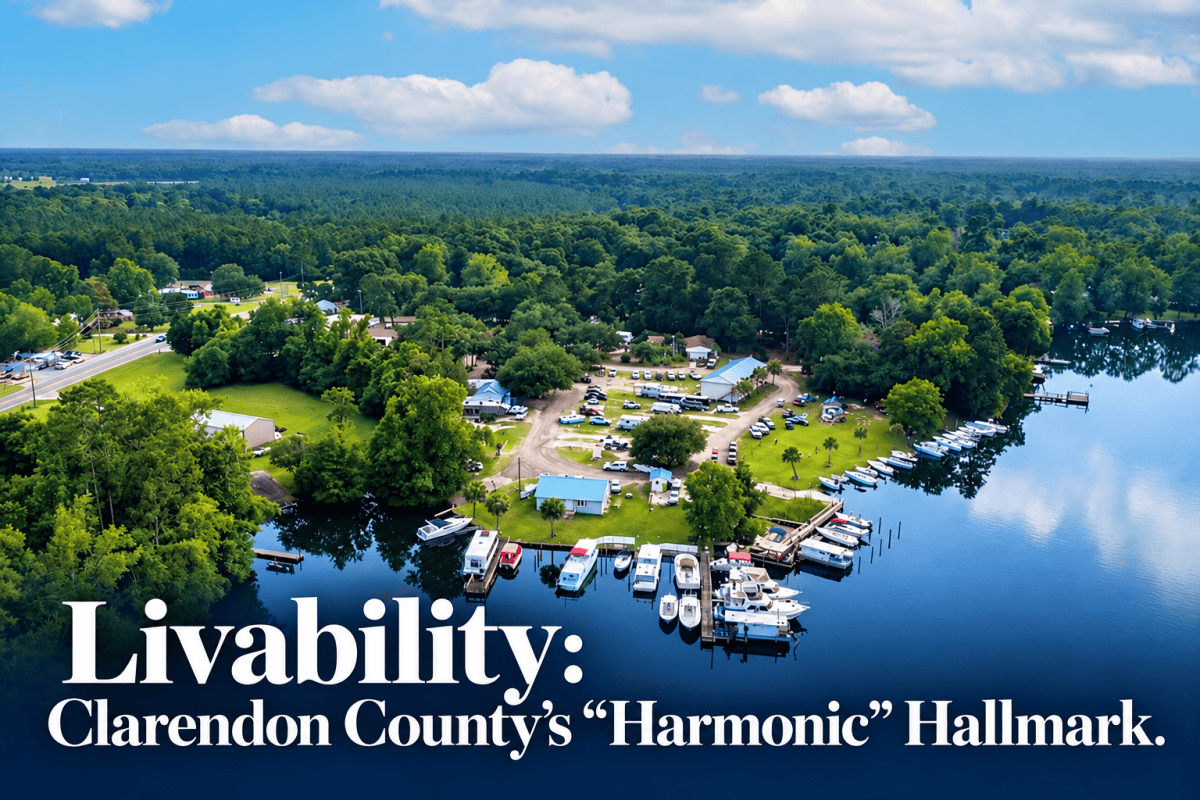
Photo caption: Bells Marina & Resort sits on the shore of Clarendon County’s Lake Marion, which consistently ranks as one of the Top Five recreational lakes in the U. S. (Photo credit: Bells Marina & Resort)
The maxim is timeless, and everyone who has a business to grow is familiar with it. If you are serious about expanding your footprint, the key to finding the perfect place to set up shop is “location, location, location.”
True, and no one can deny it. But in today’s highly competitive business environment, an equally important consideration should shape a company’s decision about where to do business: “livability, livability, livability.”
Already well established in infrastructure, innovation, and strategic location, Clarendon County, South Carolina, has set itself apart by pursuing growth that attracts business and industry while also attracting and retaining the workers who make those enterprises hum.
Industrial Growth Creates Opportunity
Over the past several years, companies including Georgia-Pacific, Westinghouse, Cummins Meritor, European-based wood products manufacturer Homanit, precision metal fabricator Latitude, Powell Valves, and 84 Lumber have chosen Clarendon County to expand their global, national, and regional footprints.
“We’ve had tremendous success in attracting new, innovative industries because of our strategic location and infrastructure over the past few years,” says George Kosinski, executive director of the Clarendon County Economic Development Board (CCEDB).
The county’s newer industries “are a little bit different than traditional rural manufacturing. Many of them utilize the latest technologies in advanced metal fabrication and producing engineered building products and large-scale wood products.”
Those companies, he says, “offer great opportunities for people to work and what we’re seeing now is tremendous development in making the County an increasingly attractive community for those workers to both live, work, and grow.”
While Clarendon County continues attracting businesses to its strategically located industrial parks and speculative buildings, another pattern is emerging: what Kosinski calls “a great harmonic of prime industries creating jobs that leads to rooftops, then commercial and retail growth.”
Housing, Retail, and Recreation Build Momentum
What are some of the elements of that “great harmonic”?
“Retailers, restaurants, and service providers are moving into the County in large numbers and we currently have development in the Somerton area underway, while the Lake Marion area is attracting serious residential demand connected to lake access and recreation,” says Kosinski.
Lake Marion consistently ranks as one of the top five most popular recreational lakes in the United States. Often referred to as South Carolina’s “Inland Sea,” it encompasses 110,000 acres with 315 miles of shoreline and a reputation for some of the country’s best bass fishing.
Clarendon County, Kosinski adds, saw about 125 privately owned housing units permitted in 2025, with that figure expected to double over the following year.
A new Huggins Hill development of single-family homes is underway, while a surge in major retailers is helping create the environment needed to attract and retain large-scale industrial employers.
“We have a lot of land available in Clarendon County and work is underway to improve our utility infrastructure to meet the demands of the residential growth we’re seeing,” says County Administrator Walt Ackerman.
I-95 Connectivity Supports Business Expansion
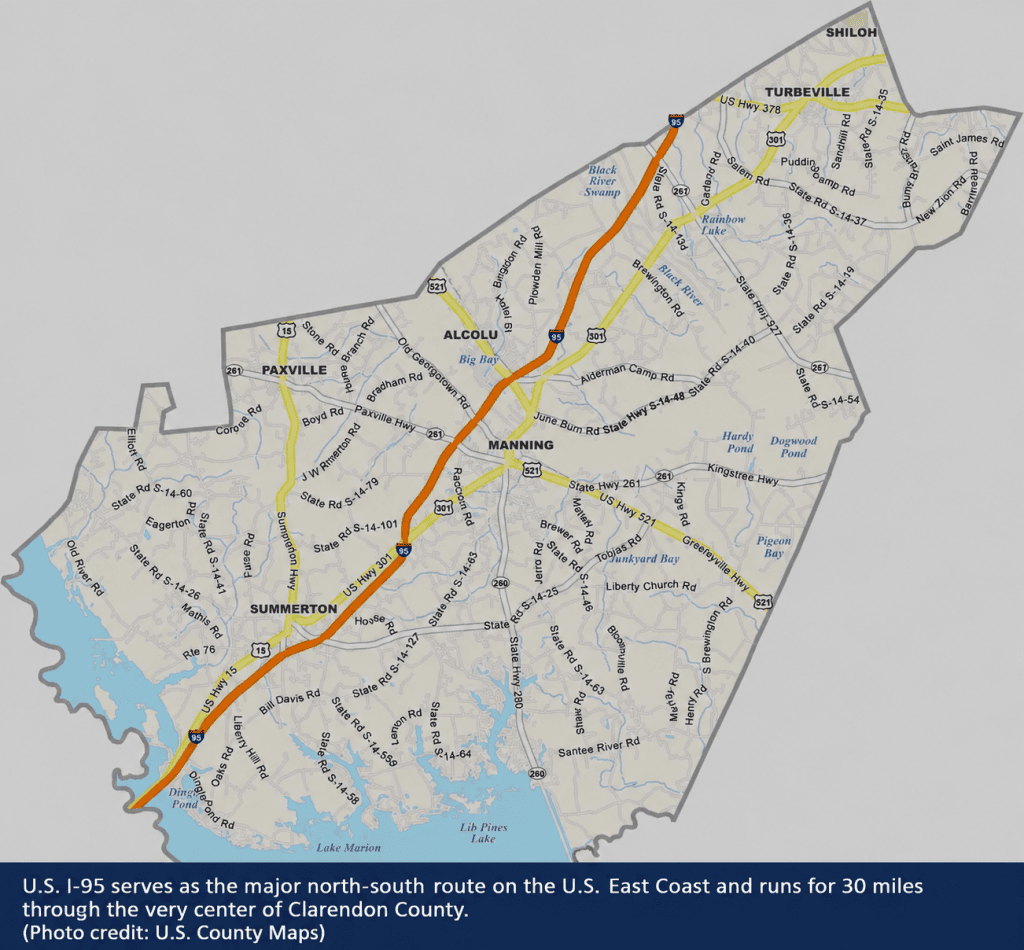
Another key component of Clarendon County’s growth is the ongoing development of access to Interstate 95, the major north-south route along the U.S. East Coast.
The interstate runs for a 30-mile stretch through the center of Clarendon County and serves every major population center in 15 states from Florida to Maine.
“We’re in a perfect location along the I-95, exactly halfway between Miami and New York City,” says Ackerman.
He sees opportunities to bring distribution centers, warehousing, and trucking operations into the county’s industrial parks.
“It seems like a perfect fit.”
That, he adds, brings another dimension to Clarendon County’s vibrant “harmonic.”
A Business Perspective on Community Development
Before working in government, Ackerman put his accounting degree to work in management at the third-largest nail manufacturer in the United States.
There, he learned the value of balancing an ideal business location with a community where workers can settle, prosper, and enjoy recreation.
“It’s all about the cost-cutting measures, quality control,” he says. “Whether you’re manufacturing a product or providing a service, you want your operation to be as responsibly and economically run as possible. You want it to be as beneficial as possible for your customers and workers to make your company productive.”
“You want it done right the first time as you want to have a good quality product going out the door for everybody involved. That’s as true for a community like Clarendon County as it is for any business.”
If an industry is considering setting up shop in Clarendon County, Ackerman says, “They’ve got a great economic development team working for them; a team of skilled people working on their behalf up front to make sure that their project is a success.”
Livability Strengthens the Workforce
Any company looking to invest millions and create hundreds of jobs needs to “evaluate the entire ecosystem,” says Kosinski.
“Clarendon County has a quality of life, great schools, a rapidly expanding market of affordable single-family and apartment housing, and retail businesses of all kinds to support a growing force of highly trained and committed workers.”
“Industrial business development remains the foundation with more and more companies moving into our I-96 Megasite and other industrial parks, and residential construction and commercial following suit to reinforce and build on that employment base,” says Kosinski.
“When a company looks at a new location, they’re not only looking at the land and building. They want to know that everything else will work for the company and their employees,” he says.
“They ask: ‘Do they have a good health care system? Do they have a good school system? Do they have all the other things to support our potential employees? Because if we’re going to hire 200 to 300 employees, we’ve got to know that they’ll be able to find a house or an apartment. We want to know whether they’ll be able to go shopping and enjoy a meal at a nice restaurant?’”
“All of those things are critically important, not only quality of life for the folks who already call Clarendon County home, but others looking to potentially invest millions of dollars in the community and create jobs doing it,” says Kosinski.
“We want to partner with companies that are seriously looking to plant here in the Clarendon County community and grow for the future.”