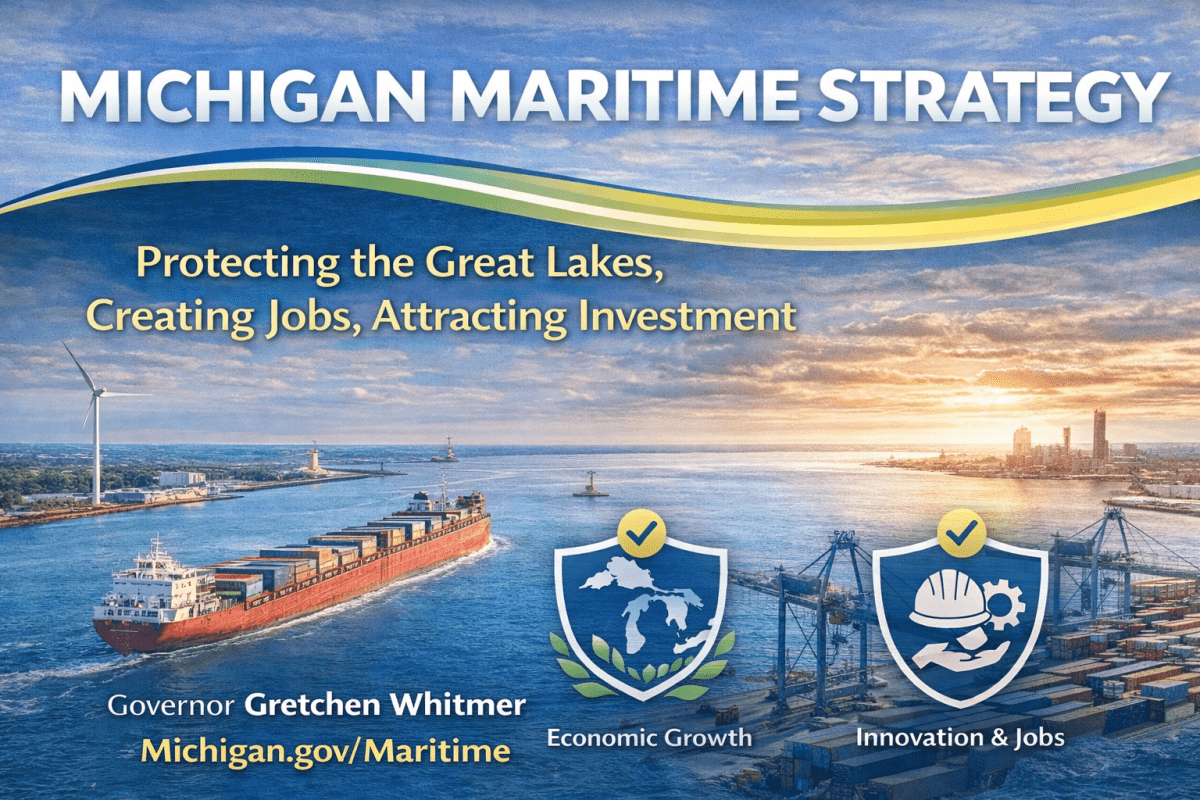
LANSING, Mich. — Governor Gretchen Whitmer today announced the Michigan Maritime Strategy, a first-of-its-kind, 10-year statewide plan designed to strengthen Michigan’s multi-billion-dollar maritime industry while protecting the Great Lakes. The strategy establishes a coordinated roadmap to drive economic growth, modernize infrastructure, foster innovation, and create good-paying jobs across Michigan’s water-based economy.
“Michigan is prepared to lead the future of maritime innovation while protecting the waters that define us,” said Governor Gretchen Whitmer. “The Michigan Maritime Strategy is a long-term plan to create good-paying local jobs and attract cutting-edge investment while safeguarding the Great Lakes, which contain 21 percent of the world’s fresh surface water. We have an incredible opportunity—and responsibility—to grow our economy while preserving these resources for future generations.”
Michigan’s maritime economy already plays a critical role in the state’s prosperity. Michigan ports support approximately 17,000 jobs and contribute $3.3 billion annually to the state economy, while water-based tourism supports roughly 45,000 jobs and generates nearly $12 billion each year.
The Michigan Maritime Strategy aligns priorities across multiple state agencies, including the Department of Environment, Great Lakes, and Energy (EGLE), Michigan Department of Transportation (MDOT), Department of Agriculture and Rural Development (MDARD), Department of Natural Resources (DNR), the Office of Future Mobility and Electrification (OFME) within the Michigan Economic Development Corporation (MEDC), and the Department of Labor and Economic Opportunity (LEO). Together, these agencies will support port modernization, marine manufacturing, clean energy deployment, workforce development, and long-term sustainability.
“The Michigan Maritime Strategy underscores our commitment to protecting the Great Lakes while driving sustainable economic growth,” said Phil Roos, Director of EGLE. “By reducing pollution and investing in cleaner energy, modern infrastructure, and innovative ports and vessels, we can strengthen Michigan’s maritime sector and create good-paying jobs.”
“Our Great Lakes are Michigan’s greatest natural asset,” said Scott Bowen, Director of the DNR. “This strategy supports responsible maritime growth while safeguarding coastal habitats, fisheries, recreation, and the quality of life that sustains our communities and tourism economy.”
Workforce development is a central focus of the plan.
“Michigan’s Maritime Strategy prepares people for careers that power our economy—from port operations and marine manufacturing to emerging clean energy technologies,” said Susan Corbin, Director of LEO. “By aligning training with industry needs, we’re creating pathways to future-ready, good-paying jobs.”
The strategy also strengthens Michigan’s supply chains and global market access.
“A strong maritime sector moves Michigan-grown products efficiently to markets at home and around the world,” said Tim Boring, Director of MDARD. “This plan supports ports and logistics systems that are vital to farmers, agribusinesses, and rural communities.”
“The strategy is key to modernizing ports, diversifying cargo, and improving supply-chain resilience,” said Bradley Wieferich, Director of MDOT. “It ensures Michigan’s marine highways remain competitive, reliable, and globally connected.”
Michigan’s leadership in clean energy and mobility innovation is another cornerstone.
“Michigan is uniquely positioned to lead the maritime industry’s transition to clean energy,” said Quentin Messer, President and CEO of the MEDC. “This strategy advances sustainable growth through clean marine fuels, electrification, and innovative shipbuilding technologies.”
Developed through a year-long, stakeholder-driven process, the Michigan Maritime Strategy reflects input from more than 200 participants statewide, including industry leaders, government agencies, businesses, communities, and academic partners. The effort was led by EGLE’s Office of the Great Lakes and facilitated by the University of Michigan’s Department of Naval Architecture and Marine Engineering.
“With input from stakeholders across the state, we developed a strategy grounded in real-world needs and opportunities,” said Thomas McKenney, University of Michigan professor of practice in naval architecture and marine engineering. “By taking a holistic view beyond freight shipping, we aligned agencies and industries around a unified vision for Michigan’s maritime future.”
Six Strategic Goals
The Michigan Maritime Strategy centers on six guiding goals:
- Modernize ports and invest in intermodal infrastructure
- Grow Michigan’s maritime manufacturing economy
- Accelerate adoption of low- and zero-emission vessels and fuels
- Lead the nation in recruitment, training, and retention of the maritime workforce
- Cultivate a thriving maritime innovation ecosystem
- Increase sustainability and resilience of recreational harbors and marinas
The strategy builds on Michigan’s clean energy laws, climate and mobility plans, and workforce development initiatives. Today’s announcement opens a public comment period prior to formal adoption.
The draft strategy is available at Michigan.gov/maritime. Comments may be submitted to Simon Belisle at belisles@michigan.gov through February 27.