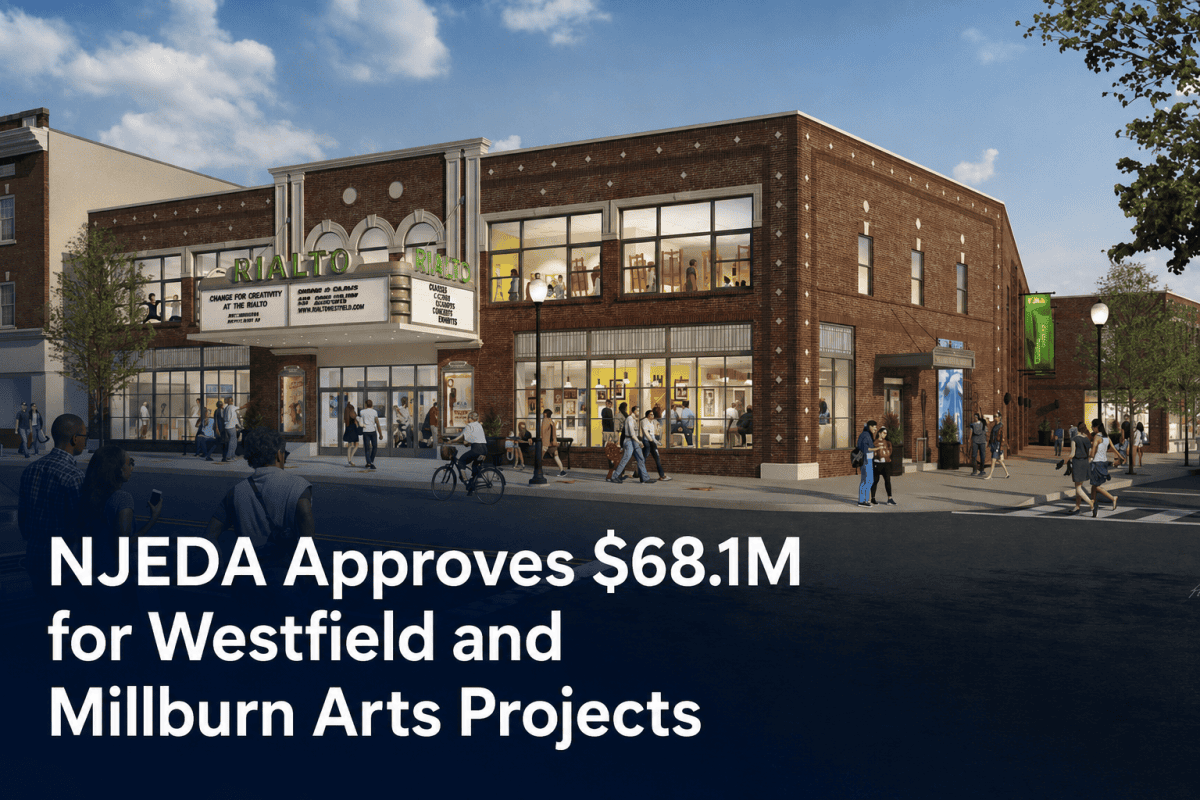
CAFE Program tax credits will support the redevelopment of Westfield’s historic Rialto Theater and accessibility improvements at Paper Mill Playhouse in Millburn.
The New Jersey Economic Development Authority Board has approved up to $68.1 million in Cultural Arts Facilities Expansion Program tax credits for two major arts and cultural projects in Westfield and Millburn.
The awards will support the transformation of the historic Rialto Theater into the Center for Creativity at the Rialto and an extensive renovation of the entrance and public spaces at Paper Mill Playhouse. The projects are expected to expand access to performing arts programming, attract visitors and generate economic activity across Union and Essex counties.
“New Jersey’s arts and culture sector is a powerful economic driver, fueling local businesses, creating good-paying jobs and strengthening communities across the state,” NJEDA Chief Executive Officer Evan Weiss said.
Weiss said the CAFE Program helps communities increase access to major cultural institutions while supporting tourism and regional economic growth.
Rialto Theater to Become Westfield Cultural Hub
The NJEDA approved up to $43.3 million in tax credits for the Center for Creativity at the Rialto project in downtown Westfield.
The project will transform the community’s 1920s-era Rialto Theater into a modern cultural destination through an extensive adaptive reuse and interior renovation.
Plans for the first floor include:
- A flexible performing arts and event space accommodating up to 450 people
- A new lobby and ticketing area
- A catering kitchen and café
- Dressing rooms
- Gallery space
The second floor will include four multipurpose classrooms for arts education, workshops and rehearsals, as well as administrative and gallery space.
Building improvements will include an elevator, a geothermal wellfield and upgrades to the theater’s mechanical, heating, ventilation and air-conditioning systems.
Once completed, the Rialto Center for Creativity is expected to offer year-round visual and performing arts programming while generating additional activity for downtown Westfield businesses. Its operating model will include sliding-scale rental fees, scholarships and discounted tickets designed to make programming accessible to a broader segment of the community.
Plans also call for youth programming and partnerships with organizations serving individuals with cognitive and mobility challenges.
“The Rialto is one of our community’s most cherished historic landmarks, and its restoration represents an extraordinary opportunity to honor our past while investing in our future,” Westfield Mayor Jeremy Berman said.
Berman said the center will strengthen downtown Westfield while creating a welcoming destination for residents, visitors, artists and businesses.
Paper Mill Playhouse Plans Major Lobby Expansion
Paper Mill Playhouse received approval for up to $24.8 million in CAFE Program tax credits for its Front of House renovation project in Millburn.
The project will reconfigure and expand the theater’s entrance and lobby while addressing longstanding accessibility, circulation and building-system deficiencies.
Plans include:
- A new two-story lobby
- Redesigned entrances and interior walkways
- New elevators and monumental stairs
- Modern, ADA-compliant restrooms
- Expanded box-office, concessions and merchandise areas
- An enlarged donor lounge
- Upgraded mechanical, electrical and plumbing systems
The renovations are designed to remove accessibility barriers and improve the experience for patrons attending performances and educational programs.
“The patron experience at Paper Mill will be greatly enhanced and improved for generations to come with the upgrades that are included in this project,” said Mike Stotts, executive director of Paper Mill Playhouse. “Greater accessibility and a more thoughtful layout of our public spaces are the driving forces of this project.”
Founded in 1938, Paper Mill Playhouse is New Jersey’s largest producing theater. The organization serves more than 200,000 people annually, including approximately 40,000 students, and provides programming for underserved schools and individuals with disabilities.
Arts Investment Supports Downtown Revitalization
New Jersey’s arts and cultural sector generates billions of dollars in annual economic activity, supports tourism and contributes to the state’s quality of life.
Programs such as CAFE and the Activation, Revitalization and Transformation Program are designed to leverage arts and cultural investments to increase downtown foot traffic, support small businesses, create jobs and strengthen community engagement.
The CAFE Program provides tax credits for the construction and renovation of eligible cultural facilities, including theaters, museums, galleries, libraries, aquariums and historical organizations. Qualified projects may receive tax credits covering up to 100% of eligible costs, with awards capped at $75 million.