
While Not Renewable “According to Hoyle” Nuclear is Getting Closer
Recognized Forms of Renewable Energy
Under standard definitions, the major forms of energy considered to be renewable include solar, wind, hydropower, geothermal, biomass, along with other forms like ocean energy from tides and waves. These energy sources are replenished naturally on a human timescale and are used to generate electricity, heat and biofuels.
Although nuclear energy is not formally classified as “renewable,” it is getting closer, especially on the heels of new developments in small nuclear reactors (SMRs) which use fuel more efficiently than legacy reactors, produce virtually no greenhouse gases and generate much less waste that can be managed or recycled. Technologies to extract uranium from seawater breeders could supply energy needs for billions of years at stable costs, consistent with some interpretations of “renewable.”
Used in tandem with renewables like solar and wind, nuclear also avoids the intermittent challenges associated with fossil-free systems. For these reasons, nuclear power is closer than ever to being considered effectively renewable as a reliable and multi-generational energy source. Nuclear’s full comeback will take time and money, decades and billions by some measure, but the upside is huge for our nation and its increasingly strained power grid.
A Federal Push for Nuclear
For the first time in decades, the U.S. Energy Department will no longer have an Office of Energy Efficiency and Renewable Energy, which was established in the 1990’s to oversee efforts to increase the energy efficiency of appliances and drive down the cost of solar panels. That office has been rebranded as the Office of Critical Minerals and Energy Innovation. The reorganization at the Energy Department reflects the ongoing shift in the federal government’s energy priorities: less renewable energy, “drill, baby, drill” when it comes to fossil fuels and bring back more nuclear.
In addition to the skyrocketing demand for electricity by the booming data center industry, the Trump administration’s America First trade policies are spurring the reshoring of large scale manufacturing investment back to U.S. shores putting more strains on our power grid. The Trump administration plans to quadruple the current nuclear energy output over the next 25 years through construction of conventional reactors and next generation SMRs. U.S. Energy Secretary Chris Wright has made it known that the largest use of the Department of Energyʼs Loan Programs Office will be for nuclear power plants.
 SMRs and Data Centers
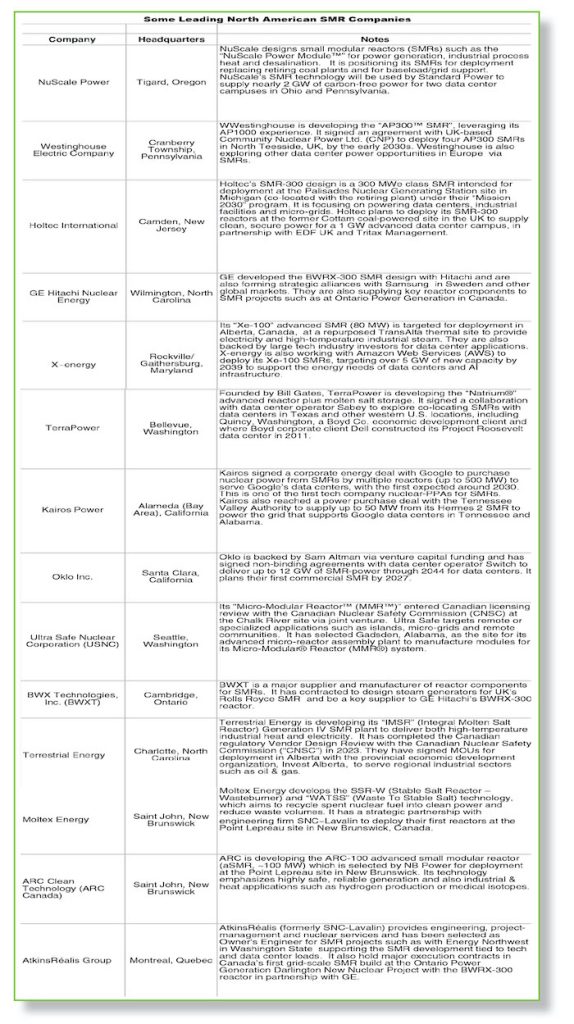
Over the past year, a number of leading tech companies led by Google, Amazon and Microsoft have signed agreements with nuclear energy firms for major projects. Small modular nuclear reactors are emerging as a timely and effective solution to meet the massive energy demands of their current and planned data centers with a power source that is both carbon-free and scalable for future expansions. The smaller footprint of SMR’s versus traditional nuclear reactors make them highly suitable for deployment on-site at data centers, large-scale manufacturing plants or at industrial sites not suitable for large power plants.
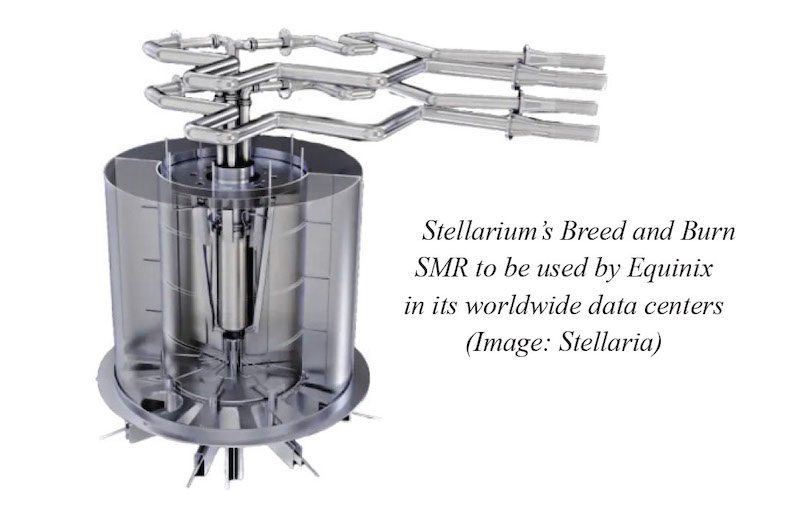
Equinix, the giant data center and colocation provider, has entered into an agreement with French molten salt reactor developer Stellaria securing power on the Stellarium, the SMR that Stellaria plans to deploy starting in 2035. Equinix data centers in Europe are all powered by renewable energy and it is now expanding its energy portfolio into sustainable nuclear power through the use of SMRs.
In addition to its SMR deals, Amazon has also purchased a 1,200-acre site next to Susquehanna nuclear power plant in Berwick, Pennsylvania, to draw power directly from the facility to power its planned data center. Also in Pennsylvania, Microsoft is partnering with Constellation Energy to purchase power from the former Three Mile Island Unit 1 nuclear plant.
Pennsylvania Governor Josh Shapiro’s Lightening Plan for energy, put into place after the state’s withdrawal from the Regional Greenhouse Gas Initiative, promotes an “all of the above” approach to energy – highlighting nuclear, along with hydrogen, natural gas, carbon capture, battery storage and other renewables. Much of the energy and heavy industrial production is expected to take place in western and central Pennsylvania.
In eastern Pennsylvania, developers are preparing for new demands for Class-A, lab and flex office space for research, engineering, compliance and other support functions associated with nuclear, hydrogen and carbon capture technologies. Likely landing spots are popular Philadelphia suburbs with access to major universities, transportation assets and underutilized Class-A office parks like Horsham Township in suburban Montgomery County. Further fueling new energy-related office demand is the fact that research and support services in emerging sectors like nuclear, hydrogen and carbon capture involve significant proprietary information and trade secrets requiring workers to be in a secure company office due to data security and intellectual property concerns rather than working remotely.
FANCO Energy Park in Indiana
 FANCO Energy Park in Indiana
First American Nuclear (FANCO), a startup based in Richland, Washington, is developing advanced nuclear technology in partnership with the State of Indiana. Announced in November 2025, the company is establishing the nation’s first “closed-fuel cycle” nuclear energy park where spent nuclear fuel will be reprocessed and reused onsite, eliminating about 97 percent of long-lasting nuclear waste and enabling the reactor to produce more fuel than it consumes. The timeline calls for gas-powered electricity starting around 2028, with the nuclear reactor launch planned for 2032 with a potential 60-year operational lifespan. FANCO is also relocating its headquarters to the Indianapolis suburb of Carmel.
The Oklo Project at Oak Ridge, Tennessee
Tennessee’s rich nuclear history traces back to the Manhattan Project, the top-secret U.S. program to develop atomic bombs during World War II. In 1942, the U.S. government selected a remote site along the Clinch River, about 20 miles west of Knoxville, for uranium enrichment and plutonium production facilities. Fast-forward to 2025 when Tennessee governor Bill Lee announced a program to attract advanced nuclear technology companies to the state and committed funds to develop a nuclear workforce and help set up a regulatory framework for commercial fusion.
In 2025, the Tennessee Valley Authority (TVA) saw its fiscal year operating revenue increase by more than a billion dollars, and with that, is planning to make unprecedented capital investments in nuclear energy. TVA is planning to build up to four SMRs at its Clinch River Nuclear Site, and it also entered into an agreement with Type One Energy to develop a plan for a TVA fusion power plant project.
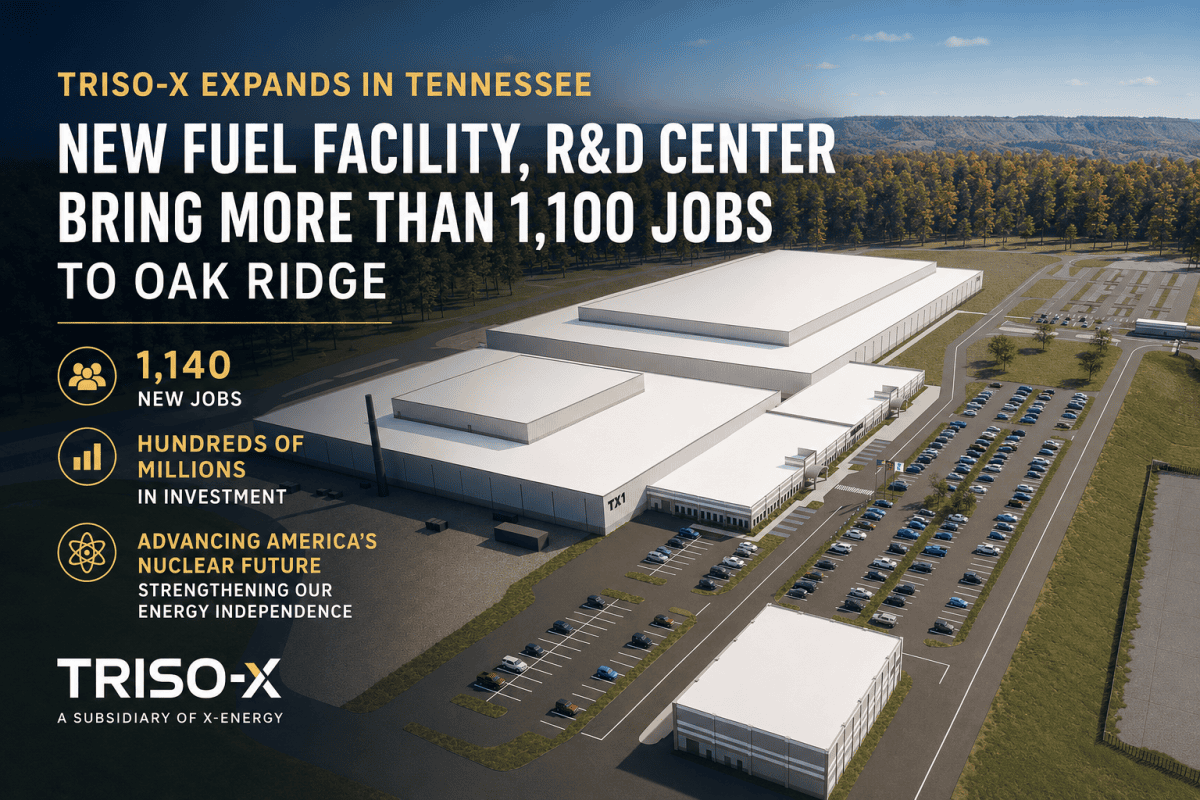
Also in Tennessee is the Oklo fuel recycling facility designed to be the first phase of a larger Advanced Fuel Center in Oak Ridge representing the nationʼs first privately funded commercial nuclear fuel recycling operation. The facilityʼs primary purpose is to recycle used nuclear fuel from the existing U.S. reactor fleet, comprised of over 94,000 tons of stored spent fuel across the country, into high-quality metal fuel suitable for advanced fast reactors, such as Okloʼs Aurora powerhouse, a version of which is under construction at the Idaho National Laboratory. Oklo’s work with TVA represents the first time a U.S. utility has explored recycling its used fuel into clean electricity, turning a long-standing liability into a new and secure energy asset.
Nuclear Power Plant Restarts
Several previously closed nuclear power plants in the U.S. are in the process of being reopened, driven by rising electricity demand from data centers, federal incentives and a shift in state energy policies. While none have fully restarted operations as of late 2025, significant progress has been made on at least three major projects, which could mark the first such revivals in U.S. history. Here’s a summary of those restarts, all tied to rising AI and hyperscale data center demand in Michigan, Pennsylvania and Iowa.
Palisades (Covert Twp., Michigan) is projected to be the first U.S. nuclear plant ever to be recommissioned. Owner Holtec recently moved the plant from “decommissioning” back to “operations”, and the site received its initial fuel shipments in Oct 2025 as part of the restart effort. A major driver for the restart is the 20-year power purchase agreement signed between Constellation and Microsoft to power its data center operations.
Three Mile Island Unit 1 (Harrisburg Area, Pennsylvania), now being marketed as the “Crane Clean Energy Center” by Constellation Energy, is planning to restart the plant through a power purchase agreement with Microsoft to support the tech company’s data center demand. The plant is expected to start generating power again as early as 2027 backed by a Department of Energy $1 billion loan.
Duane Arnold (Cedar Rapids Area, Iowa) is slated for a restart by early 2029, following its 2020 shutdown from a powerful derecho storm that hit the area. NextEra Energy is leading the project, supported by a 25-year power purchase agreement with Google to power its data centers. The unit could be supplying power by the end of this decade.
Nuclear Waste
 Nuclear Waste
Still, despite recent advancements in recycling, the “big gorilla in the room” issue regarding nuclear that’s been grappled with for decades is how to store, manage and dispose of radioactive waste – the toxic byproduct of harnessing uranium to generate electricity and portions of which remain hazardous for millennia. Around the world, some 490,000 metric tons of radioactive spent fuel is temporarily stored in pools and dry casks above ground. No spent nuclear fuel anywhere in the world has yet been placed in a permanent repository.
A leading innovator in nuclear waste disposal technology is Deep Isolation Nuclear which is combining the underground burial concept with oil-and-gas fracking techniques. Richland, Washington-based Deep Isolation sees possibilities of co-locating its boreholes at active and decommissioned nuclear plants, most of which have good shale or granite formations nearby, thus avoiding the need to transport the waste and the risk of highway or railway accidents.
Other nations have moved forward with the idea. Finland, for instance, is nearing completion of the world’s first permanent underground disposal site for its five reactors’ waste. Sweden has started construction on a similar project, and France, Canada and Switzerland are in the early stages of their subterranean disposal sites.
Summary
The U.S. nuclear power industry is experiencing a significant comeback driven by a perfect storm of policy, technology and demand pressures. New federal initiatives, including clean-energy tax credits, streamlined licensing and financing support for reactor deployments, have all combined to renew investor confidence and accelerate timelines. At the same time, emerging technologies like SMRs and next-generation advanced reactors promise lower construction costs, enhanced safety and flexible integration with renewable grids.
A major tailwind to nuclear’s comeback is the explosive growth of hyperscale AI data centers, whose enormous 24×7 power needs are straining regional grids and elevating the need for stable, carbon-free baseload power. Overall, there is a coming together among government, the business community and the general public that the time is right for a nuclear power renaissance, and even if the massive build-out could take a decade or more and cost hundreds of billions of dollars.
About the Author: John H. Boyd is founder and principal of The Boyd Co. Inc. Founded in 1975 in Princeton, NJ, and now based in Boca Raton, FL, the firm provides independent site selection counsel to leading U.S. and overseas corporations.
Organizations served by Boyd over the years include many Fortune 500 companies, The World Bank, The Council of Supply Chain Management Professionals (CSCMP), The Aerospace Industries Association (AIA), MIT’s Work of the Future Project, Canada’s Privy Council and The President’s National Economic Council.