Despite the challenges of roller-coaster tariffs, conflict-related shifts in trade routes, and adopting new technologies, the nation’s East, West, and Gulf Coast, as well as Great Lakes and Inland Waterway ports, continue to maintain a high degree of both stability and elasticity.
According to the latest figures released by technology provider Descartes Systems Group, U.S. seaports are experiencing a substantial surge in cargo volume, with June container imports alone climbing by 8.2 percent year over year to 2,400,627 TEUs.
The recent traffic spike, the company says, “is heavily driven by proactive shippers front-running a July 1 increase in ocean freight costs that were spurred by geopolitical friction and rising fuel surcharges, alongside anticipated end-of-July U.S. tariff updates regarding forced labor.”
The federal government’s investment in the ability of the country’s ports to continue to effectively function despite the circumstances was given a major boost in May when the U.S. Department of Transportation’s Maritime Administration (MARAD) said it would pump $774 million into projects at 37 U.S. deepwater, Great Lakes, and inland river ports “to strengthen our supply chain and restore U.S. maritime dominance.”
The port improvements, said MARAD Administrator Stephen M. Carmel, “will have generational impacts and enhance the nation’s short and long-term economic competitiveness.”
Dubbed the Port Infrastructure Development Program (PIDP), the scheme aims to modernize port facilities, strengthen supply chains, reduce shippers’ costs, and, ultimately, “drive down the cost of goods for American families.”
Region by region, container, bulk, and boutique ports are adapting to changing circumstances and outlining medium- and long-term goals to keep pace with projected fluctuations in cargo volumes.
East Coast
Port of Brunswick
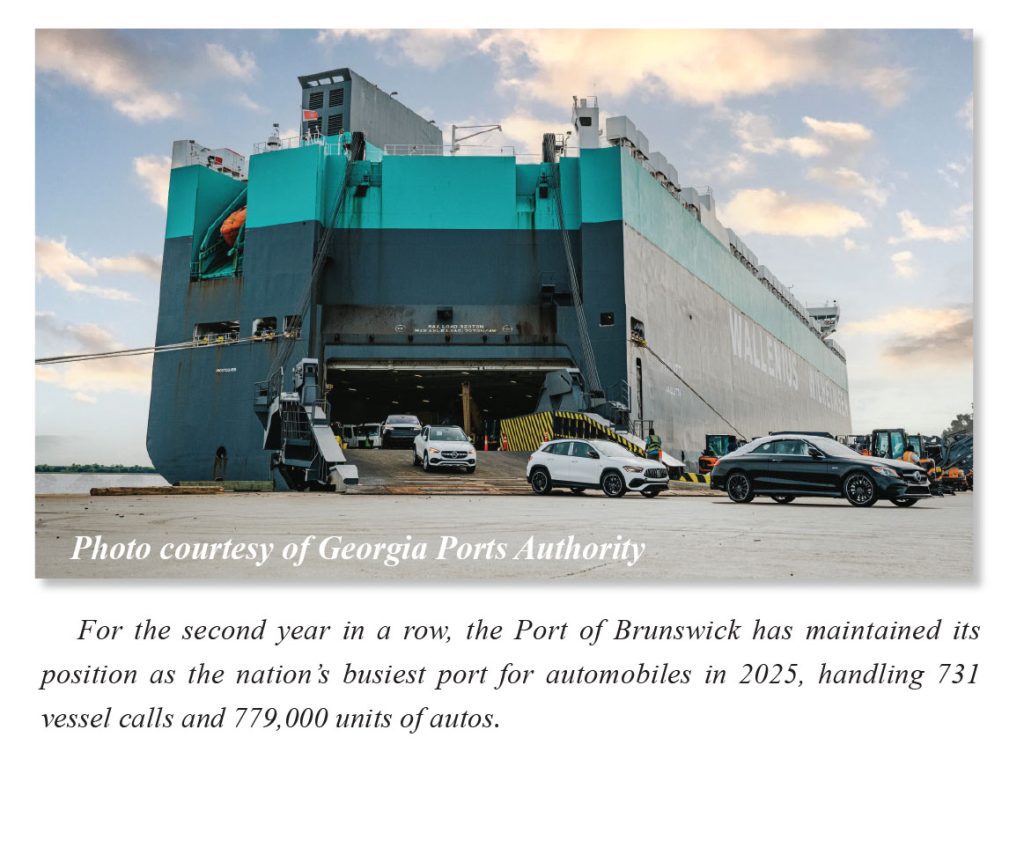
For the second year in a row, the Port of Brunswick has maintained its position as the nation’s busiest port for automobiles in 2025, handling 731 vessel calls and 779,000 units of autos, plus more than 53,000 units of heavy machinery, representing both import and export movements.
Facility enhancements at Brunswick include a new $100 million berth for Roll-on/Roll-off cargo, improvements to outdoor storage for vehicles, dredging, and the nearly completed construction to add a fourth lengthened berth at its Colonels Island facility.
Port Tampa Bay
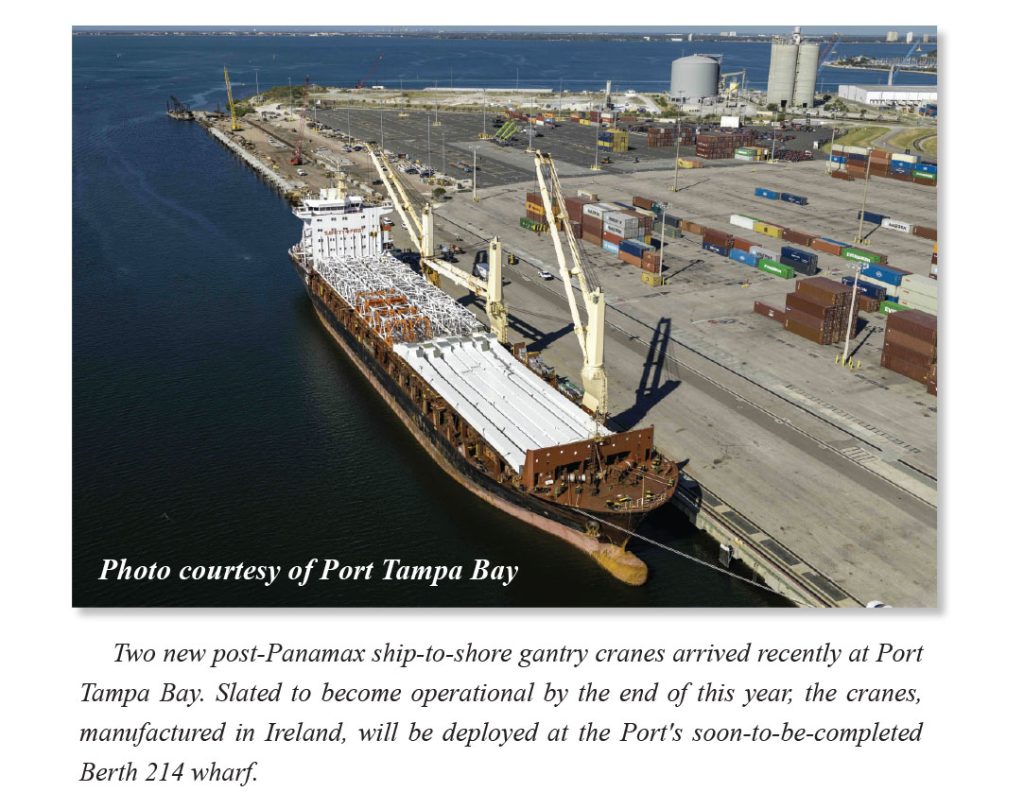
Two new post-Panamax ship-to-shore (STS) gantry cranes delivered to Port Tampa Bay will be operational by the end of this year. The cranes will enable the port to service up to three large container vessels simultaneously while increasing lift capacity.
Manufactured in Ireland, the cranes, once fully assembled, will be deployed at the soon-to-be-completed Berth 214 wharf, the latest phase of the port’s container yard development. The addition of two new cranes brings Port Tampa Bay’s inventory to six post-Panamax gantry cranes.
Gainesville Inland Port
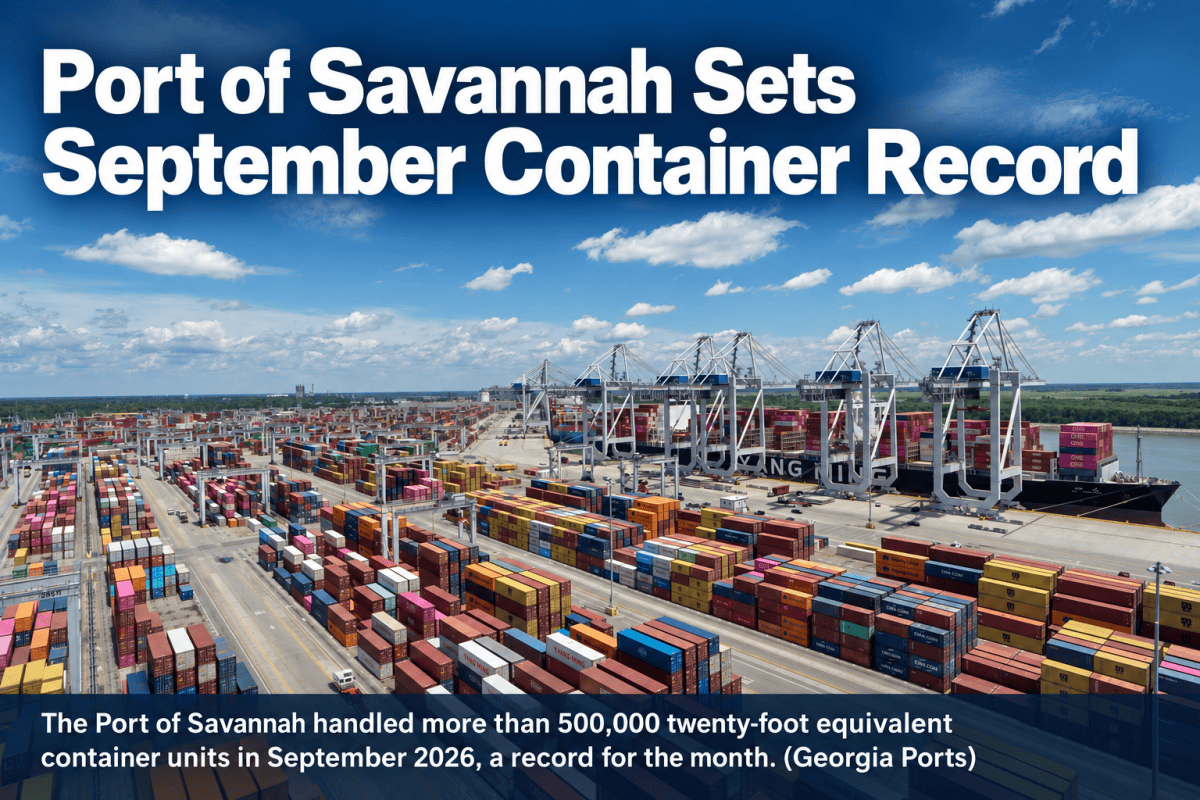
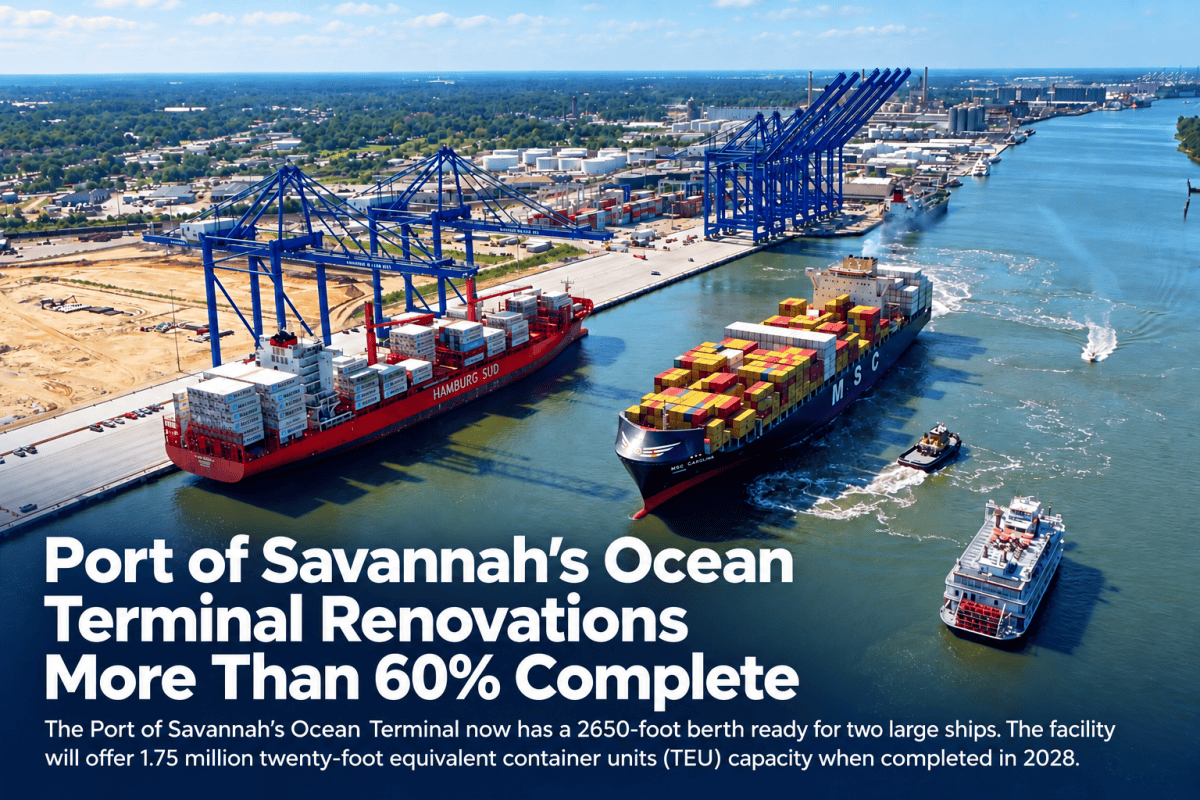
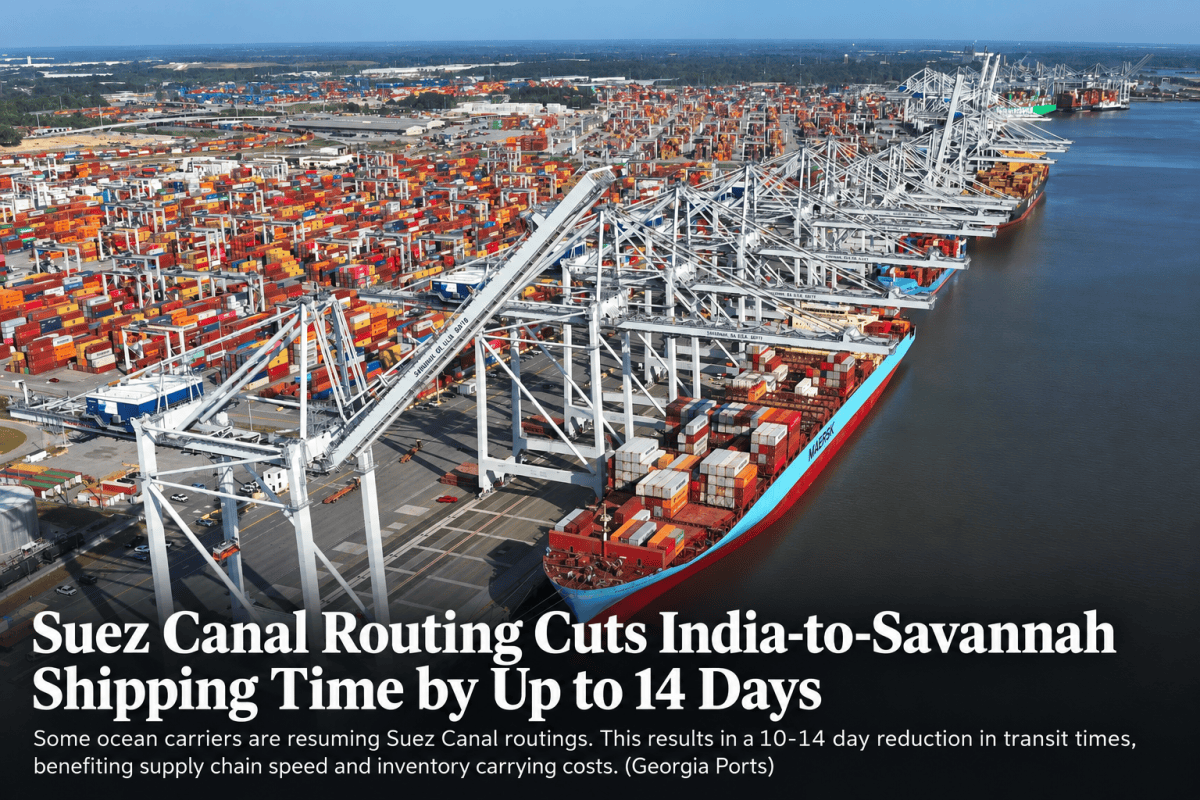
Crews at the Georgia Ports Authority’s Gainesville Inland Port have worked multiple trains and trucks at the facility since its May 4 opening kicked off direct daily rail service between the inland manufacturing hub and the Port of Savannah.
The GPA expects to shift 26,000 containers to rail in the first year of operation, improving highway traffic flow and reducing emissions. The authority is collaborating with Class I Norfolk Southern on the new service.
At full build-out, the $134 million Gainesville Inland Port will have an annual capacity of 200,000 containers.
Port of Virginia
The Port of Virginia has invested $450 million in deepening its main channel to a depth of 55 feet, making it the deepest harbor and shipping channel on the U.S. East Coast.
The two-year dredging project was completed in February and was overseen by the U.S. Army Corps of Engineers. Also included in the work was the widening of several portions of the channel to allow for the two-way traffic of ultra-large container vessels.
Port Canaveral
A new bi-monthly international container service links central Florida’s Port Canaveral with key markets in Mexico and the U.S. Northeast.
A cooperative effort between Green Tide Logistics and Canaveral Cargo Terminal GT USA, each call is projected to bring between 80 and 120 import containers carrying an array of commodities from Mexico, including electronics, refrigerated cargo, fresh produce, and other food products.
Export opportunities are also being actively developed as the service matures, the port says.

Gulf Coast
Port of Corpus Christi
The Port of Corpus Christi is moving forward with its Ship Channel Improvement Project (CIP). The project will widen the port’s main channel to 530 feet and deepen it to 54 feet to accommodate larger oil tankers.
Corpus Christi currently handles 60 percent of the country’s crude oil exports, making it the fourth-largest port by tonnage in the U.S.
Lower Mississippi River Ports
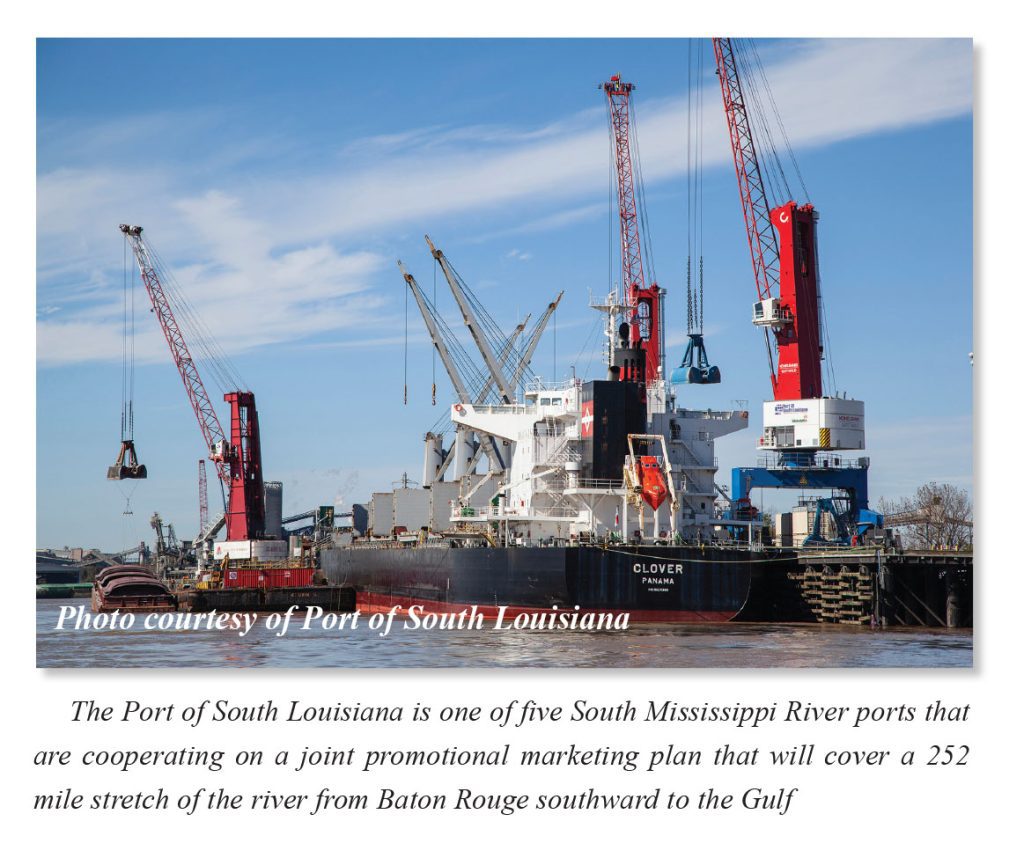
The five port systems in the Lower Mississippi River—the Port of Baton Rouge, Port of South Louisiana, Port of New Orleans, the St. Bernard Port, Harbor and Terminal District, and the Louisiana Gateway Port—are cooperating on a joint marketing plan that will cover a 252-mile stretch of the Mississippi River from Baton Rouge southward to the Gulf.
Port of New Orleans
The Port of New Orleans (Port NOLA) and the New Orleans Public Belt Railroad (NOPB) have announced the expansion of Freedom Intermodal Tank Services’ operations in New Orleans East with the opening of a new bulk liquid packaging facility.
Located adjacent to the company’s existing operation, the facility integrates the company’s processing and logistics operations and melds rail service with direct connectivity to the Port of New Orleans, the New Orleans Public Belt Railroad, and all six Class I railroads that serve North America.
Port of Brownsville
Saronic has selected the Port of Brownsville, Texas, as the site for Port Alpha, a next-generation shipyard the company plans to build to expand U.S. shipbuilding capacity.
The company will invest more than $3 billion in the facility, with construction expected to begin later this year and operations scheduled to start in 2028.
Initially, the shipyard will be capable of building vessels up to 850 feet long, with future expansion allowing the production of vessels exceeding 1,200 feet.
West Coast
Port of Long Beach
On January 5, the containership MSC Maria Christina received 6,800 cubic meters of LNG from the Seaspan Baker, an LNG bunkering vessel, marking the successful completion of MSC’s first-ever liquefied natural gas bunkering operation in the U.S.
The operation took place at the Port of Long Beach’s Inner Anchorage.

Port of Hueneme
In May, the Port of Hueneme was awarded $11,250,000 in federal funding through the U.S. Department of Transportation’s Maritime Administration (MARAD) as part of the competitive Port Infrastructure Development Program (PIDP).
The investment brings needed wharf and berth upgrades to streamline operations at one of the nation’s leading hubs for fresh produce and automobiles. The port consistently ranks among the top ten U.S. ports for automobiles and fresh produce.
Port of Tacoma
Korea’s HD Hyundai Samho has signed a contract with Washington United Terminals Inc. (WUT) to supply four advanced container cranes to the Port of Tacoma.
The contract was signed as part of a terminal modernization project aimed at expanding WUT’s terminal capacity to accommodate newer-generation container vessels. The terminal operator currently maintains eight cranes at the Port of Tacoma.
Port of Los Angeles
More than 1 million twenty-foot equivalent units (TEUs) were handled at the Port of Los Angeles in June, making it the busiest June in the port’s 118-year history.
The port handled 535,000 import TEUs during the month, up 13 percent year over year and 18 percent above the five-year average, making it the third-highest import month on record.
While June imports were strong, exports remained essentially flat at 126,000 TEUs.
Inland Waterways
Henderson County Riverport
In May, the Henderson County Riverport Authority marked the delivery of a new electric material handler and the official opening of its bulk dock for direct port operations.
The new electric material handler “enhances the port’s operational efficiency while reinforcing its commitment to modern, sustainable infrastructure,” the riverport, located on the Ohio River in Western Kentucky, says.
Port of Fort Smith
Arkansas’ Fort Smith metro port operations continue to benefit from federal funds. The latest federal award will help build an almost $10 million transload yard on more than six acres of newly acquired property at the Port of Fort Smith.
The U.S. Department of Transportation has awarded the Fort Smith Port Authority an $8.1 million grant through the federal Consolidated Rail Infrastructure and Safety Improvements (CRISI) grant program.
The 28-acre Port of Fort Smith is located near the meeting of the Poteau and Arkansas Rivers. The port authority is in the process of acquiring 6.5 acres near the port to serve as the site of a new $10 million river/rail transload facility.
Work on the project could be completed by the end of 2027.
Ports of Indiana–Jeffersonville
Ports of Indiana has been awarded a $25 million federal grant from the U.S. Department of Transportation to support a $32 million expansion of its Jeffersonville port on the Ohio River.
The grant is the largest federal award in Ports of Indiana’s 65-year history and would double the port’s general cargo footprint and increase its lift capacity from 35 tons to 300 tons.
The project includes a new crane system, a 6,500-square-foot dock, and a 22,000-square-foot warehouse.
Great Lakes
Connecting Great Lakes and Inland Waterways Trade
A group of Great Lakes ports and federal partners are launching a market study aimed at increasing cargo movements between the Great Lakes and the U.S. Inland Waterways system.
According to the American Great Lakes Ports Association and the Great Lakes St. Lawrence Seaway Development Corporation, “the effort will examine how to better link the two inland marine networks through expanded waterborne trade.”
Participating port agencies include the Ports of Indiana, the Illinois International Port District, and Port Milwaukee.
Together, the Great Lakes and Inland Waterways systems handle nearly 700 million tons of cargo annually, serving industries such as steel, agriculture, energy, and manufacturing.
Wisconsin Harbor Improvements
The Wisconsin Department of Transportation (WisDOT) has awarded $7.5 million in Harbor Assistance Program grants to support dredging, dock repairs, and cargo-handling infrastructure projects at ports across the state.
The funding will support work in Green Bay, Manitowoc, Marinette, Milwaukee, and Sturgeon Bay.
State officials said the awards are aimed at maintaining navigable depths, improving vessel access, and modernizing port facilities to handle larger vessels and expanded cargo activity.

Foreign-Trade Zones
A highly active, multi-billion-dollar economic engine despite the challenging environment facing the international trade community, the nation’s U.S. Foreign-Trade Zones (FTZs) continue their effectiveness with more than 260 general-purpose FTZ projects and nearly 400 subzones across all 50 states.
Handling the processing and distribution of a vast array of finished and semi-finished products and commodities, FTZs offer a variety of conditional advantages for both importers and exporters, such as the deferral or elimination of customs duties; waived import duties on defective components and some raw materials that are scrapped or turned into waste; and consolidating processing fees into weekly entry filings.
The FTZ program accounts for over 7.3 percent of total U.S. goods exports, handling roughly $949 billion in combined foreign and domestic merchandise annually, with Texas serving as a prime example of the economic value of their operations.
The Lone Star State currently benefits enormously from FTZ-generated activities, with numerous zones and subzones serving the state’s burgeoning energy, aerospace, and manufacturing industries.
Port of South Louisiana and Port of Houston
Frequently ranked as the No. 1 FTZ in the nation, FTZ No. 124 at the Port of South Louisiana facilitates the movement of massive volumes of cargo, oil, and agricultural products across the state and the U.S. Southeast.
The Port of Houston’s FTZ No. 84 serves as a major hub for consumer electronics, automotive components, and oil refining, and frequently handles the highest value of imported merchandise in the country.
Port of Corpus Christi
FTZ No. 122 at the Port of Corpus Christi encompasses some 25,000 acres stretched over seven counties on the South Texas Coastal Bend.
It was the first FTZ in the U.S. to feature an oil refinery subzone and currently hosts active subzones for over a dozen refining and industrial manufacturing facilities.
Port of Brownsville
The Port of Brownsville’s FTZ No. 62, located on the U.S./Mexico border, is ranked No. 3 in the nation for the value of exports and No. 14 overall among all FTZs in the nation for the value of imports, with more than $10 billion in petroleum, steel, and machinery processed annually.
South Louisiana’s Industrial Corridor
The Port of South Louisiana’s FTZ No. 124 continues to rank as one of the country’s most prominent industrial corridors, operating 19 active subzones across eight parishes to support massive energy and agricultural trade.
Phoenix and San Jose
Seen as an engine for local economic development, FTZ No. 75, overseen by the City of Phoenix, Arizona, has become a magnet for advanced manufacturing, as well as manufacturers in the electronics, semiconductor, aerospace, automotive, and solar panel industries.
FTZ No. 18, operated by the City of San Jose, California, continues to have a significant economic impact serving the region’s high-tech manufacturing and electronics sectors.
About the Author
Michael D. White is a published author with four nonfiction books and well more than 1,700 bylined articles on international transportation and trade to his credit.