Texas is entering a defining era of economic leadership as workforce development, digital infrastructure and financial sector expansion converge to drive long-term growth. With record job creation, rapid population growth and billions of dollars in corporate investment flowing into the state, Texas is increasingly positioned as one of the most influential economic engines in the United States.
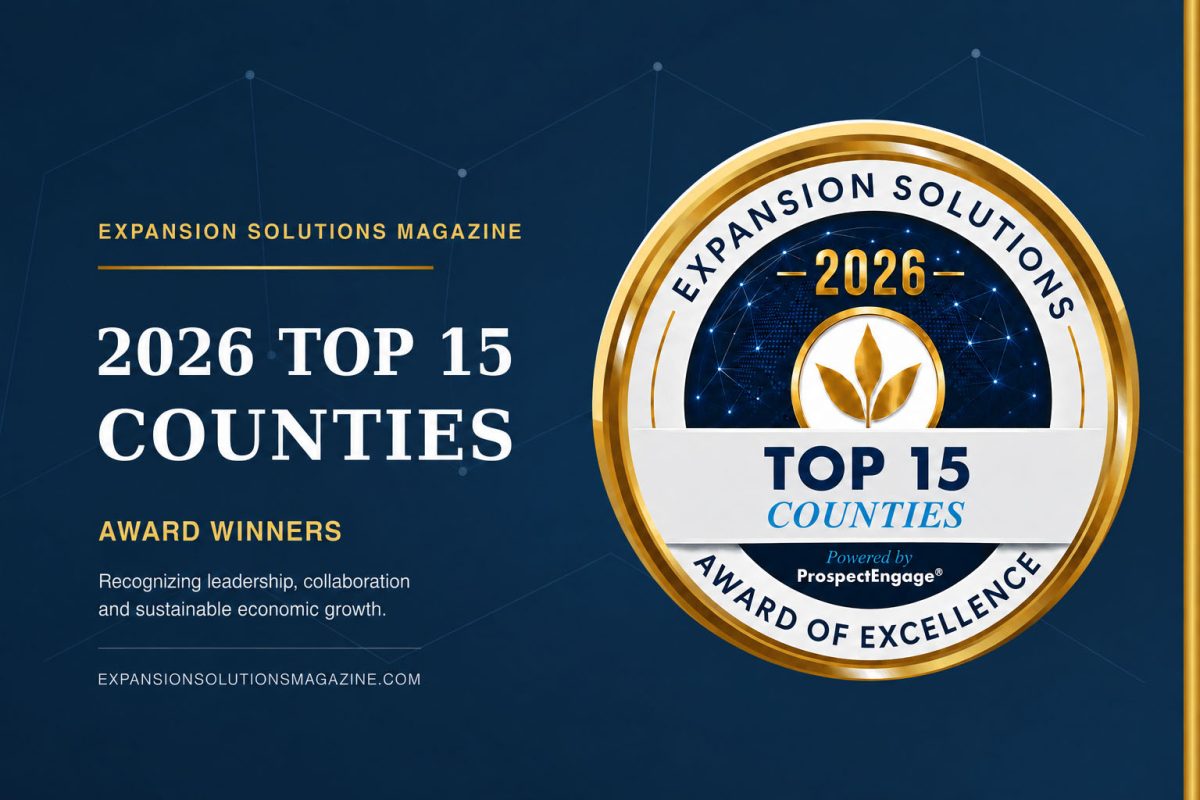
This momentum was further validated in 2026 as Texas earned Site Selection magazine’s Governor’s Cup for the 14th consecutive year and 22nd time overall, reinforcing its position as the nation’s top state for corporate facility investment and expansion projects. The recognition underscores Texas’ sustained competitiveness in attracting new business activity and large-scale capital investment.
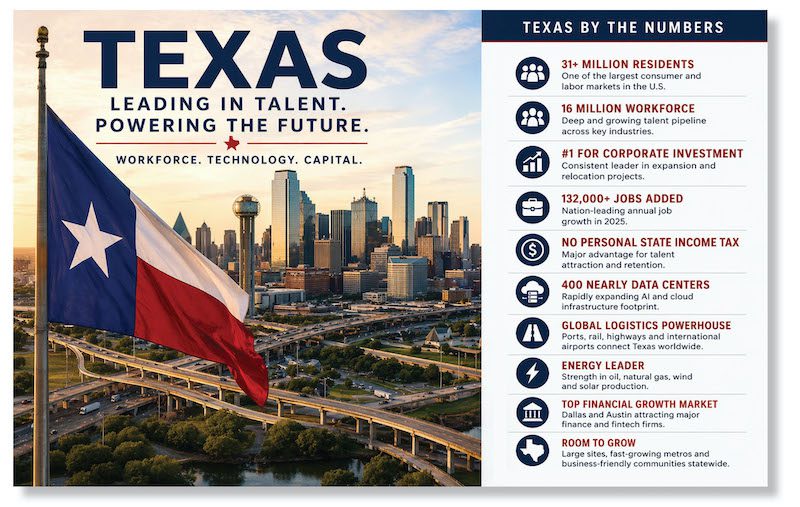
The state continues to lead the nation in business expansion and relocation projects, while also posting the largest annual job gains of any state. In 2025 alone, Texas added more than 132,000 jobs and reached record highs in total employment and labor force participation, reinforcing its reputation as one of the most dynamic business environments in the country.
By aligning talent development, digital infrastructure investment and financial services growth into a unified economic strategy, Texas is building a foundation for sustained competitiveness in an economy increasingly defined by artificial intelligence, advanced computing and capital markets innovation.
Workforce Development Takes Center Stage
Workforce readiness has become a cornerstone of Texas’ economic strategy, with Governor Greg Abbott prioritizing education and skills development as key drivers of long-term economic expansion.
As industries such as advanced manufacturing, energy, technology and financial services continue to scale across the state, demand for skilled talent is rising rapidly. Texas has responded by investing in higher education partnerships, career and technical training programs and industry-aligned workforce initiatives designed to prepare workers for high-wage, high-skill careers.
Community colleges like Dallas College, universities and workforce boards are working closely with employers to ensure training pathways reflect real-time industry needs. These partnerships are helping create a pipeline of talent capable of supporting emerging sectors such as AI, advanced manufacturing and fintech.
With the Texas labor force approaching 16 million workers and continuing to grow, the state’s focus on workforce development is strengthening its ability to attract major corporate investments while supporting the expansion of existing businesses.
Data Centers and AI Drive Digital Infrastructure Growth
Texas is rapidly emerging as one of the nation’s most important hubs for data center development, fueled by the explosive growth of artificial intelligence, cloud computing and advanced analytics.
Major metropolitan regions including Dallas–Fort Worth, Austin, Houston and San Antonio and regions like West Texas with AI Project Stargate are becoming critical hubs in the digital economy. These markets offer robust fiber connectivity, large development sites and scalable power infrastructure that appeal to hyperscale cloud providers and enterprise technology firms.
Today, Texas is home to nearly 400 data centers statewide, with a significant concentration in North Texas with new developments rapidly emerging in communities like Red Oak, Texas. The sector has generated billions in economic activity and more than $3 billion in combined state and local tax revenue, supporting public services and infrastructure investments across communities.
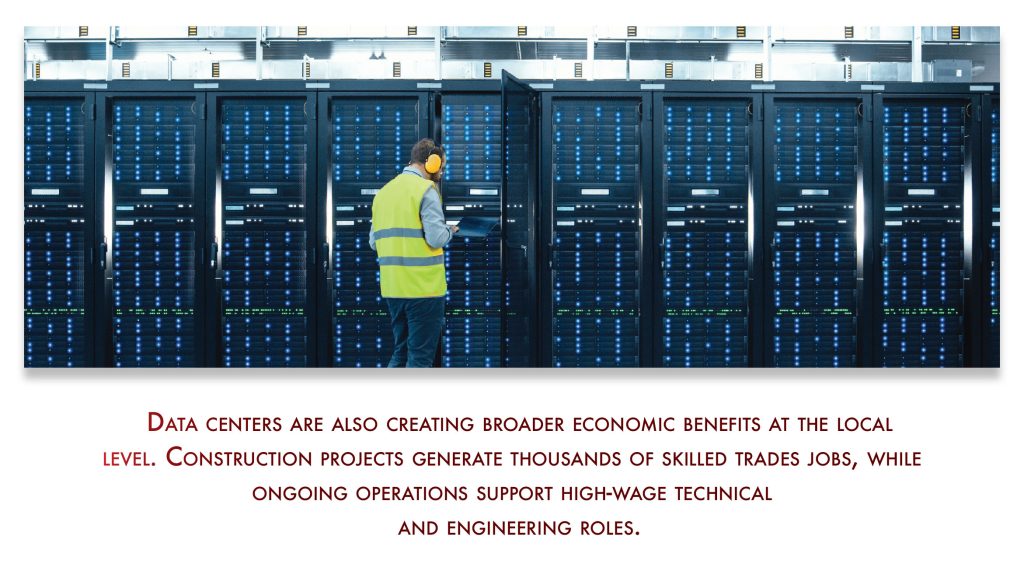
Data centers are also creating broader economic benefits at the local level. Construction projects generate thousands of skilled trades jobs, while ongoing operations support high-wage technical and engineering roles. These projects often include upgrades to electrical transmission systems, fiber networks and transportation infrastructure that strengthen regional connectivity for surrounding businesses and residents.
Developers are also integrating energy-efficient design, advanced cooling systems and water-conservation technologies into new facilities, ensuring that digital infrastructure expansion aligns with long-term infrastructure planning and resource stewardship.
Advancing Energy and Infrastructure Solutions
As digital infrastructure continues to expand, Texas is leveraging its leadership in energy production to support the growing demand for computing capacity.
Utilities, policymakers and private sector partners are working together to modernize the power grid, integrate renewable energy resources and deploy advanced cooling technologies that improve efficiency and reduce resource consumption. At the same time, strategic investments in water and wastewater infrastructure are helping ensure sustainable operations, supporting everything from cooling systems to long-term community resilience.
This coordinated approach is helping ensure that Texas remains capable of supporting large-scale computing infrastructure while maintaining reliable, scalable energy and water systems that benefit both industry and local communities.
Financial Services Expansion Reshapes the National Landscape
Texas is also strengthening its role as a major financial services hub as firms increasingly look beyond traditional financial centers for expansion opportunities.
Cities such as Dallas and Austin are attracting financial institutions, fintech startups and investment firms seeking access to talent, cost efficiencies and a pro-business regulatory environment.
The state’s expanding technology ecosystem is accelerating growth in digital banking, fintech and AI-driven financial services. As financial firms increasingly rely on data analytics and high-performance computing, Texas’ expanding digital infrastructure further reinforces its competitive advantage.
The result is a more diversified economic base that combines financial services, technology and advanced industries—strengthening the state’s long-term economic resilience.
A Unified Strategy for Long-Term Competitiveness
Texas’ economic development strategy reflects an integrated approach that connects workforce readiness, digital infrastructure and financial innovation.
Regional economic development organizations across the state are leveraging these strengths to attract investment across multiple industries, emphasizing Texas’ comprehensive value proposition for global businesses.
At the same time, continued investment in transportation, housing and public infrastructure is helping communities accommodate population growth while supporting sustained economic expansion.
Texas’ Next Chapter in Economic Leadership
As global competition for talent and investment intensifies, Texas’ ability to align education, technology and financial services into a cohesive strategy will remain a defining strength.
For site selectors, corporate executives and investors, the state offers a powerful example of how targeted policy alignment, workforce investment and infrastructure development can drive transformational economic growth.
By prioritizing talent development, advancing AI-driven infrastructure and expanding its financial services footprint —while continuing to lead the nation in corporate investment projects—Texas is shaping a narrative of sustained leadership and opportunity in the decades ahead.