For generations, America’s farmers have contended with the vagaries of weather, politics, and markets both domestic and global, while still delivering their produce to a hungry nation and the world.
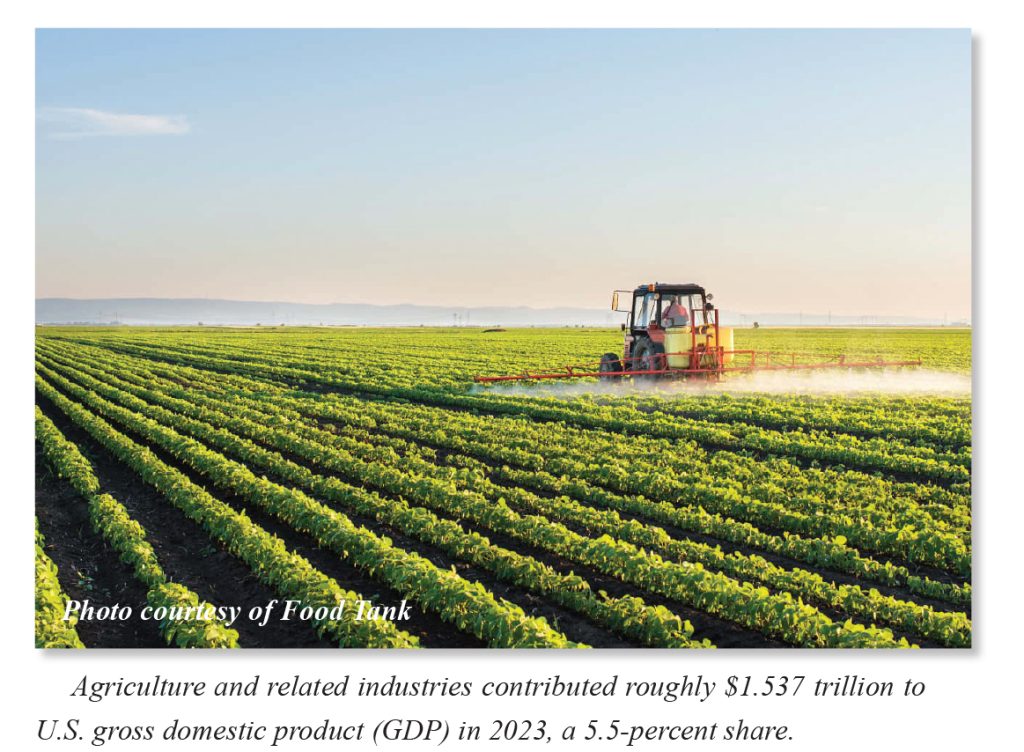
Agriculture and related industries, says the U. S. Bureau of Economic Analysis, contributed roughly $1.537 trillion to U.S. gross domestic product (GDP) in 2023, a 5.5-percent share.
The output of America’s farms contributing $222.3 billion of that sum, while “the overall contribution of agriculture to GDP is larger than 0.8 percent because sectors related to agriculture rely on agricultural inputs to contribute added value to the economy.”
That staggering contribution to the nation’s economy comes while the agribusiness sector continues to implement new and sometimes bewildering technologies to not only grow the food we consume but contribute that “added value” to the economy by cultivating crops that help fuel cars, power rural economies, and supply many of the everyday products that Americans rely on every day.
Currently, about one-third of the U.S. corn crop is currently used to produce ethanol, while almost 50 percent of U.S. soybean oil now goes toward the production of alternate fuels such as bio- and renewable diesel.
The U.S. is the world’s third-largest cotton producer and its leading cotton exporter, with the cotton industry supporting more than $21 billion in products and services annually.
Despite the growing number of industries becoming increasingly dependent on what agriculture produces, the pressure on the ag sector to deliver is increasing and has never been higher.
Technology: No Quick Fix
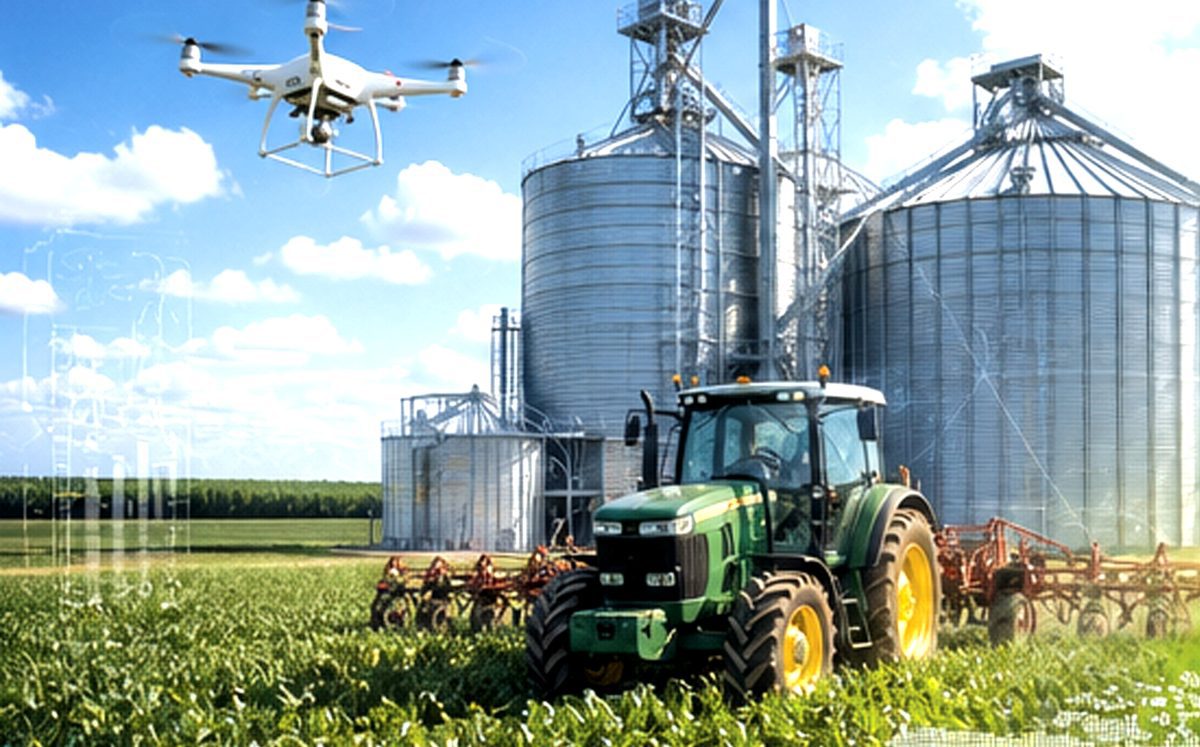
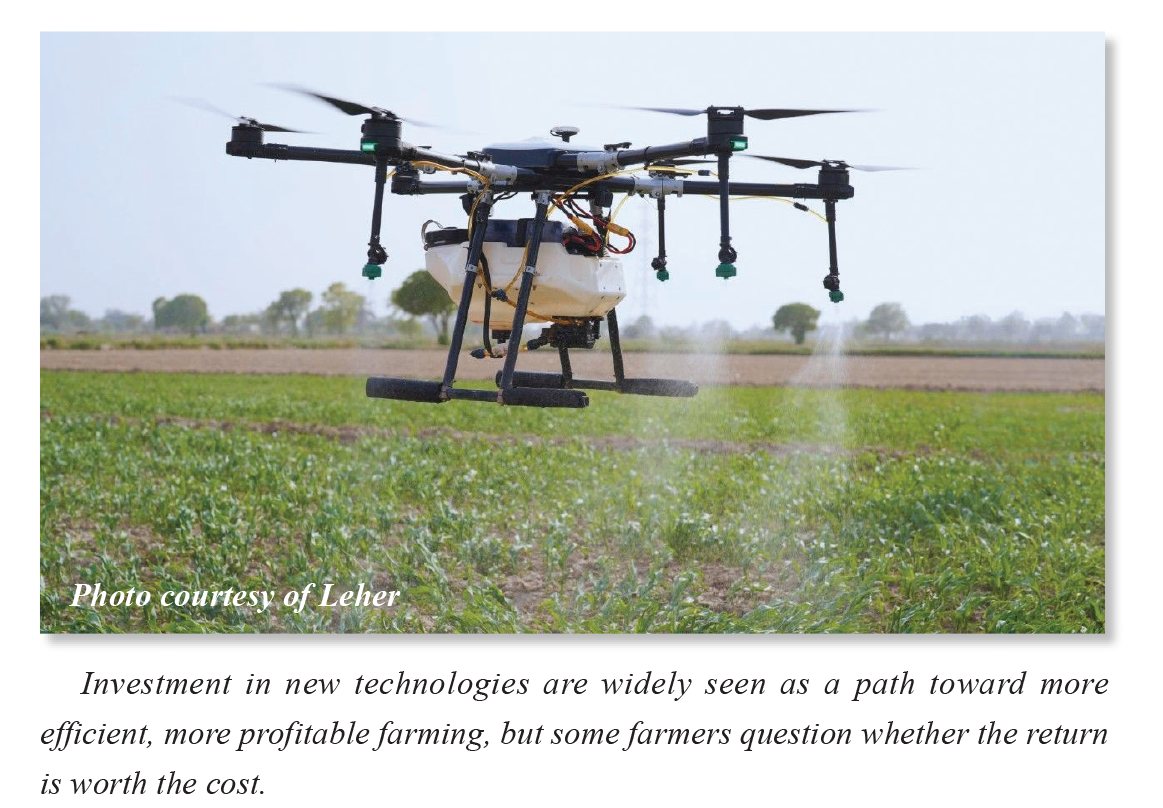
On an almost daily basis over the past several years, new technologies from AI to drones have fueled the shift to invest in and implement precision agriculture technology ─ automated guidance, yield monitors, soil sampling, and section control, for example ─ which is widely seen as a path toward more efficient, more profitable farming.
Yet, according to Purdue University’s Center for Commercial Agriculture, “farmers themselves often struggle to identify exactly what financial return they get from these investments.”

An article recently published by the Center looked at whether using these technologies “actually made Kansas farms more efficient at generating gross revenue, and for what type of farms the benefits are most likely to show up.”
On average, according to the article, a detailed analysis across the seventeen technology combinations showed that “precision agriculture technology does not broadly improve farm efficiency” as “most were not associated with meaningful gains in the ability to generate revenue relative to costs. The added expense of adopting these tools was not offset by higher revenue.”
The Center stressed, however, that its findings “do not mean precision agriculture technology has no value. It does mean that the added costs of most technology bundles are not, on average, overcome by the revenue gains they generate.”
The fundamental challenges, it would seem, lie at least in part not with the implementation of new technology as much as with the basics of real-world ROI.
Some Serious Hurdles
The 110-member, Omaha, Nebraska-based Modern Ag Alliance (MAA) recently released its inaugural State of the American Farmer report, providing a first-of-its-kind national assessment of the economic, regulatory, and operational challenges currently facing U.S. farmers.
The findings reveal a critical, strategic industry facing serious hurdles.
Currently, the report states, only two percent of Americans work in the agricultural sector, while, in 1920, the figure was 30 percent and today only about half of the nation’s farmers would recommend farming as a career to their children; costs continue to rise while commodity prices for major crops have fallen by as much as 58 percent since 2022.
Farm bankruptcies are up roughly a shocking 60 percent year over year with the “rising input costs, declining commodity prices, and growing regulatory uncertainty, contributing to increasing concern about the long-term viability of their operations.”
It also found that almost six out of ten farmers expect higher input costs, while 39 percent expect lower yields if the access to crop protection tools is restricted with farmers stressing that “maintaining access to proven crop protection tools [the chemical, biological, and mechanical methods to manage weeds, pests, and diseases] is essential to producing enough food and keeping prices affordable for American families.”
The report concludes by stating that, some 60 percent of U.S. farmers predicting that “without a course correction, farming may cease to exist as we know it.”
The nation’s farmers “are being squeezed from every direction,” according to MAA Executive Director, Elizabeth Burns-Thompson.
The data, she says, “show that economic pressure and regulatory uncertainty are colliding on the farm. Policymakers need to understand what this means in real terms ─ for farmers’ ability to stay in business and for the affordability of America’s food, fuel, and fiber.”
In March, a coalition of 54 agricultural organizations, growers and producers led by the Washington, D.C.- headquartered American Farm Bureau Federation (AFBF) penned a letter to the White House outlining the growing list of challenges facing the industry that amplified the MAA’s concerns.
In the letter, the organizations requested “expanded assistance that builds on existing programs” such as the Farmer Bridge Assistance Program, which expired in April, and highlighted the need for “targeted support for specialty crop, sugar, and alfalfa growers, as well as aid for farmers impacted by catastrophic weather.”
Beyond short-term relief, the groups emphasized the broader implications for the nation’s food system if current conditions persist.
Severe winter storms, drought, wildfires, and shifting weather patterns, for example, “have already caused significant damage across key production regions. At the same time, farmers are facing high expenses, declining crop prices, and ongoing trade uncertainty.”
Global events, the letter continued, “have added another layer of strain. The recent closure of the Strait of Hormuz has driven up fuel and fertilizer prices, further tightening margins during a critical time in the growing season. The combination of sustained market pressures, weather-related challenges, and geopolitical uncertainty “poses a serious threat to the upcoming growing season and the long-term viability of U.S. agriculture.”
“Food security is national security, and America’s farmers call on you to support additional resources during this turbulent time to ensure a strong, reliable and affordable domestic food supply for communities across the country,” the letter stressed.
Relief, But is It Enough
The SOS has not fallen on deaf ears as, over the past 15 months, the Department of Agriculture (USDA) has put into place a number of programs to assist the country’s agricultural sector in moving forward in what have proved to be challenging times.
For example, this past May, the U.S. House of Representatives passed the Nationwide Consumer and Fuel Retailer Choice Act at the White House’s urging.

The Emergency Commodity Assistance Program has distributed more than $9.3 billion to more than 560,000 farmersfor soy, corn, sorghum, and other row crops, while the Marketing Assistance for Specialty Crops initiative was created to assist specialty crop producers in recovering from rising input costs and other market disruptions with more than $1.8 billion in assistance distributed to 52,000-plus producers across the country.
In addition, more than $2.5 billion via USDA block grants is earmarked and delivered to states and sugar beet and cane processors via block grants to cover losses from 2023 and 2024 that were left uncovered by pre-existing USDA programs.
At the same time, the agency’s Supplemental Disaster Relief Program has distributed nearly $6 billion to over 388,000 farmers with up to an additional $9 billion to be distributed by the end of this year to help farmers recover from severe weather events in 2023 and 2024.

Last September, the USDA and the Department of Justice signed a Memorandum of Understanding “to protect American farmers and ranchers from the burdens imposed by high and volatile input costs, such as feed, fertilizer, fuel, seed, equipment, and other essential goods, while ensuring competitive supply chains, lower consumer prices, and the resilience of U.S. agriculture and the food supply.”
In June, the USDA’s Farm Service Agency began notifying eligible landowners by direct mail that they have the opportunity to expand their farm safety net coverage by adding 30 million base acres across the country. Landowners can reportedly add base acres based on crops planted between 2019 and 2023 that were not previously enrolled in any government safety net programs.
The legislative and financial relief proffered by the White House and the USDA are, the industry feels, a step in the right direction, and hopefully the first steps in the “course correction” needed to avoid the immeasurably disastrous economic and social decline of a unique, critical industry.
About the Author
Michael D. White is a published author with four non-fiction books and well more than 1,700 by-lined articles on international transportation and trade to his credit.