

The line dividing the aerospace and defense industries continues to blur even further as strategic geopolitics and new AI-driven technologies such as commercial and military drones, robotics, and advanced manufacturing increasingly propel the trajectory of their development across all five domains – sea, air, land, space, and cyber.
“The aerospace and defense industry stands at a pivotal crossroads as it enters the latter half of the decade,” according to industry analyst Deloitte’s 2026 Aerospace and Defense Outlook.
“Forces that have shaped the sector in recent years ─ digital transformation, supply chain volatility, talent constraints, and geopolitical events ─ are converging with new catalysts such as agentic AI, emerging vehicles, and the rapid evolution of autonomous systems,” the report states.
The commercial aerospace sector, it continues, “appears poised to continue growth, fueled by rising fleet utilization, continued fleet growth, and steady gains in both passenger and cargo demand, while persistent aircraft production backlogs are prompting operators to fly existing fleets longer and invest more in reliability, availability, and maintainability.”
On the defense side, “budgets are a key focus, with a growing emphasis on enhancing mission readiness,” the reports concludes, adding that, “At the same time, defense priorities are shifting to accelerate the fielding of AI-enabled systems and collaborative combat aircraft.”
 ResearchAndMarkets’ recent “Artificial Intelligence and Robotics in Aerospace and Defense Market Report 2026” states that, “The artificial intelligence (AI) and robotics market in aerospace and defense is experiencing significant growth. From 2025 to 2026, the market will expand from $26.9 billion to $29.73 billion, reflecting a compound annual growth rate (CAGR) of 10.5 percent.”
This surge “is due to increased use of autonomous drones and AI-driven threat detection, alongside advances in defense research and development and predictive analytics for maintenance and operations.”
Looking ahead to 2030, it forecasts, the market is projected to grow to $44 billion, with a CAGR of 10.4 percent. Key contributors to this forecast include the deployment of AI-driven autonomous systems, enhanced robotics for defense operations, and the integration of quantum computing in defense intelligence.”
Further trends, “involve AI-powered predictive maintenance and simulation for defense training, advanced sensor fusion for surveillance, and AI-assisted mission planning” with rising defense expenditures “serving as a catalyst for market growth. Nations, seeking to increase military capabilities amid global tensions, are investing in AI and robotics.”
Artificial intelligence “offers vast potential for the space domain by enhancing satellite operations, predictive technologies, and accelerated decision making,” according to California-headquartered Aerospace Corp.’s website.
These advancements “support more efficient missions and position the U.S. for strategic advantage in space. As AI capabilities continue to evolve, the growing pace of global innovation is elevating the importance of space for national security and beyond,” the company says, adding that “as the space domain becomes increasingly congested and contested, the ability to respond quickly and effectively is crucial to maintaining U.S. leadership in space.”
In an environment where speed and agility are paramount, “AI is a powerful enabler guiding key decisions. From real-time monitoring and threat detection to data analysis of space assets, AI supports earlier identification of risks—such as space debris or adversarial behavior—allowing teams to act with greater accuracy, confidence, and decreased response time.”
These capabilities “can also improve satellite communications, optimize bandwidth and support autonomous navigation” with AI-driven predictive maintenance capable of anticipating equipment failures, timely repairs, and minimizing downtime,” while simulations and digital modeling using AI “provide engineers with highly accurate representations of space systems, supporting design, testing and deployment.”
“AI is different from past technologies. It is a generic platform, waiting for users to apply it and provide us, as developers, with the specific use cases,” said Shawn Sloan, Corporate AI Technical Fellow in Aerospace’s Digital Innovation Division. “The industry is moving towards democratizing this capability, commoditizing it, and then letting everyone use it.”
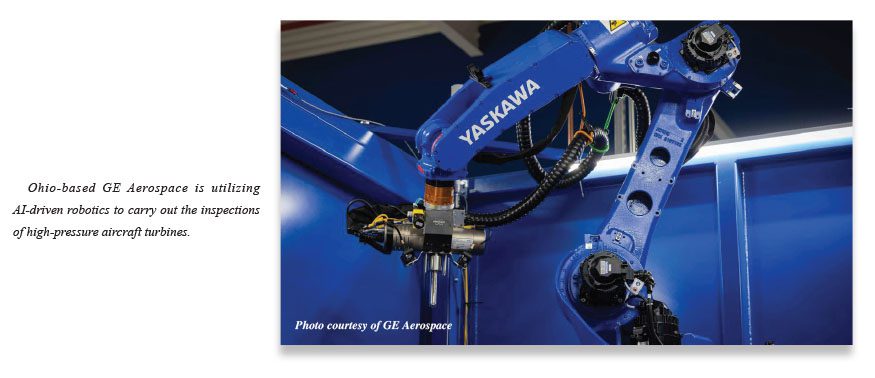
Ohio-based GE Aerospace is utilizing AI-driven robotics to carry out the inspections of high-pressure aircraft turbines ─ one of the most intensive and crucial tasks in maintaining the integrity of aircraft jet engines.
Standing in a universal workstation, two articulated industrial robots equipped with white light optical scanners move closely over the entire surface of the engine.
While the robot scanners’ movements are directed by human operators, AI is used to collect and analyze data with optimal accuracy, speed, and consistency, simultaneously creating a digital record of every component part’s condition.
Every surface of the engine is inspected, particularly the precision-machined, nickel-based disks that support the engine’s turbine blades, which are painstakingly scrutinized for any flaw, however small or seemingly insignificant.
GE Aerospace’s engineers in New York and at the company’s Global Automation and Robotics Center in Quebec, Canada, invested five years in developing the robot-inspection system, which was first deployed in 2024 at its 85,000-square-foot Services Technology Acceleration Center (STAC) in Cincinnati, Ohio.
In January, GE Aerospace announced that it had successfully completed the ground testing of a commercial turbofan engine that can extract, transfer, and reinsert electrical power while in operation.
It showed a full hybrid electric engine system operating together in real conditions, generating data that could shape the next generation of single-aisle aircraft used across the United States.
The hybrid electric engine architecture “incorporates electric motor/generators in a gas turbine engine to supplement power during different phases of operation.”
The design, developed in partnership with the National Aeronautics and Space Administration (NASA), “optimizes engine performance, so the aircraft can operate with or without energy storage like batteries,” the company said.
The “narrowbody hybrid electric architecture” embeds electric motor/generators in a gas turbine engine to supplement power during different phases of operation.
The successful ground test “demonstrated a narrowbody hybrid electric engine architecture that doesn’t require energy storage to operate,” said Arjan Hegeman, vice president of future of flight for GE Aerospace. “It’s a critical step to making hybrid electric flight a reality for commercial aviation with technologies that meet customer needs for greater efficiency, durability, and range.”
Drones
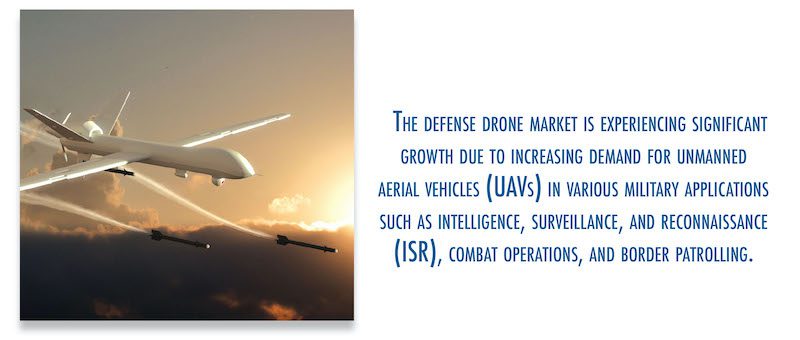
The defense drone market is experiencing significant growth due to increasing demand for unmanned aerial vehicles (UAVs) in various military applications such as intelligence, surveillance, and reconnaissance (ISR), combat operations, and border patrolling.
Drones are being increasingly adopted for these purposes because they can provide real-time data and reduce human casualties.
Looking at the future, advancements in drone technology, such as improved endurance and autonomous capabilities will add to the drones’ popularity. Many countries are significantly increasing their defense spending to modernize their military capabilities and acquire advanced military technologies like drones. This surge in government spending is expected to create lucrative growth opportunities for military drone
manufacturers.
A report from industry insider, Coherent Market Insights (CMI) predicted that the global military unmanned aerial vehicle (UAV) drone market is estimated to reach $52 billion by 2032, exhibiting a compound annual growth rate (CAGR) over the next six years of 11.3 percent.
According to CMI, strategic drones, also known as High-Altitude Long Endurance (HALE) drones, “provide military forces with real-time intelligence, surveillance, and reconnaissance (ISR) data, enabling them to monitor large areas, track targets, and gather critical information about enemy activities.”
HALEs ─ which held a 43 percent share of the global drone market in 2025 ─ can also be used for border patrol, maritime surveillance, and communication relay, “further expanding their utility in various military applications. Moreover, artificial intelligence (AI) and machine learning (ML) technologies will improve the drones’ autonomous capabilities, such as decision-making and target identification.”
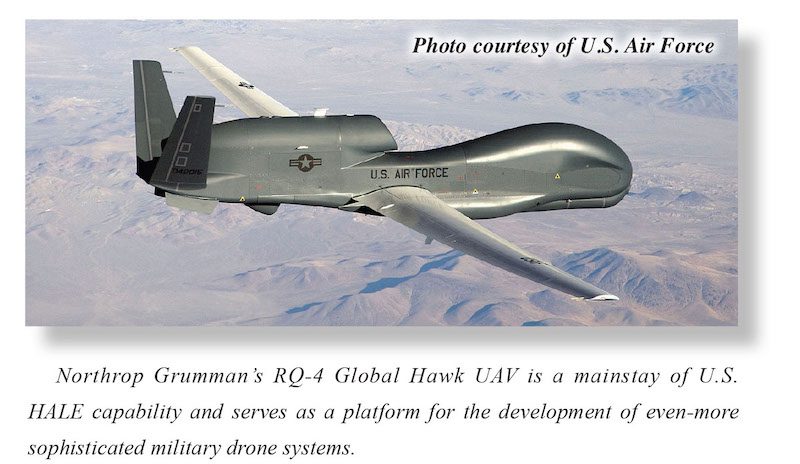
Over the past two decades, Northrop Grumman’s RQ-4 Global Hawk UAV has come to serve as a mainstay of U.S. HALE capability.
During Operation Iraqi Freedom, RQ-4s flew five percent of the U.S. Air Force’s high-altitude reconnaissance flights but generated more than 55 percent of the time-sensitive targeting images used to assist attack missions.
The time-tested RQ-4 also served as a testbed for the development of more up-to-date UAV systems under the oversight of the U.S. Navy’s Broad Area Maritime Surveillance (BAMS) program, which was developed to address any shortfall in assets for conducting intelligence, surveillance, and reconnaissance.
The U.S. Defense Advanced Research Projects Agency (DARPA) has selected Raytheon to develop a new sensing and targeting system “to protect commercial and naval logistics vessels from emerging maritime threats from unmanned surface vehicles (USVs) and other low-cost, asymmetric threats.”
The Pulling Guard system will mount electro-optical and infrared sensors on a tethered drone linked to a semi-autonomous unmanned platform towed behind a vessel that will utilize detection software to feed real-time target tracking information to remote operators.
The system will offer “an elevated vantage point for wide-area maritime surveillance and target tracking in congested or contested waters to enable faster and more informed engagement decisions,” the Massachusetts-headquartered defense contractor says.
Beyond commercial and naval logistics vessel defense, the company said the system “could also support wider naval operations, including automated overwatch for unmanned and manned vessels across multiple theatres.”
Advanced Manufacturing
The aerospace parts manufacturing market is being driven by the growing demand for commercial aircraft. The sector’s growth is fueled by the continuous rise in international air travel, which increases the demand for parts and systems used by manufacturers to build new aircraft.
Additionally, the aerospace parts manufacturing industry is growing as a result of increased funding and interest in space exploration as the need for critical components for satellites, rockets, and exploration vehicles continues to surge.
According to SNS Insider, the aerospace additive manufacturing market was valued at $8.75 billion in 2025 and is projected to reach $45 billion by 2035, expanding at a CAGR of 17.79 percent during the 2026-2035 forecast period.
“The additive manufacturing in aerospace market growth is driven by increasing adoption of additive manufacturing technologies to produce lightweight, high-performance aerospace components, enabling fuel efficiency, cost reduction, and improved design flexibility,” the industry analyst says. “Growing investments in aerospace innovation, rising aircraft production, and expanding use of metal additive manufacturing for structural and engine parts continue to accelerate industry adoption globally.”
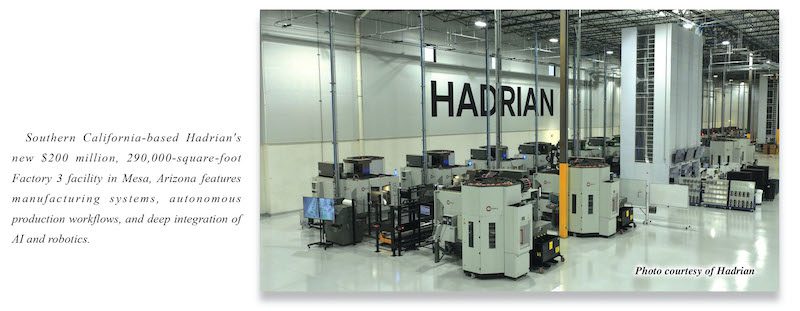
In January, Southern California-based Hadrian opened the doors at a new AI-powered manufacturing and software hub facility in Mesa, Arizona.
The new $200 million, 290,000-square-foot Factory 3 “features manufacturing systems, autonomous production workflows, and deep integration of AI and robotics to accelerate throughput and enhance the quality of components and systems for the aerospace and defense sectors.”
The Factory 3 software hub “supports the coordination of advanced manufacturing processes and extends Hadrian’s ability to deliver precision systems with speed and reliability,” the company said.
Last September, in partnership with L3Harris Technologies, The Austin Company announced the completion of a new spacecraft manufacturing facility with a ribbon cutting for the new 92,000 square-foot spacecraft manufacturing facility.
The state-of-the-art complex will support the Golden Dome for America and the next generation of space systems. The newly completed facility marks a significant milestone in L3Harris’ continued investment in advanced aerospace manufacturing.
Austin served as the design-build partner, delivering comprehensive services including planning, architecture, engineering, preconstruction, and construction management.
Known as Project LEO, this facility supports the manufacturing of next generation satellites that will identify, track and defend against hypersonic and advanced missile threats. It features three expansive high bays with large capacity overhead cranes and unique security requirements. Support spaces and site upgrades include essential amenities, expanded infrastructure, and enhanced security features to streamline operations and modernize the facility.
The American Center for Manufacturing & Innovation (ACMI), based in Austin, Texas, and Germany-headquartered EOS GmbH have partnered to support advanced manufacturing and domestic production in the United States.
Under the deal, ACMI has acquired several EOS Additive Manufacturing machines with the new collaboration expecting “to support the growth of the commercial manufacturing base and the development of new applications for AM in the defense industry.”

Pairing ACMI’s expertise in developing large-scale production ecosystems with EOS’ technology and industry knowledge “will provide the capabilities needed to address advanced manufacturing requirements and scale production,” according to a an ACMI spokesman.
Additive manufacturer Velo3D and Linde AMT have signed an agreement to supply domestically produced copper-nickel alloy (CuNi) powder in support of the U.S. Navy’s Maritime Industrial Base (MIB) Program.
The collaboration between the two companies “provides a fully U.S.-based solution for producing corrosion-resistant copper-nickel components used in naval systems that leverages Linde AMT’s expanded manufacturing facility for additive metal powders and Velo3D’s Sapphire XC large-format printer to enable faster production of key parts for shipbuilding and fleet readiness.”
CuNi is widely used in naval systems such as shipboard piping, cooling systems, and structural components as it is highly resistant to seawater corrosion and biofouling, while maintaining its mechanical strength and durability in harsh marine environments.
On December 18th, 2025, the National Aeronautics & Space Administration and The Aerospace Corporation placed four experimental satellites called DiskSats into orbit.
The launch was the first successful demonstration of the new spacecraft design, which exchanges a traditional bulky, boxy configuration for several one-inch thick, flat, disk-shaped satellites stacked one upon the other like pancakes. Many of the DiskSats’ components were produced via advanced manufacturing.
According to the business website ScreenRant, “The flat, over-sized coin design changes how DiskSat behaves once in space. When oriented edge-on, the spacecraft presents a lower drag profile, enabling sustained operations at extremely low earth orbit altitudes where atmospheric drag would normally shorten mission lifetimes.
The program focuses on deploying multiple satellites at once on “ride share” missions thus reducing the number of launches required to build constellations. The four satellites were sent aloft aboard a Rocket Lab Electron rocket from its launch site on Wallops Island, Virginia.
Commercial launch provider Rocket Lab successfully completed 21 Electron rocket launches in 2025 and deployed the four DiskSat satellites for the U.S. Space Force a full five months ahead of the original schedule.