Propelled by the demand for increasingly high levels of customer service and the critical implementation of new technologies, companies in all industry sectors are upgrading their supply chain strategies in an all-out effort to achieve cost savings and remain competitive.
Those drivers include the rapid growth of e-commerce as online retail continues to reshape supply chain infrastructure; the impact of the increased implementation of AI-powered technologies; and labor shortages pushing the use of robotics and automation.
Add on the increasing demand for ever higher levels of customer service, a mounting number of stock keeping units (SKUs) impacting inventory and delivery, and what results is a warehouse/distribution environment of dramatically increased complexity.
The days of managing a warehouse/distribution operation based on a laundry list of simple alphabetic categorizations are over and the task of balancing those elements is a daily challenge that cannot be ignored which sits at the very core of the evolving role of the warehouse/distribution center.

In 2026, companies “will face severe geopolitical volatility, constantly shifting trade policies, critical cost and sourcing pressures, and more,” according The Top Ten Supply Chain Trends in 2026, a recent study published by the Association for Supply Chain Management (ASCM).
“These challenges demand a fundamental operational overhaul, with supply chain success hinging on embracing the power of digitization and highly interconnected networks,” it says.
Manufacturers, wholesalers, and retailers wanting to allay the costs of managing warehouses and shipping in-house outsource those functions to third-party logistics providers (3PLs) that handle specialized inventory management, warehousing, packing, and transportation.
The result of partnering with the right 3PL is the creation of a strategic partnership balanced on active collaboration and a shared commitment to long-term value rather than transactional relationships.
In the past, “3PL warehouses were often viewed as places to store inventory until it was needed,” says Doug Sampson, Chief Commercial Officer and Shareholder at Acme Distribution, a Denver-based 3PL with operations in Pennsylvania and Washington, as well as Colorado.
Sampson also serves as Chairman of the Board of the Illinois-headquartered International Warehouse Logistics Association (IWLA), which is comprised of more than 400 3PLs and warehouse operators in North America.
Today, he says, “they play a much more dynamic role in fulfillment, inventory management, transportation coordination, and customer service. The rise of e-commerce, omnichannel retail, and heightened customer expectations for speed and visibility has significantly increased the importance of warehouse operations.”
As customer expectations rise and order profiles become more complex, shippers and 3PLs are continuing to invest in flexible warehouse operations capable of scaling quickly while, at the same time, maintaining accuracy and efficiency.
The melding of the business-to-consumer (B2C), business-to-business (B2B), and omnichannel fulfillment models that align a business’s sales channels such as physical stores, e-commerce, and marketplaces under a single, synchronized inventory system is increasingly driving the distribution/warehouse sector’s growth and survivability.
“Across the 3PL warehousing industry, operators are leveraging technologies,” says the ILWA’s Sampson. “Long-time solutions like warehouse management systems are working more seamlessly than ever before with robotics, automated storage and retrieval systems, predictive analytics, and AI-powered forecasting.”

Automation
Using the right technology the right way, he says, “improves efficiency, accuracy, and visibility in the modern warehouse.”
According to the ASCM study report, automation, for example, streamlines repetitive tasks such as picking, packing, sorting, and inventory movement, enabling facilities to process higher volumes with greater consistency.
The integration of advanced supply chain technologies including robotics, autonomous systems, and AI to streamline and optimize operations, enhanced automation “is crucial for building resilient global networks that can manage disruption and scale to meet fluctuating demand.”
By enhancing precision in manufacturing and logistics, it said, “automation reduces both labor and delivery costs, while supporting sustainability, improving overall efficiency, and adaptability across the value chain.”
The list of examples of companies seeing direct-to-consumer demand accelerate and brands face mounting pressure to deliver faster with tighter margins is growing almost daily.
California-based 3PL Komar Distribution Services has contracted with warehouse robotics developer Exotec to equip its 760,000 square foot facility in Savannah, Georgia with the developer’s Skypod robotic system which allows Komar DS to scale capacity incrementally as demand rises.
The integrated system includes the operations of robots, conveyors, carton sealers, outbound scanning, all operating under the developer’s proprietary warehouse system which orchestrates all process functions in real time.
With facilities in Oklahoma, California, and Georgia, Komar provides distribution services to a number of clients across a number of apparel, home goods, and consumer products brands.
Medical-surgical products provider Medline has become the first health care company to plan the implementation of next-generation warehouse automation from system developer Symbotic “as part of its ongoing efforts to strengthen the resiliency, efficiency and scalability of the health care supply chain.”
The Illinois-based company will pilot the technology in 2027 at one of its 45 North American distribution centers.
According to Sean Halligan, chief supply chain officer at Medline, the enhanced automation capability “will help us provide even more efficiency for our customers and help them meet their operational, clinical, and financial goals.”
Artificial Intelligence
According to the 30th Annual 3PL Study released by the Council of Supply Chain Management Professionals earlier this year, the majority of shippers (80 percent) and 3PLs (81 percent) of those surveyed “are deploying advanced analytics at some level.”
AI and machine learning, it found, are utilized by shippers at a 67 percent rate and at 73 percent for 3PLs.
However, “the barriers that exist to the deployment of next generation tech is said to include insufficient funding, unclear business cases, inadequate talent, trust of the technology, risk aversion, and scalability,” the study noted.
“More shippers expect real-time visibility, data-driven insights, and agility, and 3PLs are responding with technology that can drive operational performance,” it found, with advanced analytics and network optimization among the top drivers identified by both shippers and 3PLs.
The study also found that “digital supply chains are being used to improve the flow of goods, information and finances. Among shippers, 70 percent reported significant use of digital supply chain technologies, compared to just 13 percent of 3PLs. This gap is likely to recede as 3PLs make related investments to better meet shipper expectations.”
In response to this need, 3PLs “are investing in multiple technologies, including those that can capture and analyze data to improve asset utilization and service, enable predictive analytics, and strengthen agility and resilience,” the study found.
AI, which is fueling the surge to implement the latest technologies, is also helping operators make smarter business decisions by improving labor planning, inventory optimization, route forecasting, and demand prediction.
A recent survey conducted in the U.S. by global technology intelligence firm ABI Research found that more than 90 percent of retailers plan to deploy AI for both decision support and supply chain network optimization.
“Gen AI applications have slowly been applied by retailers over the last year, with most exploring system support chatbots and customer-focused support tools,” says ABI Senior Analyst, Ryan Wiggin.
“More eyes are turning towards agentic AI applications, and more than 40 percent of respondents strongly agree that AI agents can help automate decision-making for tasks such as adjusting inventory levels, re-routing shipments, and triggering automatic re-orders,” he adds.

The People Problem
While AI is a given and is, in many ways, becoming the new default application in warehouse and distribution, a continuing imperative is the scope of human machine collaboration, which, when successfully combined, aims at faster, more accurate decision-making.
But the fly in the ointment continues to be a stagnant pool of skilled workers agile enough to transition to a new AI-fueled work environment.
“Labor continues to be one of the most pressing concerns,” says Acme Distribution’s Doug Sampson. “Warehouses require skilled employees to operate increasingly sophisticated equipment and technology, while competition for talent remains high.”
To address this, he says, “many operators are investing in employee training, workplace safety initiatives, technology adoption, and stronger workforce development partnerships.”
The issue of upping the skillset of the supply chain work force “is vital, due to the scarcity of skilled labor and the urgent demand for digital literacy in AI and data analytics,” according to the ASCM’s Top Ten Supply Chain Trends report.
Companies, it says, “must focus on upskilling and training existing employees while attracting new talent. This also demands a cultural transformation toward continuous learning, ensuring organizations build resilient human capabilities to drive innovation and maintain a competitive advantage.”
The proliferation of exciting new technologies “is fundamentally redefining roles, shifting the human workforce away from repetitive, transactional tasks toward strategic oversight and analytical problem-solving. Intelligent scheduling, predictive maintenance, and conversational agents are poised to transform the frontline by optimizing workflows and improving safety.”
Artificial intelligence, it says, “is automating administrative tasks and freeing planners to focus on scenario planning and network redesign.”
The digital skills gap “must be urgently addressed as preparation involves a comprehensive commitment to educating the existing workforce, shifting focus to technical fluency and critical thinking. Key competencies include data analysis and visualization, plus strong end-to-end supply chain thinking.”
Furthermore, it added, “it’s necessary to redesign onboarding programs to embed AI literacy from day-one and implement mentorship systems to capture the invaluable operational knowledge of retiring employees.”
Robotics
The issue of investing the cash and the time to train and mentor a skilled workforce that can achieve that “technical fluency and critical thinking” is being offset by the rise in the application of Autonomous Mobile Robot (AMR)technology into the warehouse environment.
Also driving that application are the impossible to ignore realities of the dizzying complexity of e-commerce product assortment; the need for faster order processing and reducing human error; the integration of all operations with warehouse management software; and the growing demand for high-throughput micro-fulfillment centers and urban distribution hubs.
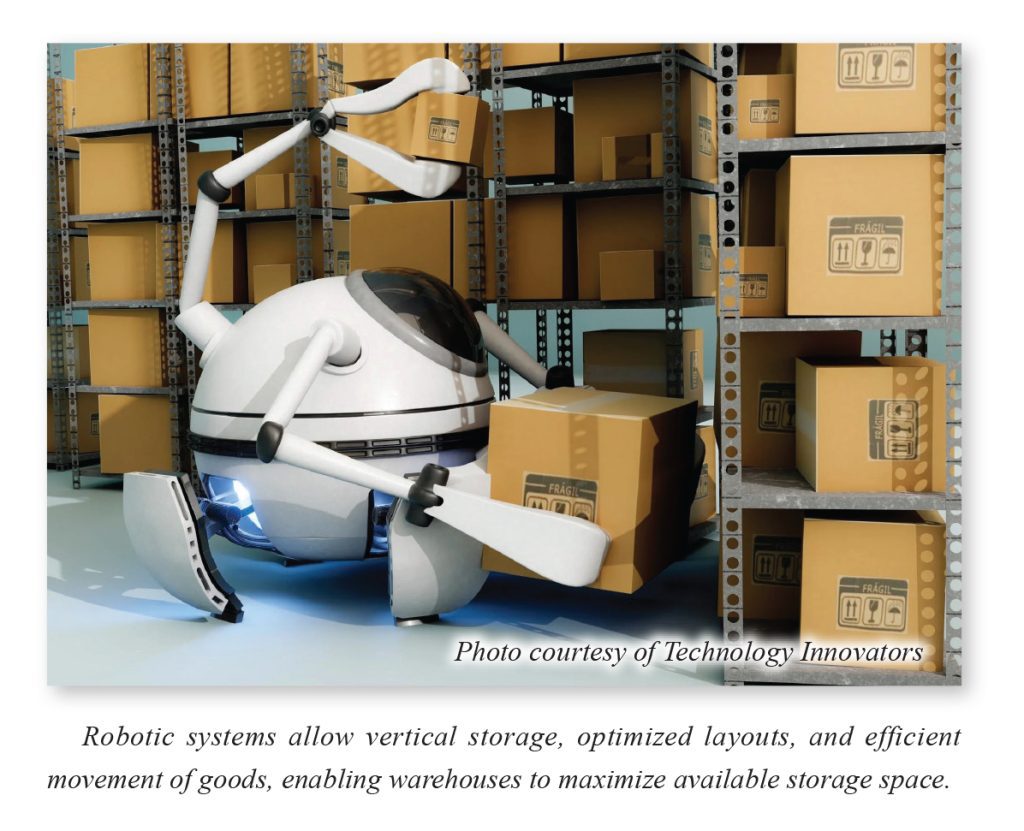
In short, robotic systems allow vertical storage, optimized layouts, and efficient movement of goods, enabling warehouses to maximize available storage space. Their application is expected to soar over the next decade as the utilization of warehouse robotics gains momentum, says industry researcher Future Market Insights (FMI).
The technology “is entering a new phase of accelerated expansion as logistics operators worldwide adopt intelligent automation to manage rising e-commerce volumes and complex supply chains.”
According to its latest industry analysis, the market for AMRs is projected to grow three-fold from $1.8 billion in 2025 to $6.6 billion by 2035, advancing at a CAGR of 13.8 percent during the forecast period.
Among various robotic technologies used in warehouses, AMRs designed to navigate dynamic warehouse environments using advanced sensors, AI-driven mapping systems, and machine vision currently dominate the market with approximately 44.4 percent share.
“Unlike traditional automated systems that rely on fixed infrastructure, AMRs offer greater flexibility and faster deployment,” says Future Market Insights, adding that “their ability to work collaboratively with human operators and other robotic systems allows warehouses to scale operations efficiently.”
AMRs are widely used for inventory transportation; goods-to-person picking systems; automated replenishment processes; and real-time logistics coordination.
With ongoing improvements in navigation software, battery life, and sensor accuracy, autonomous mobile robots “are expected to remain the most widely adopted warehouse robotics solution over the coming decade,” according to FMI.
Within the functional segmentation of warehouse robotics, the picking and placing segment holds around 38.6 percent share, reflecting its critical role in order fulfillment operations.
“Robotic picking systems equipped with advanced vision sensors and AI-driven motion control are capable of handling diverse products with high precision,” the researcher says. “These systems are particularly valuable in industries with large product catalogs and high order turnover.”

Security
Leading 3PLs, says the Association for Supply Chain Management (ASCM) study, “are making advanced security a core service offering, recognizing that their interconnected systems” are prime targets for cyber bandits.
“By implementing rigorous protocols, these providers can effectively manage the risk of catastrophic events that could halt physical movement and order fulfillment for their clients,” it adds.
This focus “also enables 3PLs to guarantee greater operational resilience and data integrity, giving partners the confidence to outsource sensitive logistics operations.”
Cyberattacks have grown more frequently with increasing supply chain digitization and global networks are first tier targets because, like their clients, their digital profiles can contain systemic points of failure that go unrepaired that sophisticated cyber bandits can exploit.
“This isn’t just an IT problem,” the trade group says, “Every supply chain professional must prioritize security. In 2026, leading businesses are emphasizing strong security frameworks that encompass compliance and data regulation, especially when engaging with third-party providers.”
The ultimate goals “are to prevent disruption and maintain operational continuity” with the modern cybersecurity paradigm “shifting toward protecting the supply chain from threats that originate outside the corporate perimeter.”
One critical application is network segmentation, which isolates sensitive enterprise resource planning systems from partner-facing applications.
Furthermore, “organizations are implementing and actively monitoring continuous vulnerability detection tools that scan supplier interfaces and enforce multifactor authentication for all key data exchanges,” the ASCM says.
If the already dizzying pace of adaptation and operational realignment by both 3PLs and the companies they serve wasn’t challenging enough, the May announcement that global behemoth Amazon was opening its freight, distribution, fulfillment, and parcel shipping service to other businesses with the creation of Amazon Supply Chain Services (ASCS).
Procter & Gamble is using Amazon’s freight services to transport raw materials to production facilities and move finished goods across its distribution network with 3M utilizing the new super service to move products from its manufacturing sites to distribution centers worldwide.
Lands’ End is using a unified inventory pool within Amazon’s network to fulfill orders across multiple sales channels, while American Eagle Outfitters, Inc. is using Amazon’s parcel shipping network to deliver online orders from its American Eagle and Aerie website directly to customers nationwide.
While the overall effect of Amazon’s move and how 3PLs and their customers will be affected will play out in time, the realities facing the industry remain and are expected to be even more finely defined.
As the warehouse/distribution sector shifts to malign with new technologies and customer requirements, the criticality of cultivating strategic, performance-based partnerships with clients under pressure to deliver the goods on-time and on-target to increasingly demanding customers is paramount.
The reality is that the metrics of warehouse/distribution are being elevated to an entirely different level on an almost daily basis.
With advanced technologies like AI, analytics, and digital supply chains achieving even higher levels that have become critical for meeting the needs of modern logistics demands, more and more shippers consider a 3PL’s technological capabilities such as advanced analytics and network optimization tools an absolutely essential asset ─ an asset that becomes increasingly critical as the competition for business across all levels of commerce stiffens at an unprecedented pace.
About the Author
Michael D. White is a published author with four non-fiction books and well more than 1,700 by-lined articles on international transportation and trade to his credit.