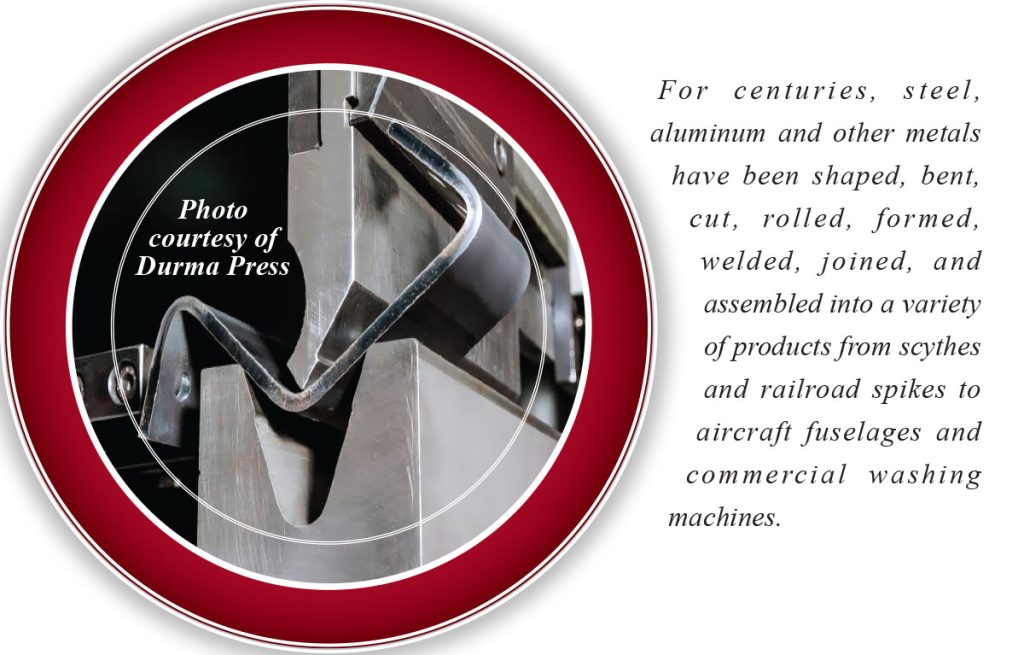
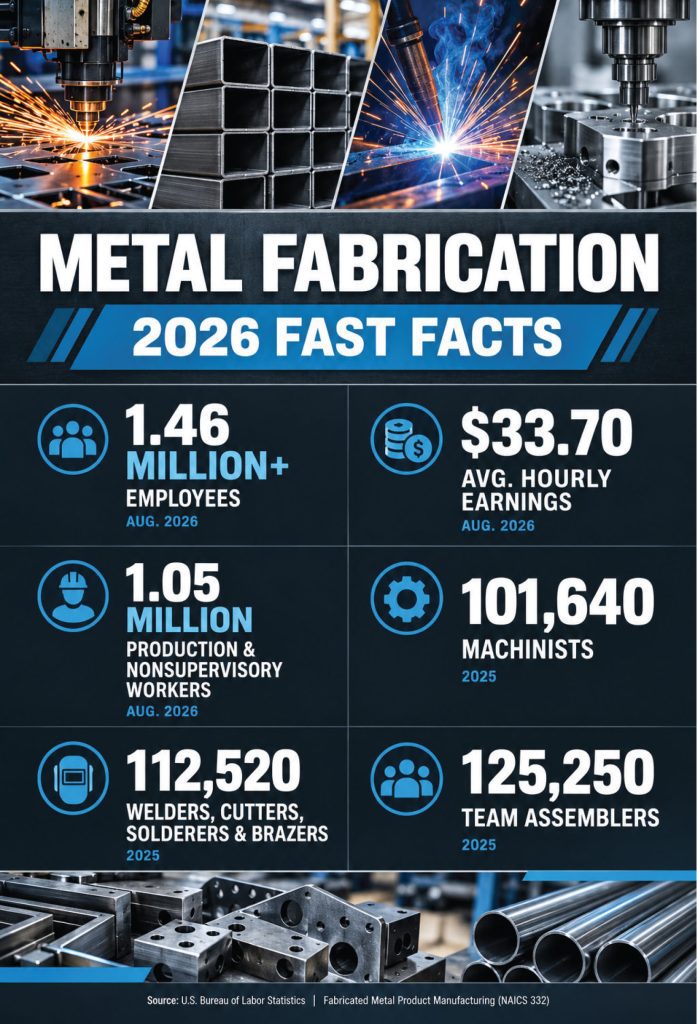
From raw material to finished product, the metal fabrication sector shapes, bends, cuts, rolls, forms, welds, joins, and assembles metal stock—primarily steel and aluminum—into a horizon-less variety of products for use in countless industries, from automotive and aerospace to construction and consumer electronics.
Overall, the industry is currently experiencing a significant growth acceleration, driven by a surge in domestic manufacturing, infrastructure investments, and data center construction.
According to India-based international industry analyst Straits Research, the U.S. metal fabrication sector is showing “remarkable resilience with a growth trajectory that significantly outpaces earlier forecasts, reflecting accelerated adoption of automation, digital integration, and strategic reshoring initiatives that are fundamentally transforming operational models across the industry.”
U.S. metal fabrication production this year could grow by 5.5 percent, the analyst says—“a dramatic acceleration compared to the 2.19 percent growth projected for 2025 and the slight contraction the industry experienced in 2024.”
The upward growth, says Straits, “reflects a divided economy where some sectors struggle while others—particularly data centers, renewable energy infrastructure, and defense—are experiencing unprecedented demand.”
Infrastructure and Data Centers Drive Demand
One of the major reasons for the projected upward growth is the major boost from the federal Build America, Buy America Act (BABA), which is channeling billions directly to domestic structural steel fabricators by mandating that federally funded bridge, highway, water system, and power grid infrastructure projects prioritize the use of materials produced in the U.S.
The Act requires that all manufacturing processes for steel and iron—from the initial melting stage through the application of coatings—are done in the U.S. This significantly shields domestic rebar, plate, and structural steel manufacturers from cheaper foreign competitors.
The ongoing AI and cloud-computing boom has caused an unprecedented spike in data center construction, which has created a massive demand for structural steel, heavy-duty HVAC systems, and custom server enclosures.
“The exponential growth of data centers, fueled by the insatiable demand for cloud computing and artificial intelligence, is creating an unprecedented need for specialized metal enclosures, server racks, and cooling systems,” according to analyst Market Prospects.
“Fabricators capable of delivering high-precision, custom solutions are finding themselves at the forefront of this digital infrastructure revolution,” it adds. “The sheer volume and complexity of these projects necessitate partners with advanced manufacturing capabilities and a deep understanding of stringent quality requirements.”
AI and Automation Transform Steel Fabrication
One example is 1872, a new automated steel fabrication plant in Cincinnati, Ohio—the brainchild of three former SpaceX engineers that was launched with $15 million in seed funding available through funds advised by The O.H.I.O. Fund, a private investment fund.
Through AI-native manufacturing, 1872 plans to automate heavy fabrication in industries that traditionally rely on manual labor by implementing a closed-loop system utilizing AI software and robots to streamline manufacturing, cutting costs and production timelines.
The new plant is expected to be fully operational in 2027.
1872 “introduces a unique AI-based factory automation solution to an industry that has struggled to innovate and has been unable to keep up with rising demand for steel products in the modular construction and infrastructure markets,” according to a statement from The O.H.I.O. Fund.
“The company’s proprietary system integrates AI software that understands the physical world with advanced automation from companies such as Ohio-based Path Robotics,” it said. “This technology automates heavy fabrication tasks that have traditionally relied on manual labor, now in critically short supply.”
The new company’s model “plans and orchestrates all downstream welding operations, managing every aspect of the manufacturing process, from purchasing materials and logistics to ingesting 3D designs, controlling robotics and other machines, and moving massive steel components across the shop floor.”
This seed funding from The O.H.I.O. Fund “allows us to begin production for customers at what we believe will be the first advanced, autonomous steel fabrication factory in the United States,” said Dan Summers, co-founder and CEO of 1872.
The new venture’s goal, he says, “is to create a new model and foundation for American manufacturing, with our software orchestrating robotics and production operations to deliver a faster, more efficient, and safer fabrication process.”

Collaborative Robotics Expand Production Capabilities
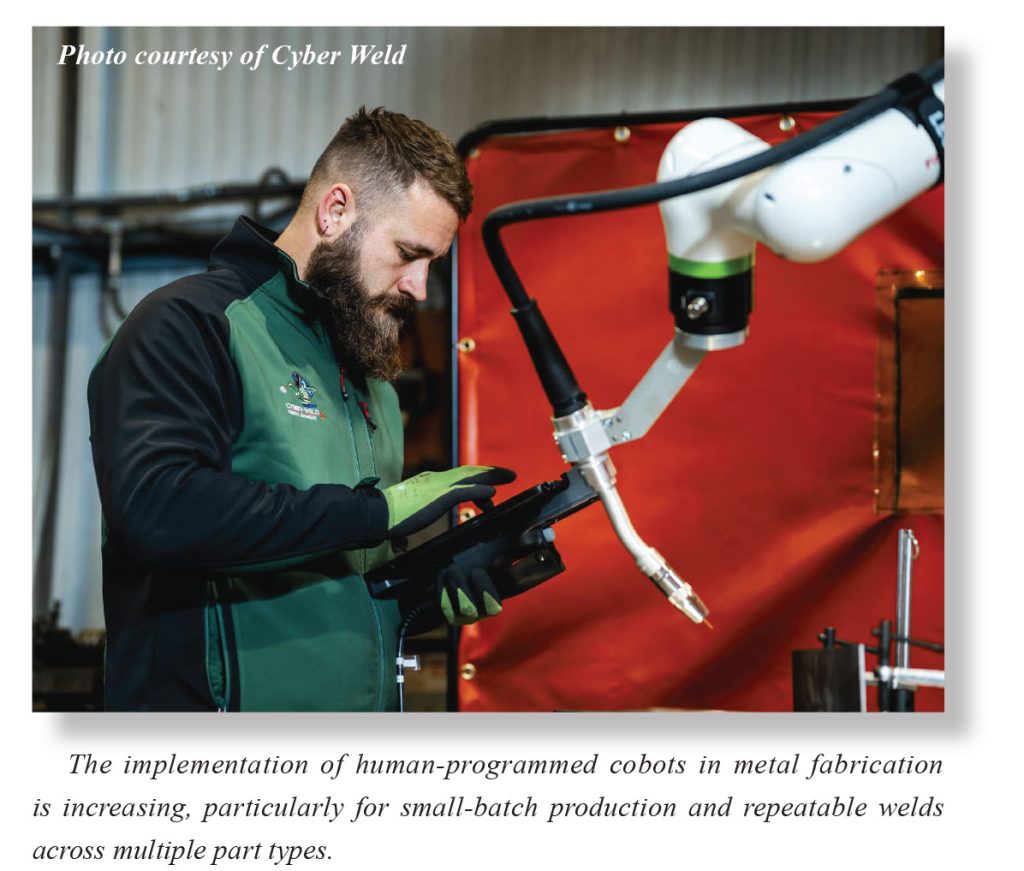
While the 1872 model is at the very cutting edge of the shift to the full automation of metal fabrication processes, a majority of companies in the industry are instead investing heavily in collaborative robotics.
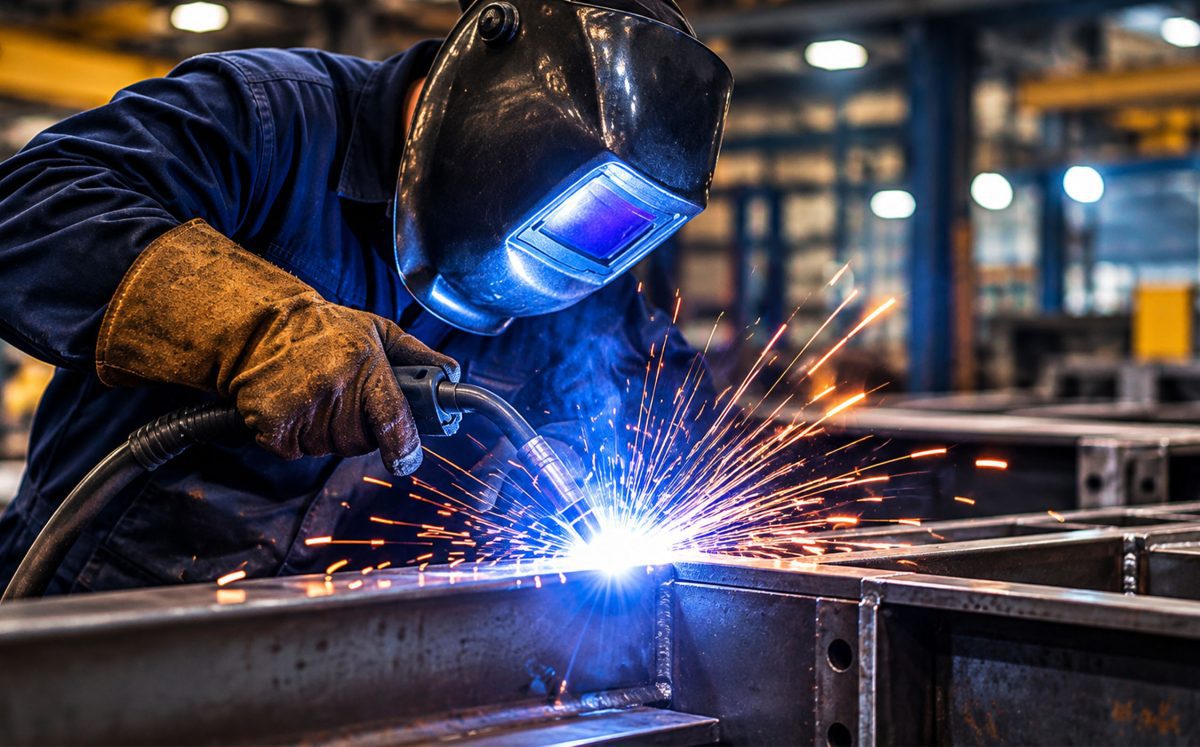
Human operators program and manage production processes while cobots handle repetitive tasks like baseline welding, a critical fabrication process that requires precision and reliability, particularly in small-batch production environments.
Hirebotics
Founded in 2016, Nashville, Tennessee-based Hirebotics is a developer of AI-powered cobot systems designed to work safely alongside humans on the factory floor.
The company’s cobots are used for metal fabrication tasks like welding and plasma cutting and can be operated, monitored, and maintained via a smartphone, tablet, or desktop app.
No CAM/CAD programming is required, as the system records and automates the process for every part after a one-time hand-guide of the weld path.
“We really aim to empower the welder, so we don’t think about our user as a robot programmer,” says Hirebotics co-founder and CEO Rob Goldiez. “We think about our user as the welder, the tradesman. That drives us a bit differently in terms of how we develop the product.”

Raymath
Two years ago, Ohio-based metal fabricator Raymath turned to cobot developer Universal Robots to automate its complex TIG and MIG welding and CNC machine tending applications.
TIG, or Gas Tungsten Arc Welding, is a precise arc welding process used to produce clean, high-quality welds on materials like aluminum, steel, and stainless steel, while Metal Inert Gas (MIG) welding is an arc welding process used to join metals like steel, stainless steel, and aluminum.
The new cobot applications significantly expanded production and helped Raymath meet customer needs, delivering ROI in less than 12 months.
“Customers want to have fewer suppliers,” said Greg LeFevre, CEO and president at Raymath, in an interview published in Robotics, the magazine of the International Federation of Robotics.
“So instead of a hundred suppliers, they would like to have ten that can do more. We wanted to satisfy those needs,” he said.
“It was very easy to automate when you make millions of a specific part. Moving into the fab-shop, sheet metal-type business, we’re now looking at a large number of different parts, but in much smaller volumes,” he explains.
Because traditional automation doesn’t lend itself to high-mix, low-volume production, Raymath needed a much more flexible approach.
The company, he said, “can now take on business the company never had the manpower and the ability to do before.”
“Now that we can meet all of our customers’ needs, they are less likely to go to a competitor who might also gain future business. It’s extremely valuable.”
Developing the Next Generation of Skilled Workers
The surge in the implementation of cobots is being fueled, in no small part, by a dwindling number of experienced welders and a shortage of tech-savvy workers entering the trade.
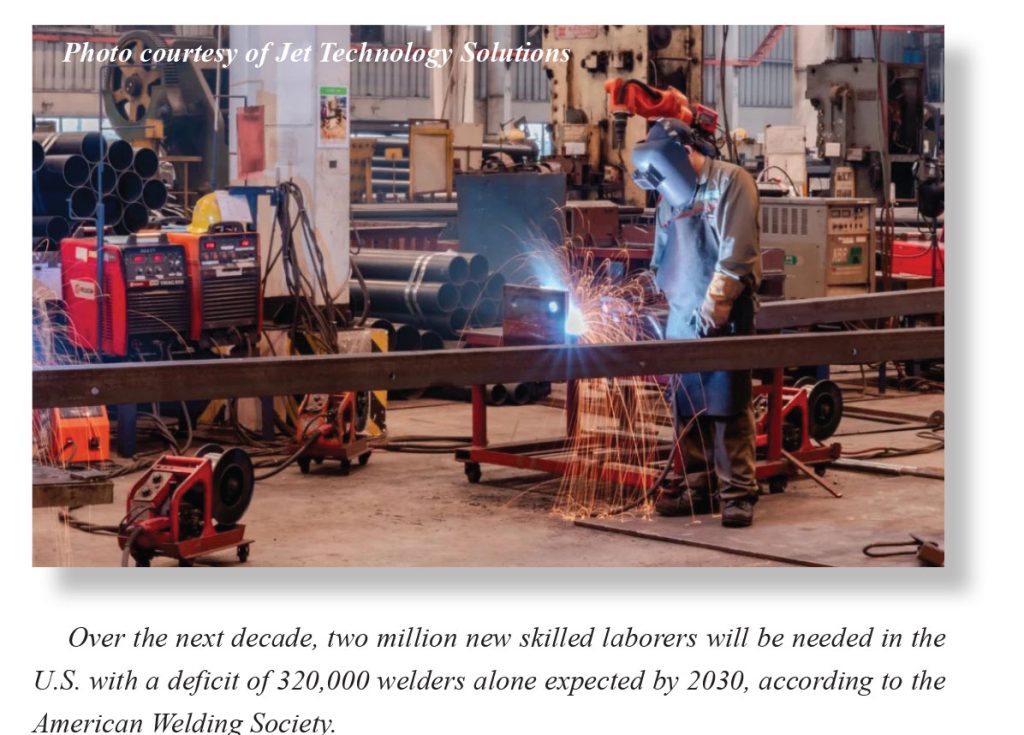
To meet surging demand over the next decade, 2 million new skilled laborers will be needed in the U.S., with a deficit of 320,000 welders alone expected by 2030, according to the American Welding Society.
Meeting the challenge are programs offered at schools across the country that aim at providing the metal fabrication sector with a new crop of skilled workers.
Southern California Training Programs
In Southern California, for example, Long Beach City College offers a comprehensive Metal Fabrication Technology program leading to an associate degree or certificate in robotics, layout, welding, and blueprint reading, while Los Angeles Trade-Technical College operates its AWS Certified Welding Test Center.
Located north of Los Angeles, the College of the Canyons in Santa Clarita has a highly regarded industrial arts curriculum that offers several classes leading to an FMA Fundamentals Metal Fabrication Certificate.
McHenry County College
McHenry County College in Crystal Lake, Illinois, operates the Foglia Center for Advanced Technology Innovation, a 45,000-square-foot space filled with classrooms and a laboratory for students to learn how to sharpen skills in a number of areas, including CNC machining, fabricating, and welding.
For the last five years, the center has conducted specialized manufacturing skills camps for interested junior high and high school students considering a future in the industrial trades.
Underwritten by grants from SparkForce, a foundation overseen by the Fabricators and Manufacturers Association, the selection of camps includes a Welding Camp that introduces students to arc welding and an Advanced Fabricating Camp, which combines metal fabricating processes with an introduction to circuitry.
Grants Pass High School
In Oregon, Grants Pass High School’s Metal Fabrication Program recently received a $10,000 Harbor Freight Tools for Schools Community Action Grant to team welding students from other area high schools in the Three Rivers School District to produce the welded hulls and trailers for a fleet of new custom boats for a local river racing club.
In addition to the boat construction project, the school’s highly regarded program has garnered attention throughout the Pacific Northwest, earning honors at several regional competitions, including Project MFG’s Welding Wars and the Rogue Community College Weld-A-Thon.
Metal Fabrication Expansions and Investments
The past year has been an eventful one for the metal fabrication industry, with a number of companies expanding their footprints and others enhancing operations at existing facilities to suit customer needs and expectations.
Some major developments in the metal fabrication industry over the past year include the following.
Baltimore Fabrication — Pennsylvania
Baltimore Fabrication has unveiled plans for a $6.2 million expansion of its manufacturing operations in York, Pennsylvania, with the acquisition of a 35,000-square-foot facility close to its existing plant.
The company fabricates and erects steel frames for buildings, including beams, columns, trusses, decking, bracing, and other structural members, as well as metal fabrications such as staircases, railings, ornamental and decorative work.
National Manufacturing Group — Indiana
In January, the Michigan-headquartered National Manufacturing Group said that it had acquired J.M. Hutton & Co. of Richmond, Indiana.
J.M. Hutton & Co. operates a 275,000-square-foot metal fabrication facility equipped with six mechanical and hydraulic stamping presses, 2D and 3D laser cutting systems, in-house fabrication, and powder coating operations for customers across the vocational truck, medical, and food service industries.
Banker Steel — New Jersey
Banker Steel, a division of the Schuff Steel Co. of Lynchburg, Virginia, has been given the green light to proceed with the reactivation of a shuttered industrial plant in Clayton, New Jersey.
The plan calls for the steel fabricator to relocate the existing operations at its facility in South Plainfield to Clayton in three phases over an undisclosed period of time.
Metal Craft Spinning and Stamping — New York
Ontario, Canada-based Metal Craft Spinning and Stamping Ltd. has unveiled plans to start up fabrication operations in the U.S. with a $1.3 million investment in renovating and equipping a 25,000-square-foot industrial facility in Niagara Falls, New York.
The company specializes in metal spinning that allows the formation of shapes and geometries to create smooth, weld-free objects that are used in many construction systems, including roofing, HVAC, and commercial lighting.
Precision Fab — Louisiana
Precision Fab, a structural steel fabrication and precision machining company, expanded its presence in Ascension Parish, Louisiana, with a move into its new 12,500-square-foot facility that doubles the company’s current workspace.
The project, the company says, is part of a broader investment that it estimates will total between $2.5 million and $2.7 million.
The five-year-old company specializes in structural steel fabrication, structural steel pipe support fabrication, and precision CNC machining.
Go Industries — Texas
In a move “to meet growing demand across multiple industrial sectors,” Richardson, Texas-headquartered Go Industries Inc. has enlarged its OEM metal fabrication and custom manufacturing portfolio.
With investments in additional equipment and processes, the company now offers CNC bending, robotic welding, laser cutting, plasma cutting, and certified welding to the highest industry standards to serve industries ranging from telecommunications and defense to medical and transportation safety equipment.
Unified Legacy Co. — Georgia
Unified Legacy Co. has said it will invest $125 million to expand its Georgia-based metal fabrication and manufacturing operations over coming years, including the construction of a new plant in Macon.
Currently, three companies—heavy plate fabricator Prince Service & Manufacturing, Unified Defense, and Tress U.S.—operate under the Unified Legacy Co. umbrella.
Trifecta Metal Works — Pennsylvania
Three Pennsylvania metal fabrication companies, all based in Lycoming County, have formed a consortium to operate under the Trifecta Metal Works brand name.
The trio—M&M Sheet Metal and Fabricators, Logue Industries, and Houseknechts Machine & Tool Company Inc.—specialize in CNC machining, metal fabrication, sheet metal work, and welding.
The new Trifecta Metal Works holds ISO 9001:2015 certification and serves clients in the aerospace, defense, industrial, and food manufacturing sectors.
Standard Technologies — North Carolina
Fremont, Ohio-based metal fabricator Standard Technologies has unveiled plans to develop an 85,000-square-foot industrial building in northern New Hanover County, North Carolina.
Standard Technologies specializes in laser sheet metal fabrication and the production of hydraulic reservoirs, fuel tanks, industrial battery enclosures, and custom metal fabrications for several sectors, including agriculture and construction, commercial and transportation, energy, and recreational vehicles.

L2 Aviation and Advance Aero — Indiana
Erlanger, Kentucky-headquartered L2 Aviation, an avionics integration, certification, and aircraft modification services firm, recently acquired Advance Aero, a precision machining and sheet metal fabrication company.
Based in Mooresville, Indiana, Advance Aero specializes in aerospace-grade machining and fabrication, supporting a wide range of complex components and assemblies.
“Advance Aero gives us the ability to bring critical manufacturing processes in-house, which improves quality, reduces lead times, and strengthens our ability to deliver fully integrated solutions to our customers,” said L2 Aviation President and COO Tony Bailey.
Axos Designs — New York
Custom millwork manufacturer Axos Designs has added metal fabrication to its service profile with the acquisition of a new 30,000-square-foot facility in Long Island City, New York.
The new plant is adjacent to the company’s existing 10,000-square-foot plant, quadrupling millwork production capacity to nearly 40,000 square feet.
The company’s clients include many of New York City’s flagship retail and hospitality venues, as well as several luxury residences designed by award-winning architectural firms.
Adrian Steel Co. — Michigan
Adrian Steel Co., a provider of automotive aftermarket equipment and cargo management products for commercial vehicles, is investing $43 million to “significantly expand its operations” in Adrian, Michigan, with the addition of 112,000 square feet to the company’s existing facility there.
The expansion, the company said, “will enhance the company’s manufacturing capabilities with additional space dedicated to raw material storage, cutting, forming, welding, painting, assembly, office functions, and shipping operations.”
OSH Cut — Ohio
OSH Cut, based in Spanish Fork, Utah, has begun operations at a second U.S. facility, located in the Cincinnati metropolitan area.
The company invested $10 million to equip the new 70,000-square-foot facility for on-demand metal fabrication and capabilities that “will especially benefit customers east of the Mississippi River, who account for 43 percent of the company’s current client base,” the company said.
OSH Cut specializes in sheet metal cutting, brake bending, metal finishing, tapping, countersinking, hardware insertion, laser tube cutting, CNC tube bending, and powder coating.
Mosdorfer — South Carolina
Austria-based Mosdorfer LLC has said it will invest $45 million in building a new facility in Westminster, South Carolina.
The facility, scheduled to be operational in late 2027, will support machining, steel fabrication, assembly, testing, and related production activities for high-voltage transmission line components and infrastructure solutions.
Dielectric Manufacturing Group — Wisconsin and Illinois
Three Midwestern companies have joined forces to form Dielectric Manufacturing Group, a single-source provider of metal parts, machining, and fabrication based in Richfield, Wisconsin.
The new firm combines the operations of Dielectric Manufacturing, Richfield, Wisconsin, which offers machining and fabricating of custom metal components and assemblies; EMS Industrial, Richmond, Illinois, a fabricator of copper, aluminum, and customized busbar systems; and Waupaca, Wisconsin-based Centerline Machine, a provider of precision machining for metal parts and assemblies.
About the Author
Michael D. White is a published author with four nonfiction books and well more than 1,700 bylined articles on international transportation and trade to his credit.