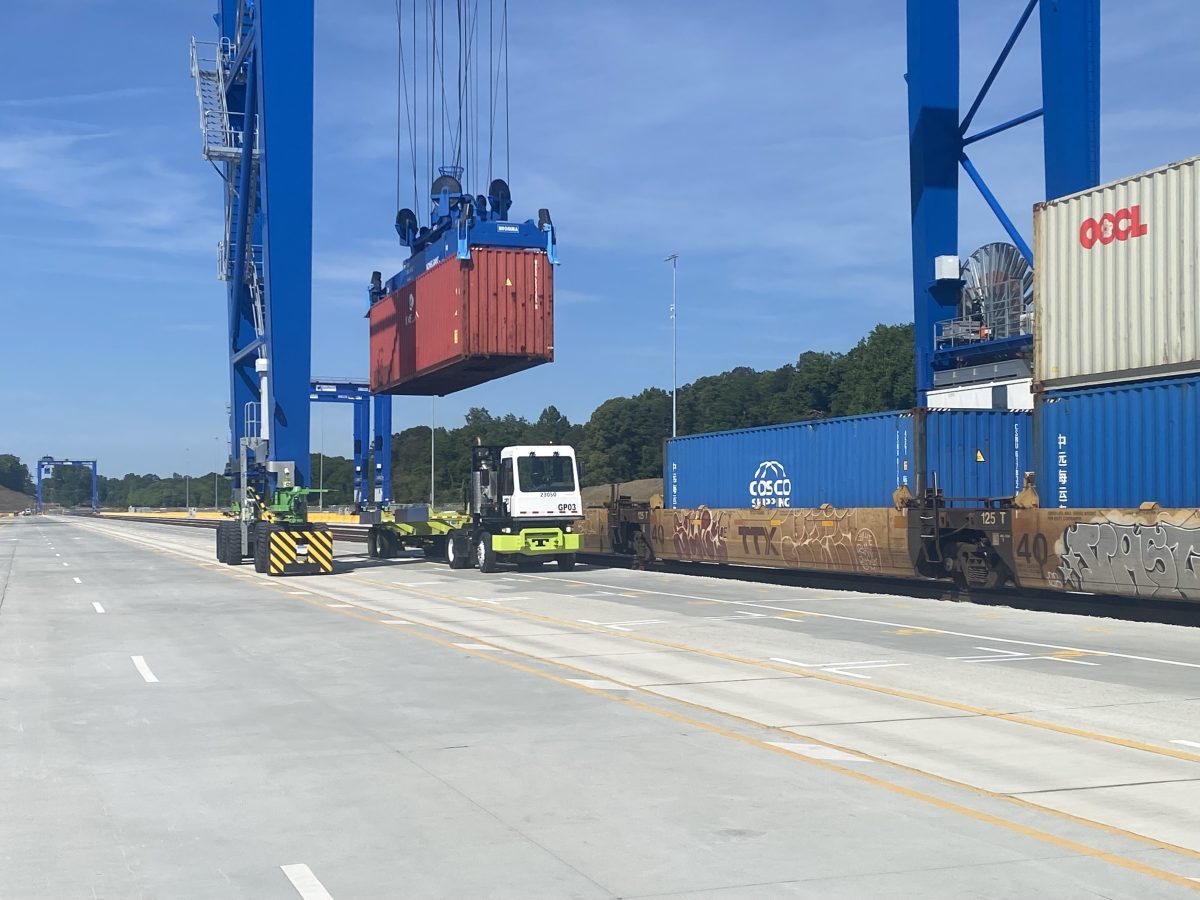

Strategically positioned across the country, inland ports and rail parks serve as critical transshipment terminals for the movement of containerized cargoes moving along the dynamic supply chain linking the nation’s ocean ports with the nation’s industry and consumer centers.
Inland ports and rail parks leverage their efficiencies to meld critical transloading, customs clearance, storage, cargo consolidation, distribution capabilities, and industrial development with ready rail/highway access that helps to ease the often-chronic congestion at deepwater ports.
The country’s Class 1 rail carriers which move an overwhelming volume of the nation’s container cargoes – the Norfolk Southern, CSX, Burlington Northern Santa Fe, and Union Pacific – are key players in the development of these so-called ‘dry ports.’
A Logistics Hybrid
The Rickenbacker Inland Port, near Columbus, Ohio, is a genuine hybrid ‘hub’ operation melding the region’s highway network with the cargo facilities at nearby Rickenbacker International Airport and the Norfolk Southern and CSX rail networks.
Both Norfolk Southern and CSX have rail hubs within the inland port, providing direct rail access to major East Coast seaports.

Nearby, I-70 passes through Columbus, providing direct highway access to a large segment of the U.S. Midwest and East.
The 175-acre Norfolk Southern Rickenbacker Intermodal Terminal can handle more than 400,000 containers annually and has the capacity to grow to 70 million square feet of industrial space.
The CSX operation at its Rickenbacker South Industrial Rail Park covers 671 acres adjacent to the rail carrier’s mainline offers quick access to major highways, and “features significant electric capacity” exceeding 100 megawatts,” according to the rail carrier.
The Jacksonville, Florida-headquartered rail carrier designated the Rickenbacker rail facility a CSX Platinum Select Site, which “identifies development-ready properties along the CSX network that meet rigorous criteria including infrastructure availability, environmental reviews, and rail serviceability.”
CSX Expands Down South
Last November, CSX and developer Scannell Properties broke ground at a 500-plus acre RailPort Logistics Mobile rail park in Mobile, Alabama.
The Park has been designated a CSX Platinum Site. That distinction, the Jacksonville, Florida-based rail carrier says, “highlights the site as development-ready and ideal for industrial expansion due to extensive pre-approvals and proximity to transportation hubs.”
According to CSX, in the initial phase of the development, it will focus on approximately 390 acres, situated less than three miles from two separate interchanges on Interstate 10 and 13 miles from the Port of Mobile.

The development’s planned nine industrial buildings, with four having direct rail service, “positions CSX to capitalize on the region’s industrial growth and increased port activity,” the rail carrier says.
The CSX also operates the Appalachian Regional Port (ARP), a 42-acre facility in northwest Georgia’s Murray County in conjunction with the Georgia Ports Authority.
The ARP has easy access to Interstate 75 and U.S. 411 with seven trains per week to and from Savannah. The facility has a capacity of 75,000 containers per year with plans to double that capacity within the next ten years.
Norfolk Southern’s Inland Port Connection
The Norfolk Southern Railway provides rail connectivity to South Carolina’s Inland Port Greer and Inland Port Dillon.
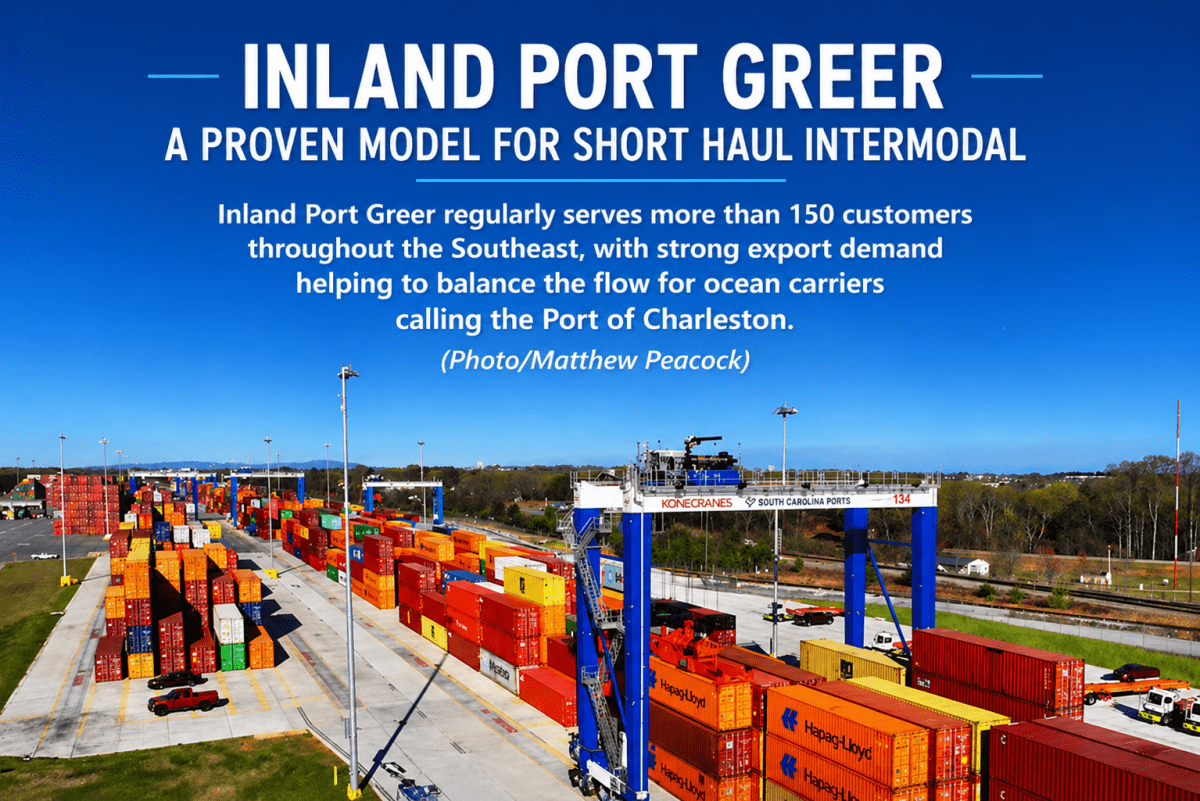
South Carolina Ports (SCP) has completed a $55 million upgrade at its Inland Port Greer facility that expands its cargo capacity by 50 percent with a new chassis lot, enhanced terminal operations, new maintenance facilities, and 9,000 feet of additional rail to handle longer double-stack trains.
The expansion gives the inland port the capacity of 300,000 rail lifts a year and meet projected customer demand through 2040, according to the SCP.
“This critical project not only supports the needs of our existing customers but also positions the region to attract more cargo and new business,” said SCP President and CEO Barbara Melvin.
Inland Port Dillon is located within a prime 3,400-acre industrial site and near I-95, serving importers and exporters in the eastern Carolinas.
Combined, South Carolina’s inland ports handled more than 22,000 rail moves in February 2025, with Inland Port Greer seeing a volume jump of 18 percent, marking its second-best month ever, and Port Dillon experiencing a slight drop in volume, but an upward trend since last December.

The volume of container cargo at both inland ports is expected to climb as the SCP is expanding rail capabilities to accommodate the container volume expected through the Navy Base Intermodal Facility, which is under construction on a 118-acre site near the port’s Leatherman Terminal.
In late 2023, Norfolk Southern Corporation said it would partner with the Georgia Ports Authority to provide rail service connecting the Port of Savannah with the GPA’s planned inland port terminal in Gainesville, Georgia.
The planned Blue Ridge Connector “will improve Northeast Georgia’s link to the global supply chain in concert with the Port of Savannah’s 35 global container ship services,” the GPA said.
Opening in 2026, the new terminal will have 18,000 feet of trackage and a capacity of 200,000 lifts annually, and serve a range of industries including consumer goods, heavy equipment, food, and forest products.

BNSF Goes BIG
The Burlington Northern Santa Fe Railway (BNSF) operates approximately 32,500 route miles of track in 28 states and three Canadian provinces.
In March, the federal Bureau of Land Management announced the approval of the noncompetitive sale of 30 acres of public lands in San Bernardino County to the Burlington Northern Santa Fe Railway for the first phase development of a $1.5 billion terminal and adjacent transload center in Barstow, California.
Barstow, in San Bernardino County, is located at the junction of Interstate 15 (north-south) with Interstate 40 and State Route 58 (east-west) and serves as the BNSF’s major hub for container cargo moving into and out of the ports of Los Angeles and Long Beach.
Plans call for the massive new Barstow International Gateway (BIG) intermodal transload facility to sit on 4,500 acres, or about 7.5 times the size of the existing 600-acre Barstow Yard.
The BNSF, which currently holds the largest market share in intermodal freight traffic among the country’s four largest rail carriers, describes the planned facility as a “state-of-the-art master-planned integrated rail facility, and the first being developed by a Class 1 railroad.”
The BIG, the rail carrier says, “will allow the direct transfer of containers from ships at the Ports of Los Angeles and Long Beach to intermodal trains for transport through the Alameda Corridor onto the BNSF main line up to Barstow.”
Once the containers reach the BIG terminal, “they will be processed at the facility using clean-energy-powered cargo-handling equipment and then staged and built into trains moving east via BNSF’s network across the nation. Westbound freight will similarly be processed at the facility to bring trains more efficiently to the ports and other California terminals.”
Last year, Ft. Worth, Texas-headquartered BNSF unveiled plans to invest $3.2 billion in developing a massive rail logistics hub near Phoenix, Arizona.
The planned facility will cover 4,321-acres in northwest Maricopa County, and “will accommodate the transportation, storage, and distribution of goods and materials throughout the Phoenix area.”
It will include a 1,770-acre intermodal terminal, an adjacent 1,420-acre logistics park that will provide sites for warehouse and distribution facilities, and a 1,131-acre logistics center featuring direct rail-served sites that will support local industry.
Work on the project is expected to begin in 2026 with a completion date sometime in 2028.
The planned Arizona terminal is the first time BNSF has combined a logistics park, which serves intermodal customers, and a logistics center, which is multi-commodity sites for carload and bulk customers.
UP Builds Momentum
The Union Pacific Railroad (UP) has invested significant energy in the development of rail parks along its rail network that spans 23 states with 32,000 miles of track.

The UP’s new Kansas City Intermodal Terminal (KCIT) is slated to start operations this summer. Located west of downtown Kansas City, Missouri, on existing Union Pacific property and will serve both domestic and international containerized shipments of grains, consumer goods, refrigerated products, and pet foods.

The UP recently unveiled the development of five new rail parks, or Focus Sites, across their network “to provide transportation solutions to business and industries.”
According to the rail carrier, Focus Sites are “large-scale, rail-served development sites suited for custom-built warehouses or industrial facilities where Union Pacific can concentrate resources, effectively manage logistics and provide targeted services for its customers.”

The five new sites are located in Shawnee, Oklahoma; Cedar City and Grantsville, Utah; and San Antonio and Texarkana, Texas. Combined, they have 15,000 available acres ready for development.
In May 2024, the UP announced the startup of operations at the Port of Nevada, a 224-acre, inland port operation and intermodal ramp in the northern Nevada community of Fearnley.
Owned and developed by the Industrial Realty Group, LLC, the facility offers direct rail service between the Port of Oakland and the greater Reno area.
The Port of Nevada, the rail carrier said, “offers a full-service rail facility” with operations that include bulk commodity and intermodal transloading and storage of multiple commodities, as well as “multiple opportunities for build-to-suits and on-site storage.”