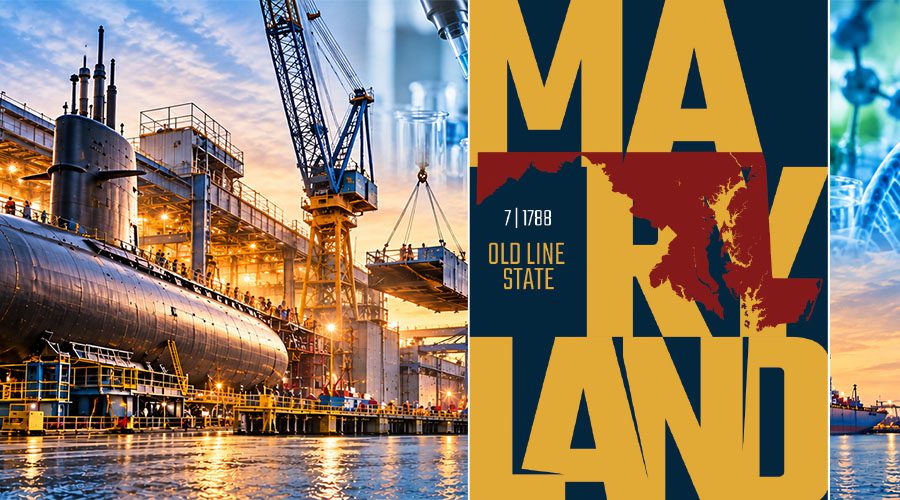
Major investments in maritime manufacturing and life sciences reinforce Maryland’s appeal for business expansion.
Maryland’s economic development story is gaining momentum where research, advanced production and global commerce intersect.
Long recognized for its concentration of federal institutions and technical talent, the state is attracting investments that translate those strengths into manufacturing capacity and commercial opportunity.
For companies evaluating expansion locations, Maryland offers a combination of specialized expertise, access to decision-makers and transportation infrastructure connecting businesses to domestic and international markets.
Recent announcements illustrate how those assets are supporting the state’s next chapter of growth.
A New Chapter for Maritime Manufacturing
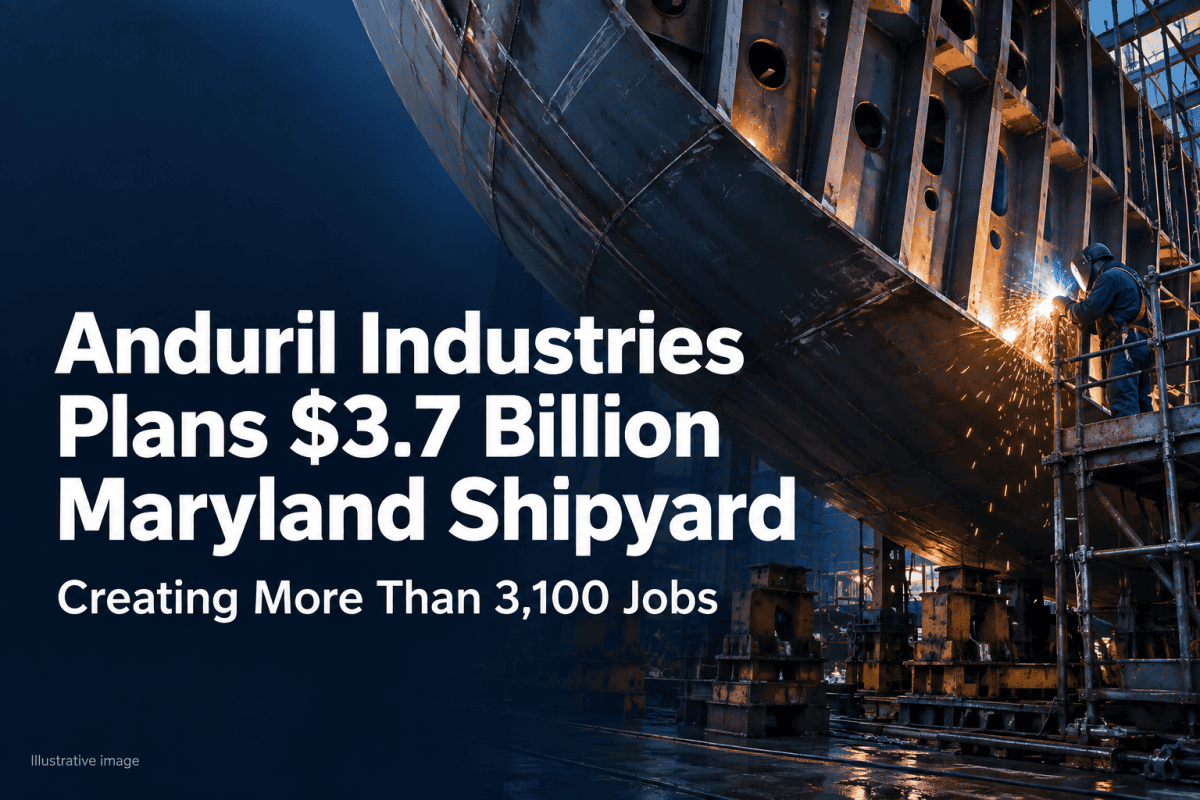
One of Maryland’s most significant developments arrived in October 2026, when Anduril Industries announced plans to invest $3.7 billion in private capital in Arsenal-2, a two-million-square-foot, software-defined shipyard at Tradepoint Atlantic in Baltimore County.
The planned facility will expand America’s submarine industrial base and create more than 3,100 permanent jobs.
State officials project that it will support more than 14,000 jobs directly and indirectly, making it Maryland’s largest single private investment and largest job-creating project in more than a decade.
The project connects Sparrows Point’s industrial heritage with a new generation of production technology. Its location brings together deep-water access, rail and interstate connections, and an established maritime workforce.
The proposed state support package also includes capital funding for a workforce training Center of Excellence at or near Tradepoint Atlantic.
For suppliers and service providers, the investment signals potential opportunities across the maritime manufacturing supply chain. It also demonstrates how an established industrial site can support a major new production mission.
Life Sciences Moves from Discovery to Production
Maryland’s life sciences sector provides another powerful growth engine.
AstraZeneca announced a $2 billion Maryland manufacturing investment in November 2025, encompassing a substantial expansion of its biologics facility in Frederick and a new clinical manufacturing facility in Gaithersburg.
The overall initiative is expected to support 2,600 jobs, including new positions, retained roles and construction employment.
The new Gaithersburg facility is expected to become fully operational in 2029. Plans call for the facilities to use artificial intelligence, automation and data analytics, illustrating the increasingly close relationship between biomedical science and advanced manufacturing.

The investment follows AstraZeneca’s opening of a $300 million cell therapy manufacturing facility in Rockville in May 2025.
These projects build on a research environment anchored by the National Institutes of Health, the Food and Drug Administration and leading academic institutions, including Johns Hopkins University.
Maryland’s appeal extends beyond laboratory discovery: its network of companies, research organizations and workforce programs supports businesses moving toward clinical development and commercial production.
For expanding life sciences firms, access to experienced talent and potential collaborators is a central part of the location decision.
Infrastructure Strengthens Market Reach
Maryland’s transportation network adds another dimension to its business proposition. The Port of Baltimore connects the state’s industrial economy to global trade, while recent rail improvements strengthen its reach into inland markets.
Completion of the $495 million Howard Street Tunnel Project enables double-stack container trains to move through the reconstructed Baltimore tunnel.
The initiative increased tunnel clearance by 18 inches and improved clearances at 21 additional locations in Maryland, Delaware and Pennsylvania. These improvements expand the options available to businesses planning intermodal supply chains.
The investment follows a record year for container handling at the port in 2025, when it handled approximately 1.1 million twenty-foot-equivalent units.
Together, port activity and rail modernization reinforce Maryland’s role as a gateway for manufacturers, distributors and other companies whose competitiveness depends on moving goods efficiently.
Cybersecurity and Workforce Capacity
Maryland’s technology economy draws strength from national security institutions and a substantial private-sector cybersecurity community.
The National Security Agency, U.S. Cyber Command and Defense Information Systems Agency contribute to a concentration of experienced professionals, including workers with security clearances.
Universities and community colleges help develop the next generation of cybersecurity, computer science and engineering talent.
For businesses, that concentration offers access to expertise relevant to government contracting, enterprise security and increasingly connected industrial operations.

Workforce development remains essential to sustaining that advantage. Cyber Maryland, now part of the Maryland Department of Labor, is intended to address cybersecurity workforce vacancies across the state.
Viewed together, Maryland’s recent investments show a state connecting its knowledge economy with physical production and trade.
For site selectors, the opportunity lies in matching project requirements with these established assets: specialized workers, research partners, industrial infrastructure and market access.
As announced facilities advance, the state’s ability to turn those connections into operating capacity will shape its next phase of economic growth.