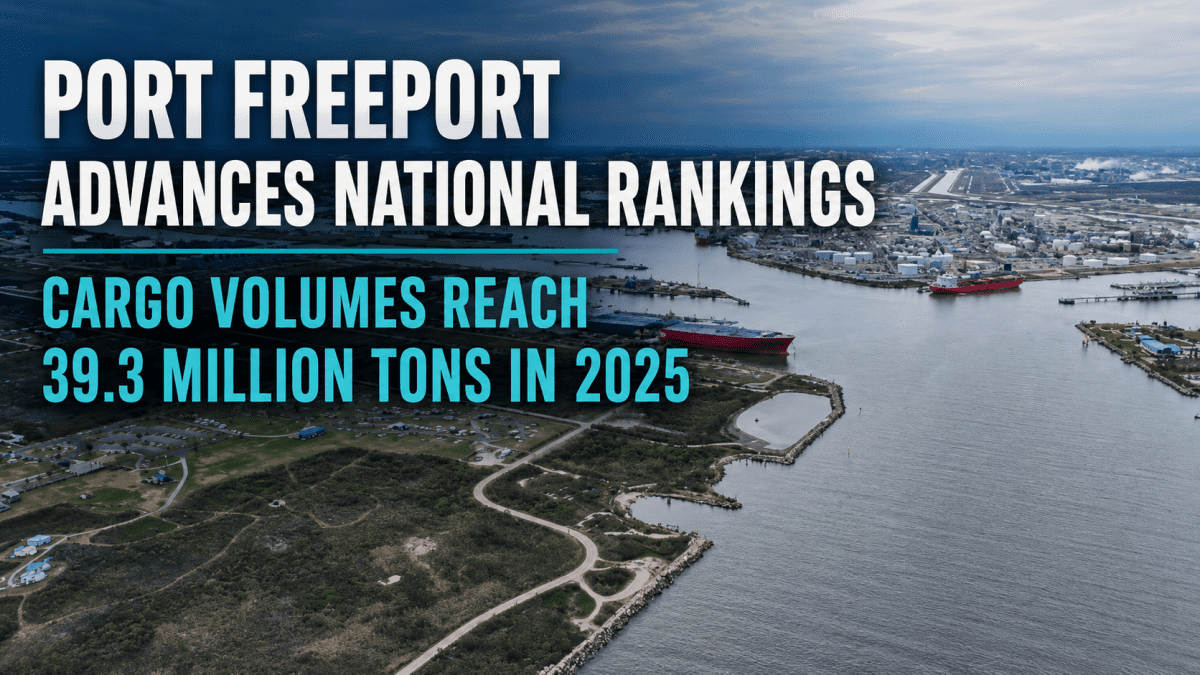
FREEPORT, Texas (May 21, 2026) — Port Freeport and its regional partners reported significant growth in cargo activity during 2025, handling 39.3 million tons of total foreign waterborne cargo, an 8.7% increase compared to the previous year, according to recently released U.S. Census Bureau Foreign Trade Statistics.
The increase in cargo activity strengthened Port Freeport’s position among the nation’s leading maritime trade hubs. The Port moved up to 13th nationally in total foreign waterborne tonnage from its previous 14th-place ranking and climbed from fifth to fourth among Texas ports. Port Freeport also improved its national standing in export activity, rising to ninth in foreign waterborne export tonnage after ranking 10th in 2024.
The latest performance highlights continued momentum across the Port’s diverse cargo sectors, including energy products, chemicals, agricultural commodities and automotive shipments, reinforcing its growing role in both domestic and international supply chains.
“These results reflect the strength of our entire port community,” said Rob Giesecke, Chairman of the Port Freeport Commission. “It is the result of collaboration among our public and private partners, terminal operators, and channel users working together to keep cargo moving through Port Freeport.”
Port officials attribute the growth to ongoing infrastructure investments and operational improvements designed to increase efficiency and expand capacity throughout the harbor, channel and terminal network.
The Port’s economic impact extends well beyond cargo movement itself. Port Freeport operations generate approximately $157.3 billion in annual economic activity nationwide, according to a Texas A&M Transportation Institute economic impact study. Those benefits support an extensive supply chain network that includes trucking operations, rail transportation, warehousing facilities and terminal services across Brazoria County and throughout Texas.
“Our continued growth reflects the investments being made across Port Freeport and the growing demand for efficient goods movement through this region and beyond,” said Phyllis Saathoff, Executive Director and CEO of Port Freeport. “This activity supports jobs, drives economic growth, and reinforces the Port’s role as a key gateway for trade and industry in Brazoria County and across Texas.”
As trade volumes continue to evolve, Port leadership says continued coordination among stakeholders and strategic infrastructure enhancements position the facility to support future growth opportunities and increased global commerce demand.
Port Freeport remains one of the nation’s leading gateways for crude oil and natural gas liquids exports and currently ranks sixth nationally for chemicals, 13th for total foreign waterborne tonnage and fourth among Texas ports by the same measure.
The Port serves a broad range of industries and companies spanning energy, automotive manufacturing, chemicals, logistics and international shipping, supporting a complex trade ecosystem that continues to strengthen the regional and national economy.