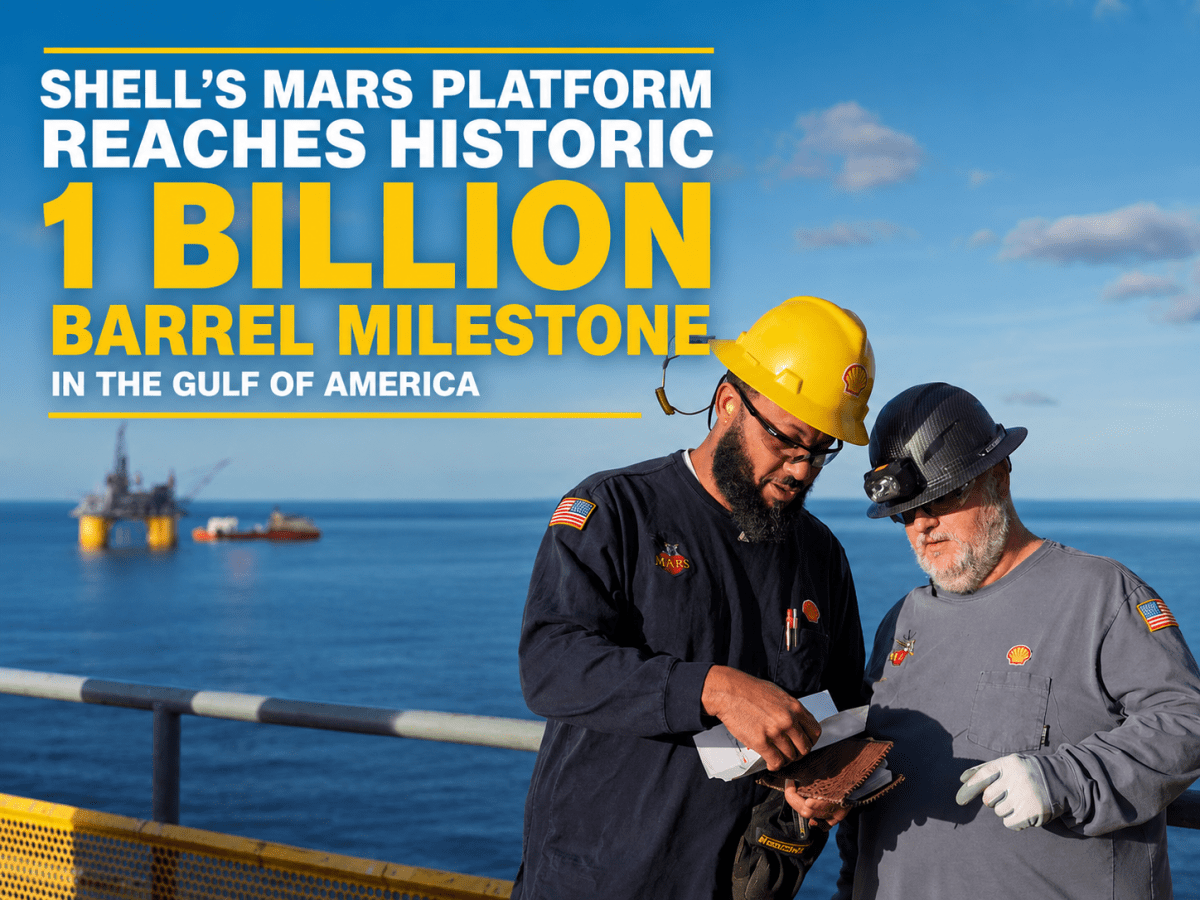
NEW ORLEANS (May 21, 2026) — Shell’s Mars platform has reached a historic production milestone, becoming the first offshore asset in the United States to produce one billion barrels of oil over its operational lifetime, reinforcing Louisiana’s long-standing role as a cornerstone of the nation’s energy economy.
Located approximately 130 miles south of New Orleans in the Gulf of America, the Mars platform first began operations three decades ago following one of the largest oil discoveries in U.S. history. The project helped usher in a new era of deep-water energy development and continues to serve as a critical component of domestic energy production.
Constructed in Louisiana, Mars represented a breakthrough in offshore engineering and established a framework that transformed the future of deep-water exploration in the Gulf. Over the years, thousands of Shell employees, contractors, engineers and Gulf Coast workers have contributed to the development and operation of the platform.
“What happens in Louisiana changes the world, and that’s certainly the case with Shell’s Mars platform,” said Governor Jeff Landry. “You can only reach a staggering billion barrels at one asset when you bring together the rich resources of our state with the determination and expertise of Louisianians.”
The Mars platform’s success ultimately laid the groundwork for additional Shell-operated developments throughout what is now known as the Mars Corridor, helping establish the Gulf region as one of the world’s leading deep-water energy hubs.
“Mars is one of the most powerful examples of what happens when innovation and determination come together,” said Colette Hirstius, President of Shell USA Inc. and Executive Vice President of Gulf of America operations. “Thirty years ago, many believed this project couldn’t be achieved. Today it remains a major contributor to domestic energy production and economic growth.”
Today, Mars remains one of Shell’s ten production hubs operating in the Gulf of America. Shell, currently the largest producing leaseholder in the basin, employs more than 6,000 people throughout Louisiana and continues expanding its long-term footprint in the state.
The company recently reaffirmed its investment in Louisiana through plans for a new deep-water headquarters within New Orleans’ River District development, further strengthening the state’s position as a center for offshore innovation and energy leadership.
“The story of Mars demonstrates why Louisiana remains a preferred location for the energy industry,” said Louisiana Economic Development Secretary Susan Bourgeois. “Investments in Louisiana create momentum for innovation while supporting broader U.S. energy security and competitiveness.”
Louisiana’s extensive infrastructure network, industrial capabilities, workforce expertise and coastal logistics systems continue to support a significant share of the nation’s offshore energy production. Industry leaders note that Gulf operations have generated hundreds of billions of dollars in federal revenues while supporting long-term economic activity throughout the region.
Shell has maintained operations in Louisiana for more than a century, with interests spanning exploration and production, refining, chemical manufacturing and pipeline infrastructure.
Looking ahead, Shell is advancing its next major Gulf development project, Sparta, which is expected to begin production in 2028.
The billion-barrel milestone represents not only a significant achievement for Shell, but also underscores the continued importance of deep-water energy investment in supporting U.S. energy security, workforce growth and industrial competitiveness.