

The U.S. health care sector is in a state of flux, with major opportunities for new facilities and more jobs in pharmaceuticals, diagnostics, and medical devices at the same time health care providers are facing a workforce shortage across many skilled and professional occupations and more financial headwinds due to planned changes in Federal reimbursements for medical care.
Larry Gigerich, Executive Managing Director of Ginovus, a site selection consulting firm in the Indianapolis area, observes, “There is significant momentum in the pharmaceutical and medical device sector due to several factors, new product launches, faster research cycles enabled by information technology and AI, and the need to serve an older, more active population. Tariffs on imports are also having an impact.” The United States, with its immense market size, continues to attract international companies. According to Gigerich, “European health care firms are looking at the U.S. to mitigate the effects of tariffs and to access a larger market.”
One notable example is Switzerland-based Roche Pharmaceuticals, which has pledged to invest $10 billion in the United States across the next five to seven years. This commitment has already yielded tangible results, including a $700-million pharmaceutical plant in Raleigh, North Carolina, and a $550-million diagnostics manufacturing hub in Indianapolis. American companies, too, are expanding aggressively. Lilly, headquartered in Indianapolis, recently announced plans for four new pharmaceutical plants, including a $6.5-billion pharmaceutical ingredient facility in Houston announced in September. “Larger firms are also pursuing acquisitions to acquire capabilities or capacity more quickly than they could build them internally,” Gigerich explains. “Lilly’s $1.4-billion acquisition of a nuclear medicine firm is a prime example of this strategy.”

Among the trends impacting the expansion of the markets for pharmaceuticals, and medical devices and diagnostics, including portable and wearable devices, is the growing size of the older population. “This population seeks to maintain an active lifestyle, embracing activities like walking, hiking, and sports. This creates demand for pharmaceuticals and orthopedic products, as well as wearable or portable devices that enable individuals to maintain, monitor and manage their own health,” notes Gigerich.
When health care product manufacturers consider expanding or building new facilities, talent availability is critical, alongside access to real estate, a favorable tax climate, regulatory considerations, and financial incentives. Gigerich highlights, “Talent is by far the most important factor. Companies need highly skilled workers for both research and manufacturing. While cost matters, the quality and quantity of available talent are the key drivers.” Unlike many industries that repurpose existing facilities, the health care sector overwhelmingly prefers greenfield construction. Gigerich says about 90 percent of health care projects choose new construction because it’s easier to meet FDA and other regulatory standards, along with their specific manufacturing processes.
This evolving landscape is not confined to metropolitan areas. While deep talent pools make urban centers attractive, rural communities also present opportunities, especially when it comes to production operation says Gigerich. Good transportation and suitable sites are essential but so is understanding the company’s workforce needs. “If communities can show the match between local skills and company needs rural areas can be very competitive,” Gigerich says, giving the example of a community that had a manufacturing workforce skilled in metal fabrication and welding that made it attractive to a medical device producer.
While research, development and production of healthcare products shows a positive trend, health care providers are facing headwinds across several areas, including the financial impact from the recently passed budget bill that will make dramatic changes to Medicaid funding and Affordable Care Act subsidies. For example, current legislation will cut an estimated $700 million from Medicaid, impacting around 11 percent of the current beneficiaries, or 7.7 million people, according to the Congressional Budget Office. The cuts would eliminate coverage for nearly two million people in rural areas by 2034, where nearly half of hospitals already operate at a loss, according to the American Hospital Association.
That potential loss of funding is a big concern to Jennifer Riley, CEO of Memorial Regional Health (MRH) in Craig, Colorado. Riley points out it is not just about health care but the economic well-being of the entire community. MRH is the largest employer in Moffat County, providing nearly 400 jobs and contributing more than $63 million annually to the local economy. “Every job we have supports two other jobs in our community. This keeps me up at night; we are not just responsible for health care but for jobs,” says Riley.

MRH, like many rural hospitals, has evolved its service portfolio far beyond traditional hospital-based care. Riley explains, “We have primary and specialty care practices, ancillary services like physical, occupational, and speech therapies as well as community initiatives that address food and housing insecurity.” However, maintaining these services in the face of reimbursement pressures is a constant struggle. Most of MRH’s revenue comes from Medicare and Medicaid, which serve older and lower-income populations but often do not cover the full cost of providing care. As Riley puts it, “Reimbursement is our biggest challenge.” In response, MRH has made difficult decisions, such as discontinuing its obstetrics program due to low volume and poor reimbursement, requiring residents to travel an hour for maternity care.
To help with reimbursements, Riley said her hospital is getting more aggressive on making changes to their operations. For example, MRH worked to get its clinics designated as Rural Health Clinics by the Centers for Medicare & Medicaid Services. To do so, the clinics have to increase using mid-level providers, such as nurse practitioners and physician assistants to address physicians shortages. By doing so, MRH gets a higher reimbursement level from Medicare and Medicaid.
Another major issue for rural hospitals in particular is workforce. MRH and all of its ancillary operations run the gamut from entry-level to highly-skilled jobs, many of them hard to fill. “Doctors, nurses, radiology and some med-tech skills are challenging. It’s a narrow pipeline with limited availability and hard to recruit to rural areas,” notes Riley.
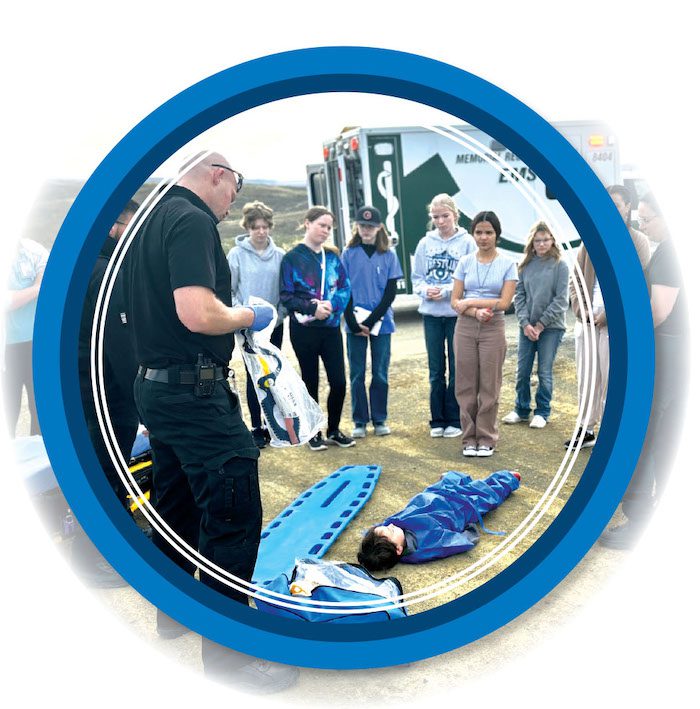
The answer for MRH has been a concerted effort to grow its own workforce. After the community college dropped training for Emergency Medical Technicians at both of its northwest Colorado campuses, MRH conducted a feasibility study on using its own emergency medical services staff and others to develop its own training program. That study indicated that if MRH could develop such a program, in a hybrid format that allowed online and hands-on learning, there would be other services in the broad region that would also use that training helping to offset costs. “Frankly, emergency medical services are a cost to us, but we cover more than 4,700 square miles so providing excellent emergency care to bring people to us, as well as quality care in transporting patients to larger hospitals is a critical need, one we believe is crucial to our mission,” says Riley.
On the flip side, the community college is looking at developing a radiology program at its campus near MRH. In this situation, MRH is partnering with the college to let it use its radiology equipment outside of regular hours, to help the college cut the costs of standing the program up and keeping it affordable to students. MRH is also developing a unique program reaching out to public school districts to encourage students to consider a health care career. “We are working with the district to let students know the opportunities, and skills needed to get them, in the thirty-five areas in our operations. Even starting at entry level, there are pathways for new employees to advance in our organization. We bring groups of students in on a regular basis to see the opportunities for themselves,” says Riley.
The challenge of filling the health care workforce is not unique to MRH. It is the heart of the mission of Kansas City University (KCU), a two-campus health sciences university based in Kansas City, Missouri. “No matter who and where you are, you know getting access to a primary care doctor or specialist is a challenge. Our pipeline has not kept up with the demand,” says Marc B. Hahn, DO, President and CEO of KCU. Hahn points out that the shortage of physicians is anticipated to be more than 130,000 by 2030, half of that in primary care.
Hahn notes that KCU has a focus on meeting the needs of rural areas, especially with primary care physicians. But he is concerned about the capacity for communities to maintain rural health care. “There are a lot of challenges to the health care infrastructure that supports communities. There is a concern about cuts to these hospitals and the health care infrastructure that are essential to these communities and their economic base. Keeping the hospitals is also important to keeping the agriculture and manufacturing base in so many of these areas,” says Hahn.
Despite KCU’s growth in the urban core of Kansas City, Hahn noted that many of its students come from rural areas and return there after they finish residencies. That started a conversation within KCU about having a campus more oriented to encouraging rural practitioners. That conversation coincided with a concerted effort in Joplin, MO to bring a medical school to the community, especially after its 2011 EF-5 tornado. Says Hahn, “The relationship we formed with the Joplin community gave us the opportunity to establish a campus meeting rural needs and the partnerships with two hospitals, community colleges and Joplin’s university to create a workforce pipeline to help address the needs of rural communities in the four-state area surrounding Joplin.”
Since opening in 2017, the Joplin campus has grown to more than 600 medical students. That success led KCU to look at addressing rural dental needs when the university found that all of the counties within a 100 radius of Joplin had dental shortages. The dental college opened in 2023, with a goal of having more than 300 students when enrollment reaches all four classes.
While enhancing medical education and medical care for the Joplin metro area and large surrounding rural area, establishing KCU in Joplin was also an economic development success for the community. The Joplin Regional Medical School Alliance, which had membership from the business community, two competing local hospitals, and the university, was formed to guide the effort and, with KCU’s commitment, pursue area funding to help the project be successful. “We are a case study on how competing health care systems, the university, community college and others can partner with a health sciences university to establish a school in a more rural area in a way that benefits the region,” says Hahn. Along with an estimated economic impact of more than $150-million annually, Hahn says the presence of a major medical and dental university helps the overall economic development effort by bringing in large numbers of professional students, creating small businesses that cater to their needs and, in turn, adding community amenities that help other companies attract younger professionals.
The large-scale trends in pharmaceuticals, medical devices, and diagnostics, along with the potential impact of AI and increasing connectivity can be a big plus for rural hospitals to survive and perhaps thrive notes Riley. But that opportunity can only come when the hospital and community leadership work together. Says Riley, “A strong hospital improves the standard of living in the community, helping us keep existing businesses and attract new ones. Leaders in hospitals and in the community need to understand the economic impact as well as the health care impact. We need to find ways to discuss stability and funding. When the hospital closes and it is now an hour or more to any care, then it’s too late.”