The Outdoor Economy Is Bigger Than You Think
Outdoor recreation is an essential thread in the economic fabric of the United States. In many regions, it serves as a pillar of local economic vitality, supporting jobs, businesses, and the community’s broader character.
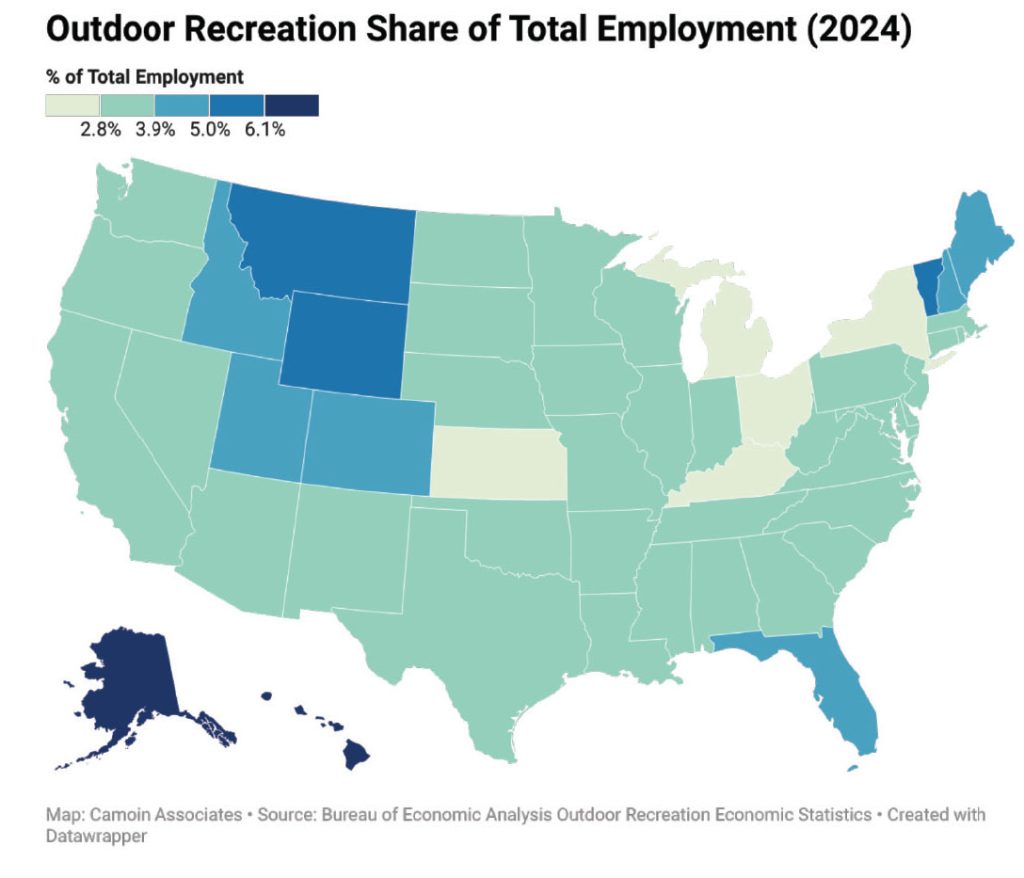
Recent data published by the U.S. Bureau of Economic Analysis (BEA) demonstrates just how critical the Outdoor Recreation sector is to economies nationwide. In 2024, the sector accounted for $697 billion of the gross domestic product (GDP), 2.4% of the nation’s total. It supports more than 5.2 million jobs and $324 billion in labor compensation.
Outdoor recreation is present in all 50 states and the District of Columbia. In Hawaii, the sector is an economic powerhouse that supports 7.2% of all jobs throughout the state. Alaska, Northern New England, Florida, and Western states like Montana, Wyoming, and Colorado are other major hotspots, where outdoor recreation accounts for about 5% or more of all jobs.
The U.S. Bureau of Economic Analysis’ Outdoor Recreation account includes conventional activities—biking, boating, skiing, hiking, etc.—and other non-conventional outdoor activities—amusement parks, golf, field sports, festivals, etc.—as well as supporting industries such as construction and tourism-related businesses that cater to outdoor recreation visitors.
The Outdoor Recreation sector fuels an ecosystem of economic activity, leveraging key natural resources as powerful assets in several ways.

Driving Tourism
According to the BEA, travel related to outdoor recreation drove $565 million of gross output in 2024 as people spent money on food and beverages, lodging, shopping, and transportation associated with their outdoor recreation participation.
Nearly 80% of this was driven by those who traveled more than 50 miles to be outdoors.
Supporting Associated Retail Establishments
In 2024, apparel and accessories used in outdoor recreation activities generated $125 million of gross output throughout the nation.
This includes equipment like bikes, boats, skis, and more, along with any apparel individuals need to engage in those activities.
Boosting Value-Added Industries
Outdoor recreation also supports value-added industries, such as manufacturing, technical services, and construction.
Every ski resort relies on skilled mechanics and technicians for its lifts. Major waterways create markets for boat builders. Building parks, extending trail networks, and establishing gateway visitor centers isn’t possible without local construction capacity.
Outdoor recreation not only drives a region’s service-based economy but also creates opportunities for value-added industries that make outdoor recreation possible.
These activities create opportunities for regions to capitalize on their outdoor recreation assets and maximize their economic impact. The next section details several illustrative examples of how communities across the nation have created successful outdoor recreation economies.

From Trails to Tourism: Outdoor Recreation in Action
At the local level, investments in the Outdoor Recreation sector can have a major return on investment. Trails, ski areas, nature-based attractions, and other recreation assets bring people into communities, generate spending at nearby businesses, and can create benefits that extend well beyond tourism.
Examples from Maine, Vermont, New York, and Montana show several ways in which outdoor recreation translates into economic activity.
Portland Trails: More Than Miles of Trail
In Portland, Maine, nearly 100 miles of trails provide residents and visitors with opportunities to walk, run, bike, and experience the outdoors.
According to an impact study completed by Camoin Associates in 2025, the Portland Trails network is visited approximately 1.3 million times each year, making it a heavily used regional asset.
In the Greater Portland area, the trail network supports approximately 2,935 jobs, $132.6 million in earnings, and $355.1 million in local sales. Statewide, its contribution expands to approximately 5,640 jobs, $258.9 million in earnings, and $685.8 million in sales.
The trail network’s value extends beyond jobs and business activity. It is associated with an estimated $290 million in enhanced property values and more than $4 million in annual property tax revenue for the City of Portland.
It also generates approximately $1.2 million in annual healthcare savings, along with an estimated $2 million to $5 million in environmental ecosystem benefits.
Meanwhile, trail commuters are estimated to replace more than 300,000 car trips and 1.3 million vehicle miles annually, reducing congestion, emissions, and transportation costs.
Vermont Trails and Greenways: Turning Trail Use Into Local Spending
The Vermont Trails and Greenways Council represents organizations focused on trail preservation, promotion, and development, including the Catamount Trail Association, Kingdom Trails Association, Vermont All-Terrain Sportsman’s Association, and Green Mountain Club.
According to an impact study completed by Camoin Associates in 2018, these trail systems attract approximately 410,000 annual trail users and generate an estimated $30.8 million in total annual economic activity.
Trail-related activity supports approximately 365 jobs, $9 million in earnings, and $22.4 million in sales each year, while also generating approximately $2 million in annual tax revenues.
Much of that impact comes from spending that occurs beyond the trail itself. Visitors purchase overnight lodging ($3.4 million), food and drink ($5.6 million), transportation ($2 million), equipment ($1.8 million), and other goods and services during their trips, thereby supporting businesses in communities throughout Vermont.
Vermont demonstrates how multiple outdoor recreation assets can collectively create a larger recreation economy. Rather than relying on a single destination, a statewide network of trails brings users into different communities and creates opportunities for visitor spending across a range of local businesses.
The Wild Center: Bringing New Visitors and New Spending to the North Country
In Tupper Lake, New York, The Wild Center demonstrates the role that a strong nature-based attraction can play within a regional visitor economy.
According to an impact study completed by Camoin Associates in 2024, The Wild Center has averaged approximately 104,052 visitors annually since 2013.
Importantly, from an economic development perspective, 68% of its visitors come from outside the region, meaning visitation brings new people and new spending into the North Country. Each party of visitors spends an average of about $400 per day.
Those figures help show how the economic value of a destination extends beyond activity occurring directly on site.
Visitors coming to experience The Wild Center also create opportunities for spending on lodging, restaurants, retail, and other businesses throughout the region—for example, staying in Tupper Lake for the weekend and renting a boat on the lake the following day.
The more visitors an attraction draws from outside the area, and the longer those visitors remain in the region, the greater the opportunity for those dollars to circulate throughout the local economy.
Whitefish Trail: One Trail, a Much Larger Outdoor Recreation Economy
According to an impact study completed by Headwaters Economics in 2018, in Whitefish, Montana, the 42-mile Whitefish Trail generates nearly 73,000 trail uses annually, with approximately 22,000 uses (30%) coming from non-local visitors.
Those visitors generate approximately $3.6 million in spending, supporting 68 jobs in Whitefish. When spending by local residents on outdoor gear purchases and rentals is included, the trail contributes approximately $6.4 million annually to the local economy.
But the trail exists within a much larger outdoor recreation economy.
Headwaters Economics found that people visiting Whitefish primarily for outdoor recreation generate approximately $101 million in annual spending, support 1,460 jobs, and generate $41.1 million in labor income.
These visitors also spend more each day, approximately $278 compared with $222 for other visitors, and stay longer, averaging 5.8 days compared with 4.2 days.
The trail itself generates measurable visitor spending and employment, while also functioning as part of a much larger recreation-based economy that attracts visitors and supports local businesses.
Turning Outdoor Assets Into Local Economic Activity
Outdoor recreation can generate significant economic activity, but the level of impact depends on how well recreation assets connect to the surrounding community and economy.
Economic developers can help strengthen those connections by identifying where visitors are coming from, where they are spending money, and where there may be opportunities to capture more local economic activity. Here’s how.
Know Your Visitors
Use visitor, mobility, lodging, trail-counter, or tourism data to understand who is coming, where they are coming from, how long they stay, and what they do while they are there.
Map the Businesses Connected to Recreation
Identify the restaurants, lodging properties, retailers, outfitters, manufacturers, and other businesses that currently benefit or could benefit from recreation activity.
Ask Businesses Where the Gaps Are
Talk with recreation-serving businesses about what visitors are asking for, where demand is growing, and what products, services, infrastructure, or workforce constraints may be limiting growth.
Create Stronger Connections Between Assets and Businesses
Develop itineraries, wayfinding, cross-promotion, events, or partnerships that make it easier for visitors to move from trails, parks, waterfronts, and attractions into nearby business districts.
Look for Ways to Extend the Season or the Stay
Identify events, complementary activities, or visitor experiences that could encourage people to come during slower periods, stay another night, or spend more time in the community.
Target Business Support and Investment
Use what you learn to direct technical assistance, financing, infrastructure, entrepreneurship support, or business retention and attraction efforts toward the most significant gaps and opportunities.
Track Whether It Is Working
Measure changes in visitation, overnight stays, visitor spending, business activity, and other community benefits to understand what is generating results and where additional investment may make sense.
About the Authors
Angela Hallowell
Angela is passionate about leveraging data and research to craft compelling narratives that drive economic development.
As a Senior Analyst at Camoin Associates, she designs custom research plans, analyzes economic data from a wide range of sources, and delivers critical insights to support data-driven policy decisions.
Her work spans diverse topics across the country, including economic and fiscal impact studies, real estate market analyses, workforce gap assessments, housing needs studies, and targeted industry strategies.
She is enthusiastic about applying her analytical skills to a diverse range of clients and projects that help make stronger communities.
Tori Conroy
Tori is passionate about finding solutions to complex problems by being creative, collaborative, and engaging diverse stakeholders.
She has a background in public administration, economic development, and marketing. Prior to working for Camoin Associates, Tori managed and worked with three different economic development authorities and enjoys strategic and organizational planning.
She has experience managing publicly owned industrial properties, building community partnerships to support workforce development, and developing and executing business retention and expansion (BRE) programs.
Using her data and analytical skills, Tori has also led and implemented business marketing and attraction efforts nationally and abroad.