When companies evaluate new locations, clarity and speed matter as much as cost and capacity. Michigan recognizes that reality and has built a practical, coordinated approach to site selection that turns promising leads into shovel-ready projects. The Michigan Economic Development Corporation’s (MEDC) MI Sites Program, together with the MEDC’s broader site selection and redevelopment services, removes friction from the process, reducing risk, accelerating timelines, and helping communities convert potential into measurable economic outcomes.
Investment-Ready Sites That Cut Time to Decision
The MI Sites Program is a custom-designed site readiness program to identify the state’s top prospects for industrial development. MI Sites drives readiness of the best-of-the-best properties by identifying site needs and providing a clear roadmap for improvements, all through the lens of what cutting-edge companies are looking for. The program begins by identifying high-potential sites across Michigan and evaluating them with comprehensive details on infrastructure, environmental conditions, and permitting. From there, it addresses barriers to development, provides guidance to site owners, and equips communities with tools to attract and manage future investment opportunities. Each MI Sites listing includes verified data on utilities, transportation access, zoning, and potential constraints, enabling site selectors and corporate real estate teams to move quickly from initial interest to deeper due diligence. That pre-work eliminates weeks-long information hunts and replaces uncertainty with a clear baseline, which shortens response times and strengthens competitive proposals.
Another critical aspect of the MI Sites Program is the early engagement of various state-level stakeholders in the process. For each property in the program, the MEDC has discussed the specifics of the site with the Michigan Department of Transportation, the State Historic Preservation Office, and the Department of Environment, Great Lakes, and Energy, making them aware of the potential for industrial development at the site, but also to get feedback and ensure an alignment of priorities.
The program’s standardized approach also helps communities present a unified, credible case to prospective investors. By meeting established screening criteria, MI Sites delivers a consistent, trusted menu of options for industries ranging from advanced manufacturing, mobility, and semiconductors to clean energy, life sciences, and food processing.
Strategic Site Readiness That Funds Progress
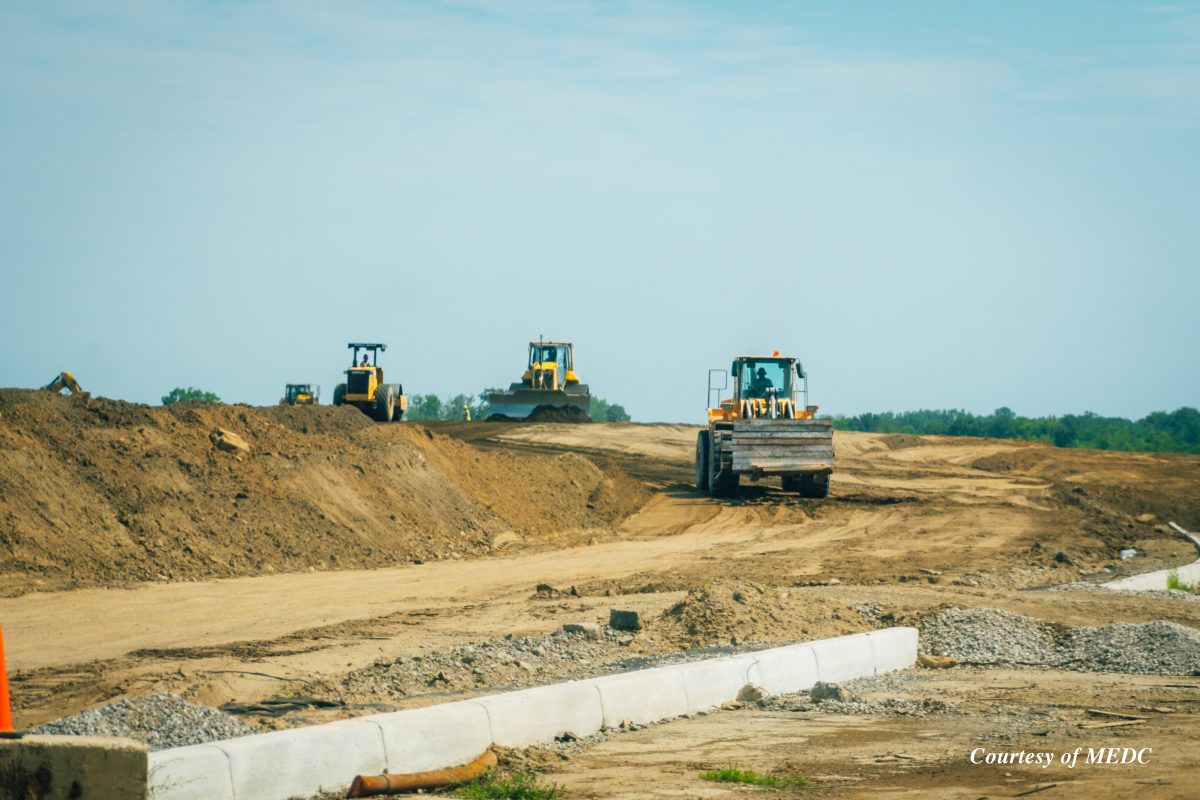
Where MI Sites provides certainty about what exists today, targeted site-readiness investments look ahead, funding and guiding the steps needed to turn candidate properties into truly project-ready sites. Grants and technical assistance focus on de-risking a site through targeted investments in the development process steps that most often stall projects, like: infrastructure investments, environmental remediation, land acquisition, roadway and utility extensions, architectural, engineering, and surveying work, stormwater management, site grading, and brownfield cleanup.
Michigan’s targeted funding reduces the upfront capital burden on local governments and developers, enabling them to move rapidly when a project materializes. This gives communities the tools and guidance to prepare and attract investments. The result is a shortened timeline from bid to construction, improved competitiveness for grants and tax incentives, and fewer surprises for employers planning facility scale-up.
Coordinated State Resources That Remove Barriers
Michigan’s site selection playbook goes far beyond property listings and one-off grants. Instead of navigating multiple, disconnected channels, companies connect with a single, responsive partner as the agency coordinates efforts across state departments, utilities, permitting bodies, and workforce partners. And for hands-on support with complex projects, the MEDC’s redevelopment services offer environmental assessments, funding strategies, public-private partnership design, and a clear path to turning community objectives into investment-ready assets.
On the workforce side, Michigan connects its training capabilities to employer needs, aligning community colleges, trade programs, and employer-led upskilling so projects come online with a local talent pipeline. That integrated model reduces ramp-up risk for employers and strengthens local hiring outcomes.
Measurable Advantages for Companies and Communities
For companies, Michigan’s site readiness ecosystem delivers three core advantages: speed, certainty, and cost predictability. Speed comes from vetted site data and coordinated state support, which accelerates permitting and infrastructure delivery. Certainty comes from standardized site qualifications and improvements that reduce the likelihood of belated surprises. Cost predictability comes from earlier clarity on necessary investments and access to state funding pathways that lower the burden on private capital.
For communities funded through MI Sites, the benefits are equally tangible: higher success rates in winning competitive projects, better-aligned infrastructure investments, and the capacity to market shovel-ready sites to a global audience. MI Sites is a community-first effort that empowers local leaders while requiring explicit community support and alignment so investments land with broad local buy-in. Sites that enter the MI Sites pathway to improved readiness often attract larger, higher-impact projects because developers value the reduced timeline and risk.
Practical Pathway from Interest to Investment
The typical journey for a company working with the MEDC begins with a project overview and site criteria. The MEDC’s team rapidly matches requirements against MI Sites inventory and local assets, presenting a short list of vetted options. If site deficiencies exist, the MEDC helps determine whether state or other funding mechanisms can resolve constraints. The MEDC then mobilizes permitting partners, utility providers, workforce partners, and local officials to align timelines and commitments. That single coordinated engagement replaces disjointed conversations and delivers a transparent project plan that corporate decision-makers can act on confidently.
That pathway also builds consistency and trust as communities attract investments that fuel shared prosperity. Projects that align with their long-term vision expand economic opportunities for residents, while giving companies confidence that Michigan’s process works reliably across regions. To strengthen that experience, MI Sites also trains communities in the site selection process through RFI boot camps, mock site selection visits, and other hands-on learning opportunities, ensuring companies receive the best experience possible and leave confident that a community can deliver on a proposed project.
Real-World Impact and Strategic Appeal
Michigan’s unified approach is well-suited to the diverse industries driving the state’s economic prosperity. Advanced manufacturing projects benefit from strong logistics, utility capacity, and skilled trades. Life sciences and biomanufacturing projects require controlled utilities, environmental compliance, and fast access to workforce training. Distribution and e-commerce operations prize highway access and scalable land. MI Sites and site readiness initiatives respond to each of these needs with tailored data, technical assistance, and funding mechanisms that de-risk initial commitments.
Recent site developments showcase how this strategy plays out on the ground. The Advanced Manufacturing District (AMD) of Genesee County exemplifies the power of aligned state and community support. Backed by significant planning, site readiness funding from the MEDC, and a letter of support signed by over 30 community partners, the site offers speed-to-market advantages for large-scale investment opportunities. This approach has created the best 1,300+ acre site in the United States for companies. Similarly, the LAC Site and the Delhi College Road Site — both receiving site readiness support from the MEDC — highlight how targeted resources are preparing land to meet the diverse requirements of manufacturers, distributors, and R&D-driven companies. Together, these sites demonstrate Michigan’s proactive model of turning potential into project-ready locations.

The state’s broader strengths — robust higher education systems, industry clusters, and a history of manufacturing innovation — amplify the practical value of site-readiness programs. For companies that prioritize speed-to-market and predictable capital deployment, Michigan’s model offers a competitive edge.
How to Engage
Companies evaluating expansion or relocation projects can begin by exploring the MI Sites inventory and other resources on the MEDC’s site selection and redevelopment pages. The MEDC’s real estate development team is available to discuss specific project needs, data requirements, and potential funding pathways.
Michigan’s approach reduces complexity and accelerates outcomes. By combining prepared site inventories, strategic public investments, and coordinated state support, the MEDC ensures that when companies choose Michigan, they choose a partner committed to moving projects from concept to construction — swiftly, predictably, and with local communities positioned to share in the success.