
US. importers, exporters, manufacturers, logistics providers, and ocean carriers dodged two bullets over the past several months as potentially paralyzing strikes by both East and West Coast longshore unions were averted.
The anxiety surrounding the ramp-up to the eventual ratification of the two union contracts dissipated only to be replaced with growing apprehension over the Trump administration’s proposed fees on Chinese-built, Chinese-flagged ships calling at U.S. ports, as well as an additional ten percent tariff of imports from China, and increased tariffs on imported automobiles, light trucks, and auto components.
The port fees – proposed by the Office of the U.S. Trade Representative (USTR) – could levy fees of as much as $1 million per Chinese ship per U.S. port visit.
In addition, any shipping line that has placed more than 50 percent of its new vessel orders with Chinese shipyards would incur a $1 million port entry fee.

The White House says the port fees would be used to revitalize the U.S. merchant shipbuilding industry and reduce the increasing global dominance of China’s shipyards.
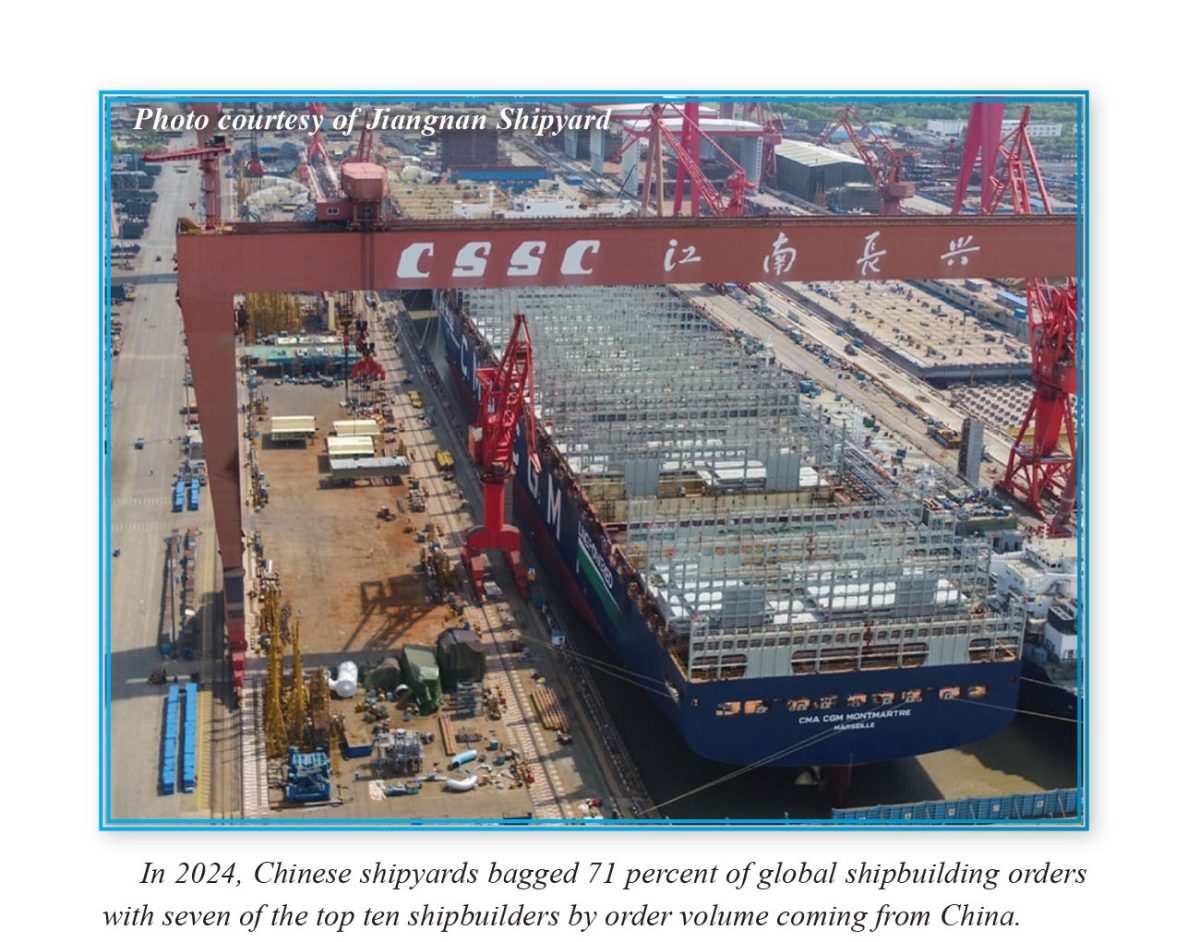
According to the latest analysis, Chinese shipyards bagged 71 percent of global shipbuilding orders in 2024 with seven of the top ten shipbuilders by order volume coming from China, according to UK-based Clarksons Research.
Currently, 21 percent of all imports entering the U.S. in 2024 arrived on Chinese-built vessels.
Reacting to the proposed port fees, the National Retail Federation (NRF) and the Retail Industry Leaders Association – two of the nation’s largest retail industry trade groups – commissioned a study by Trade Partnership Worldwide LLC, a Washington, D.C.-based international trade research firm.
The two industry groups issued a joint statement based on the study, which found that “imports and exports decline as a result of the higher costs of the fees, and/or the mandate to use more expensive U.S.-built, U.S.-owned, and U.S.-operated ships.”

The study continued: “While the potential negative impacts on U.S. agriculture are ‘headline-grabbing,’ those negative impacts extend as well to other sectors of the American economy, including retail. As higher costs filter through the economy, the wholesale and retail trade sectors, from stores to restaurants, see declines in sales and employment.”
The findings of the study were forwarded to the USTR along with a joint statement that read in part: “As a result, U.S. businesses and consumers will take the brunt of these service charges and be forced to bear increased costs for a wide array of commodities with little to no alternatives as many, if not all, of the leading ocean carriers capable of meeting U.S. shipping needs use Chinese-built vessels in their fleets.”
Growing concerns over the proposed levies have the nation’s major ports seeing a surge in container volumes as shippers prepare for the worst and act fast to shore up inventories of everything from imported hardware and sporting goods to machine tool spares and computer peripherals.

According to Jonathan Gold, vice president for supply chain and customs policy at the National Retail Federation, retailers “are continuing to bring as much merchandise into the country ahead of rising tariffs as possible.”
What he calls “the on-again, off-again tariffs against Canada and Mexico” are not expected to have a direct impact on port volumes as most of those goods move by truck or rail.
But, he adds, “new tariffs on goods from China that have already doubled from 10 percent to 20 percent are a concern, as well as uncertainty over ‘reciprocal’ tariffs that could start in April. Retailers have been working on supply chain diversification, but that doesn’t happen overnight.”
The nation’s largest container ports currently handle 86 percent of U.S. import traffic with the latest figures showing their import volume growing nearly 20 percent year-on-year.
At the Port of Los Angeles (POLA), the cumulative figures for the first two months of 2025 showed a two-way volume of just over 1.75 million TEUs (twenty-foot equivalent units) moving through the port’s seven major container terminals – a 5.4 percent increase compared to the same period in 2024.
Despite the current positive trends, “potential challenges lie ahead in the latter half of the year,” says POLA Executive Director Gene Seroka. “Many retailers and manufacturers have been importing goods earlier than usual as a precautionary measure against potential tariffs.”
The strategy, combined with the substantial inventory already present and the uncertainty surrounding tariffs, he says, “could lead to as much as a 10 percent volume decline in the second half of 2025.”
The Port of Long Beach (POLB) ran neck and neck with its San Pedro Bay neighbor during the same period, handling just over 1.71 million TEUs, a 2.74 percent increase over the first two months of 2024.
The flow of trade through the POLB climbed for a ninth consecutive month in February as retailers continued to move goods ahead of the anticipated tariffs.
The port’s terminals saw the volume of imports surge 11.8 percent to 368,669 TEUs with exports increasing by 2.9 percent to 90,026 TEUs.
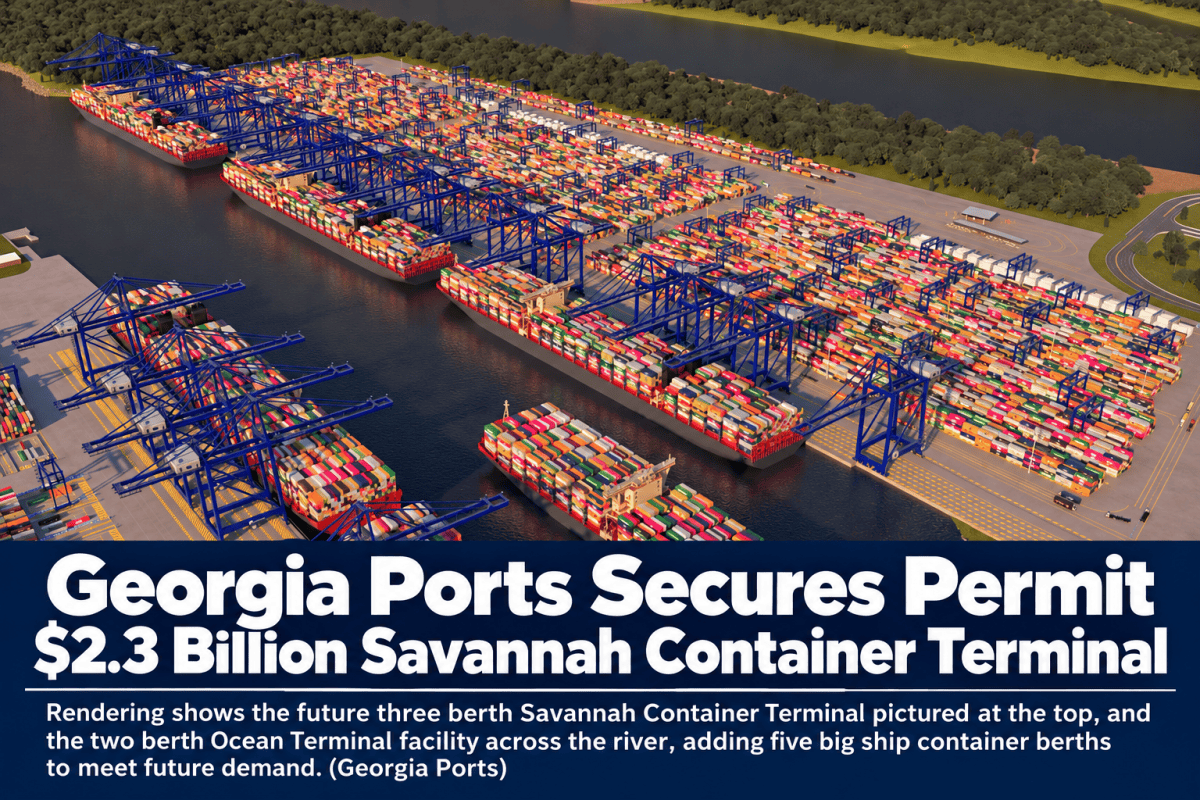
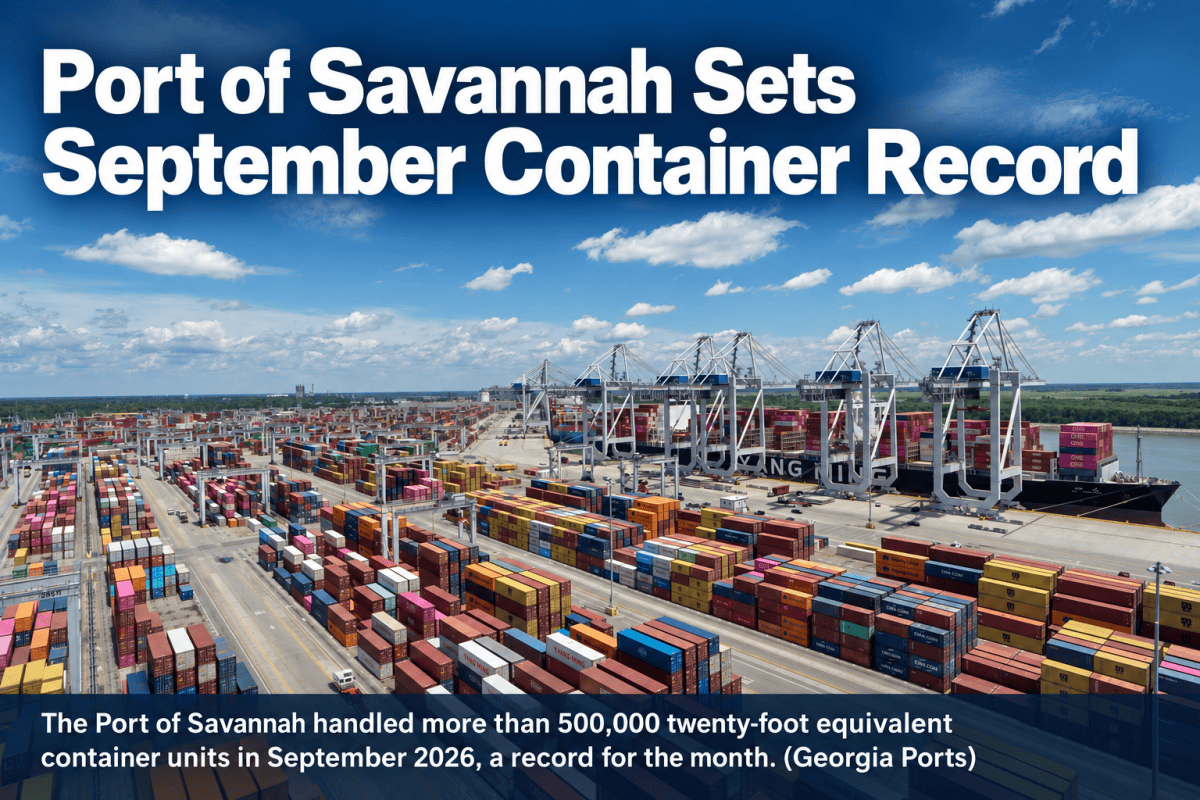
The Georgia Ports Authority said the Port of Savannah handled 206,405 import TEUs in January 2025 at its 1,345-acre Garden City Container Terminal, the largest single-operator terminal in the nation.
Commenting on the proposed tariffs in a radio interview last December, GPA President and Chief Executive Griff Lynch stated that within months of the tariffs being levied, importers are likely to reduce costs to themselves and consumers by “source shifting” goods from China to Southeast Asia and India, for example.
The Port of New York and New Jersey ranks as the nation’s second-busiest U.S. container load center after Los Angeles and Long Beach.
According to the latest figures, January container volumes at the Port of New York and New Jersey showed continued growth with the port handling 720,283 TEUs, an increase of almost eight percent year-on-year and the port’s third-highest ever for the month.
The growth continues the port’s positive momentum from 2024, when frontloading by imports ahead of tariffs and potential labor disruptions boosted import volumes. The flow was also aided by importers pulling imports forward ahead of the Lunar New Year.

Loaded containers saw the volume of loaded import TEUs rise by 10.3 percent, from 342,790 in January 2024 to 378,168 in January 2025.
Commenting on the tariffs and port fees proposed by the Trump administration, Cary S. Davis, president and CEO of the American Association of Port Authorities, stated that “tariffs are taxes [that] slow down our supply chains, tax American businesses, and increase costs for hard-working citizens.”
Instead, he says, “we call on the Administration and Congress to thoughtfully pursue alternatives to achieving these policy goals and exempt items critical to national security from tariffs, including port equipment.”
The port fees, he added, “would make U.S. exports less competitive and do little to counter China’s dominance in shipbuilding and “have few near-term effects” on domestic shipyard production.
“A fee on foreign vessels will simply not bring back American shipbuilding,” says Davis. “Our existing shipyards are working at or near capacity, and higher demand for American vessels will not enable them to produce more ships with the same resources.”

According to Farm Bureau economist Daniel Munch, “Unlike the sprawling, high-volume shipyards of Asia, U.S. shipyards are fewer in number, smaller in scale and primarily focused on specialized, military or Jones Act-compliant ships—not the container vessels that dominate global trade.”
Even before implementation, he says, “The uncertainty surrounding these proposals is already creating logistical complications for both importers and exporters who depend on reliable ocean shipping. Delays in carrier scheduling, shifts in vessel availability and rising freight premiums add risk across supply chains.”
The new policies, “whose primary impacts would be to impose costs on Chinese ships and U.S. imports, would have the unintended consequence of seriously undermining American farmers’ ability to compete in global markets,” he concludes.
Despite growing apprehension over the potential impact of both the tariff increases and the proposed port fees, the French global logistics giant CMA CGM said it will help rebuild U.S. maritime capabilities through a series of investments, including 20 more vessels for U.S. subsidiary American President Lines, which provides ocean transportation and in-country logistics to the U.S. government and military.

During a recent meeting in the White House with President Donald Trump, CMA CGM head Rodolph Saadé suggested that some of the vessels could be built in U.S. shipyards, but because U.S. shipbuilding capacity is “currently very limited,” the new ships “most likely” would be built in South Korean shipyards.
Saadé also pledged to invest $20 billion to enhance the logistics infrastructure and “improve efficiency and container throughput” at the ports of New York/New Jersey, Los Angeles, Houston, Miami, and Dutch Harbor, Alaska.
At the same time, the Port Authority of New York and New Jersey has announced a 33-year lease extension with APM Terminals, a division of Danish shipping conglomerate A.P. Moller–Maersk.
The agreement, to run through 2062, includes a commitment from APM Terminals to invest more than $500 million in the coming years to enhance cargo-handling capacity at its 350-acre terminal.
The investment, the Port Authority says, aligns with the Port Authority’s strategic master plan, which forecasts a doubling or tripling of the port’s cargo volumes by 2050.