Barry Broome never thought he’d see this day. And he’s not alone.
Broome, president and CEO of the Greater Sacramento Economic Council, spoke of the offshoring of the semiconductor industry, which, by the early 2000s, was among the industries that had basically left the U.S.
“And once they were gone, they were gone,” said Broome.
But today, for various reasons, it’s coming back, possibly stronger than it was before.
“It’s a very cyclical industry that was offshored for about 25 years,” he said, “and is now migrating into the U.S.”
While that isn’t exactly happening overnight, the onshoring is coming with a great financial punch.
“We expect [global semiconductor sales] to expand 10 times since 2020,” said Broome, “from $400 billion to $4.2 trillion in the next 14 years,” according to multiple sources.
About nine companies are moving back to the U.S., including Intel’s investment in Columbus, Ohio—“its stock is up 45% this year—plus their new project in Arizona,” he said.
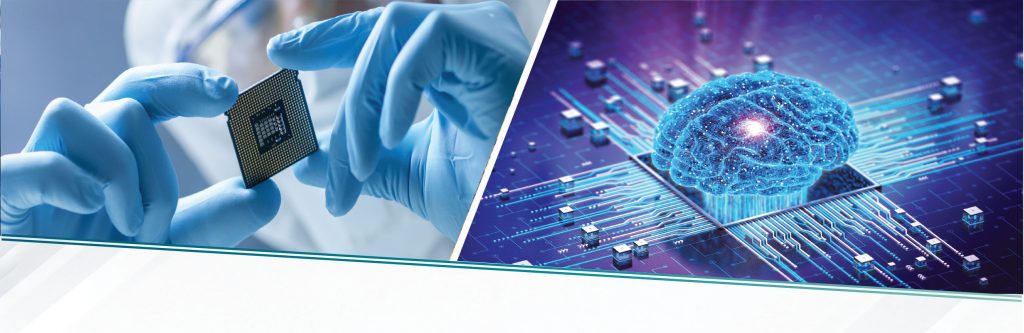
“Obviously, AI is supercharging the demand for chips. Deloitte estimates that artificial intelligence chips for data centers could account for roughly half of industry revenue in 2026.
“That combination of reshoring, AI-driven demand and major investment is creating tremendous momentum for the semiconductor industry,” said Broome. “It’s going to be a rocketship.”
Now Boarding
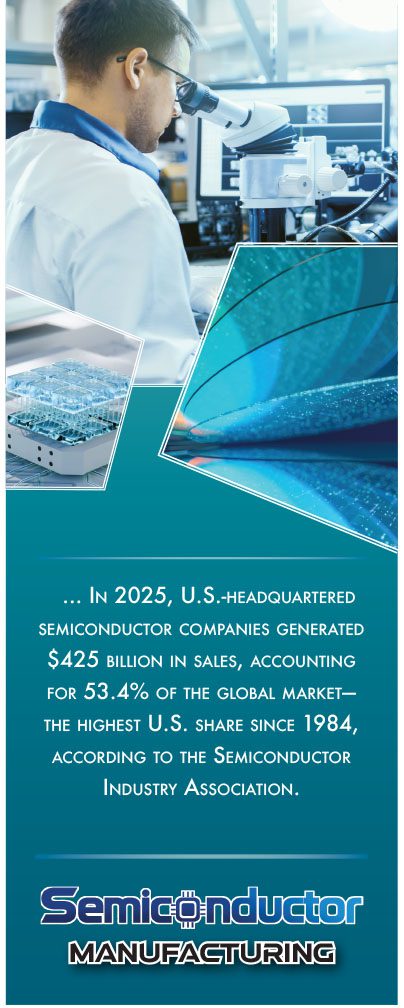
To get an idea of what’s powering the rocketship, in 2025, U.S.-headquartered semiconductor companies generated $425 billion in sales, accounting for 53.4% of the global market—the highest U.S. share since 1984, according to the Semiconductor Industry Association.
The SIA also estimated that the global market is projected to reach $1.5 trillion in 2026, with the U.S. maintaining a dominant position in design, manufacturing, and research and development.
Broome said Greater Sacramento “is now a top 10 market in economic growth and a semiconductor hotbed,” with Solidigm, Bosch, Intel, Micron and Samsung operating within the metro area.
“So we’re building deeper capabilities through educational partnerships with institutions like Sierra College, which is producing 300 mechatronics graduates a year to supply workforce that can make $100,000 to start.”
Broome also cited other hotbeds, including Oregon and upstate New York. He also thinks that what’s causing this tidal wave of onshoring is the wake of COVID-19, combined with the Chip Industry Act and the current administration.
“I’m not a booster of tariffs,” he said, “but this is one case where they are helping.”
He also turned his focus on the world’s political landscape.
“China controls lithium, then Taiwan is in the crosshairs of China,” Broome said, “so I think we will see continued movement out of Asia.”
Like other observers, he finds it uplifting to see an industry that died or, as in this case, left, return to its former glory.
“This is the first time I’ve seen an industry die domestically and come back to life. You won’t see steel, textiles or pharmaceuticals come back. But this was a critical industry from around 1960 to 2000, then it started to aggressively return in the last couple of years.”
Not only is it coming back, it’s coming back better.
“I think you will see how clean tech decarburization benefits the industry and see clean tech while this happens. Then AI will optimize everything,” he said.
“I worry about inequality and leaving tens of millions of people behind, but we’re going to see five years of the greatest tech growth we’ve ever seen, similar to the software boom with [Bill] Gates and [Steve] Jobs.”
However, first things first.
“The federal government needs to set up guidelines,” said Broome, “as OpenAI and Anthropic are already calling for regulations.”
The Ecosystem
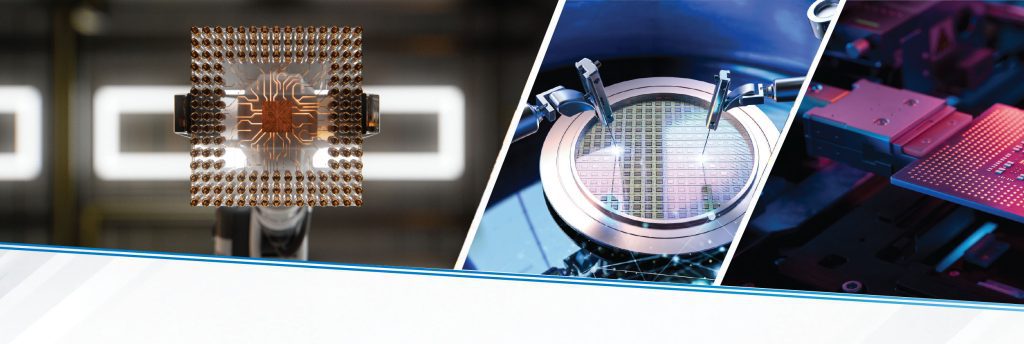
On the financial side, Bob Hess, vice chairman of the Global Strategy Consulting Practice for Newmark’s Chicago office, said the firm is “mapping out the value chain, as we have corporate, as well as economic development and government clients. The industry is very capital intensive.”
Citing traditional big market states like Oregon and New York, as well as Arizona and Texas, plus Northern California, and “second tier” states, including Minnesota and others in the mid-Atlantic, Hess noted Newmark’s two studies for the state of New York and one for Sacramento, while discussing how “capital intensive” and flat-out massive the industry is.
“Arizona alone has hundreds of prospects in the economic development stage,” Hess said, “but how can the state find the space and energy to accommodate the demands of the industry?”
And once the sites are up and operating, those demands can not only grow; they require maintenance and possibly expansion.
“It’s very capital intensive to build a fabricator,” he said, “but once you do, you can add on when new parts, infrastructure and capacity are needed. But there are always discussions about where and when, and with who. That will always continue and results in numerous partnerships in the industry.
“We can’t duplicate the industry here as it exists in Taiwan, for instance, as it takes three or four years at least to build a plant,” he said, especially due to more variable costs, including labor, water, power and transportation, plus other fixed costs.
“Property taxes are a big deal, but New York does not have a state tax. However, it has hydro power,” Hess said, noting a recent national site search for Samsung.
“When they want to expand, they have to look at a campus, expandability, workforce, how many fabricators are in the area, suppliers,” etc.
While that means the market “is very healthy,” Hess said that degree of demand can also “make it very volatile. This is about global competitiveness, the AI side and data center demand,” he said.
“Construction laborers need unique skills, aptitude and the right attitude to learn.
“When you walk into a semiconductor facility, you only see a few people,” said Hess, who noted that, as is the case in most industries, there has to be an ecosystem.
“We have to push down the path of innovation,” he said. “We’re at an occupational crosswalk,” noting needs for clean lab and wet lab skills, manufacturing, testing, etc., and having “to match them to clients, who then add training and engineering. Some states add training and some have a workforce in place. Then add a fabricator and see it all work.”
He offered a prime example.
“Arizona didn’t have everything at first, but they took a long-term approach and look now. Everybody wants semiconductor investment,” he said, “but not everyone can get it.”
Pipeline Flowing
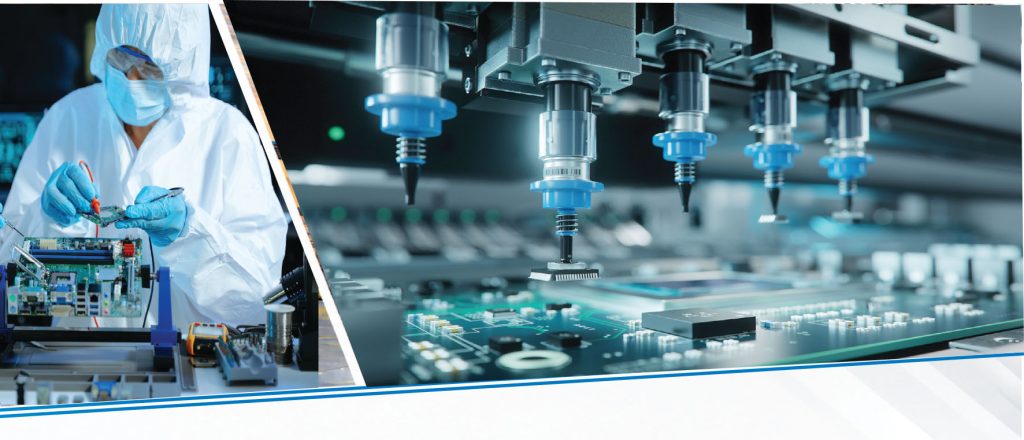
To illustrate, Sandra Watson, president and CEO of the Arizona Commerce Authority, discussed how the state grew to become a prime player in the industry.
“We’ve had more than 70 years’ presence in the industry, starting with Motorola,” said Watson. “We have led the U.S. since 2020 with $314 billion in investment and are host to more than 200 semiconductor companies.”
She pointed to 74 expansion projects in the past six years to attain that investment figure, and the announcement of more than 27,000 new jobs in the state during that span.
“Even in the down years, we’re always in the top five,” said Watson. “Today, we’re ranked No. 1 in the U.S., according to Business Facilities; also, the SIA has ranked us first in industry expansion since 2020.”
Like Broome, Watson is among many industry executives who expressed excitement about the rebirth of the industry domestically.
“I’ve never seen an industry that moved outside of the U.S. return, and with so many international companies that have not operated here before.”
She added that Arizona’s prowess has resulted in that strong ecosystem, which includes a strong workforce. In addition, AI is “driving up demand, so we’re seeing tremendous investments being made by our burgeoning pipeline of companies.
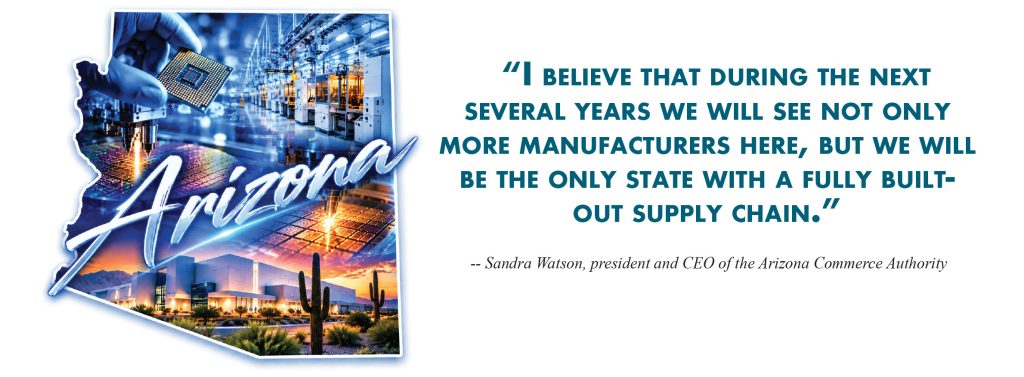
“I believe that during the next several years we will see not only more manufacturers here, but we will be the only state with a fully built-out supply chain,” she said, with that ecosystem including R&D, educational programs, manufacturing, equipment and materials suppliers, and advanced packaging.
What’s “Special”
John Boyd painted a big picture concerning why the semiconductor industry’s pie is so big and how so many people are getting a nice slice.
“Virtually every consumer product relies on chips,” said the principal of The Boyd Company, of Boca Raton, Florida, “and there has been an effort in recent years to bring more production stateside.”
A major driver of that effort has been the large defense budget of the U.S., plus a universe of medical and consumer devices. Today, he said, “much is driven by defense and aerospace, health care, AI, cybersecurity, autonomous systems and data centers.”
Pointing to the various hidden costs of doing business the old way, in this case via almost complete offshoring, he continued.
“Having so many disparate manufacturing centers in other parts of the world, which includes dealing with various political factors,” said Boyd, “created a riskier supply chain [that was] more difficult to enhance.”
As for today’s winners, he said, “The opportunity is there for states that have site readiness, workforce initiatives, power and water. A regional power network works well in states … like Texas, Ohio, Pennsylvania and Indiana; Tennessee Valley Authority states, like Alabama, Mississippi and Kentucky; and the I-90 Corridor of Upstate New York, to name a few.”
But as hot as the market is, Boyd said that it “has moderated during the past few months, with project flow slowing somewhat from last year, when Arizona was announcing a blockbuster project or expansion every few weeks.”
What he’s seeing at present are “many related projects, with respect to semiconductor supplier companies.”
For instance, an old-line company like Corning, a key supplier of specialized glass materials, recently announced major manufacturing expansions tied to Apple in Kentucky, and NVIDIA in North Carolina and Texas.
“Also, HP, Philips, Boeing and Dell are embedding advanced semiconductors and advanced microelectronics directly into their next-gen production systems.”
As noted, critical to facilitating that growth is boosting the workforce via university partnerships that heavily dot the landscape, like Arizona State University with TSMC; The Ohio State University with Intel; Samsung with the University of Texas at Austin; and most recently Elon Musk’s Terafab with Texas A&M, among others.
While there is still significant market presence offshore, states are working to attract manufacturers back onshore, and manufacturers must have a U.S. presence for federal procurement. But that’s also “what’s special about the industry,” he said.
“It’s the direct foreign investment component,” said Boyd. “These facilities are gateways to the global marketplace and global talent pipeline, with STEM engineers from around the globe, and supplier networks.”
“That One Company”
As Boyd pointed out, while the industry is hot, that doesn’t mean that the arrow on the chart is always pointing northeast. Suresh Acharya, professor of practice at the University of Maryland College Park, agreed.
“The semiconductor industry is notoriously volatile on supply and demand,” said Acharya. “Most capital-intensive industries deal with that issue on one side or the other, such as aircraft manufacturing. They have a reasonable understanding of capacity and manage demand accordingly.
“However, unlike other industries,” he said, “the supply and demand of semiconductors is highly uncertain most of the time,” calling that variability “actually very pronounced. We used to simply call this cyclical; supply and demand playing catch-up with each other.
“That has been the cycle with semiconductors over the decades,” said Acharya. “COVID-19 dramatically magnified this issue due to demand fluctuations. For instance, car manufacturers were cancelling some orders and foundries were not producing the right products, either.”
But the demand was still there.
“There was huge demand due to the needs of the digital world, due to the massive use of phones, laptops, iPads,” etc., he said, adding, “Today, it’s all about AI and data centers. And what underlying entity fuels data centers? Semiconductors are what’s fueling high demand in the information technology industry.”
If there’s one company observers need to follow in this space, it’s Taiwan-based TSMC, which is growing and catering to big hyperscalers like NVIDIA, Google, Apple and Microsoft.
“Chip manufacturing is notoriously capital-intensive,” said Acharya. “They cost hundreds of billions to even start one, and the equipment is expensive as well.
“And why this industry is so vulnerable to supply chain issues is that it’s geopolitical,” he said, “due to our dependence on that one company.”
The Constant
While Acharya thinks supply chain issues will continue, he added that it won’t especially come to the fore, either.
“The semiconductor industry is constantly in flux,” he said, “so the general public doesn’t generally see it.”
But what the public will see, he said, is how the AI rush “will continue to have a choking impact on the overall market.
“There will be a ripple effect on the health care, aerospace, defense and automotive industries, because even if they aren’t using advanced chips,” said Acharya, “manufacturers are shifting their production in that direction.”
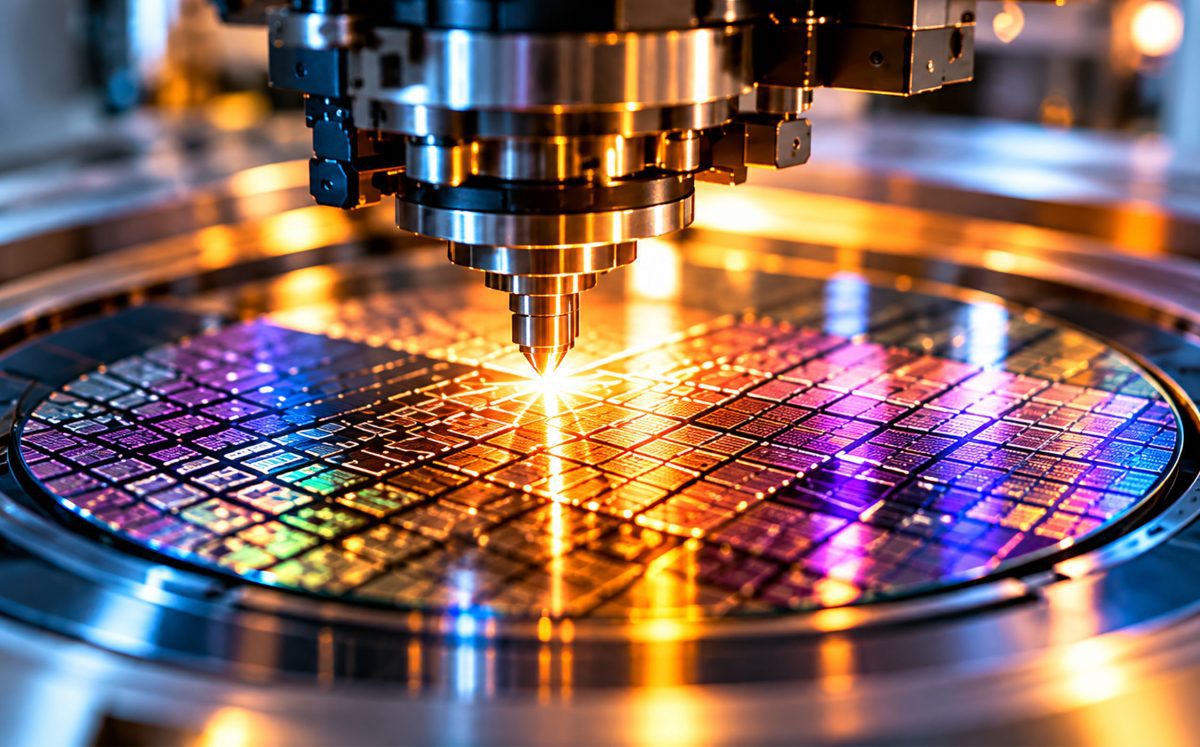
While there is some good news on improved wafer yields—the percentage of non-defective chips in a wafer—the challenges have moved elsewhere in the supply chain, namely in modern lithography and advanced packaging.
But Acharya underscored that this cycle will come and go, too.
“Supply and demand issues are ongoing,” he said, “and that’s the constant in this industry.”
About the Author
Odenton, Maryland-based Mark R. Smith joined Expansion Solutions after having written about site selection among the vast number of topics he has covered in the business universe.
That part of his career began in 1993 when he joined The Daily Record, a Baltimore business and legal publication, where he delved into the worlds of economic development and commercial real estate, among numerous other industries.
In 2003, he was named editor-in-chief of The Business Monthly, another Maryland publication that covers the scene in the Baltimore-Washington Corridor counties.
Concurrently, he’s written at length about the film and video industry for a variety of publications, and about his other loves, including music, sports and leisure.