The iconic movie starring John Candy and Steve Martin ‒ Planes, Trains and Automobiles ‒ the classic 1987 John Hughes-written and directed Thanksgiving comedy about an uptight ad exec (Steve Martin) and a cheerful but clumsy shower curtain ring salesman (John Candy) makes for a convenient and fun template for the ensuing article on “transportation”.
In the high-stakes economic development world of 2026 ‒ mobility has evolved far beyond a simple line item on our firm’s site selection checklist. It has become a multi-dimensional driver of location decisions touching upon such factors as market and talent access, supply chain integrity and new infrastructure features of the modern high-rise building. The legacy metrics of “highway access” and “airport proximity” are no longer sufficient – as people and products are moving in new ways.
Planes: The Arrival of Advanced Air Mobility
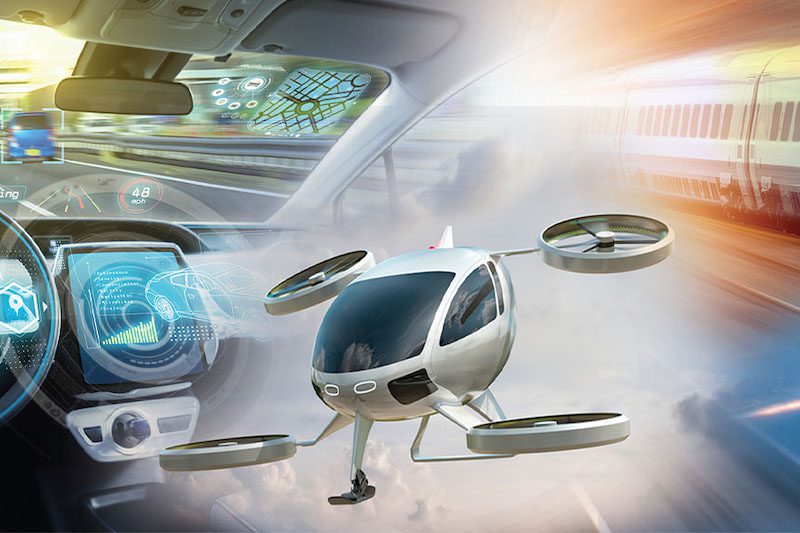
Here in South Florida, the region is rapidly ascending as a leading U.S. proving ground for the electric Vertical Takeoff and Landing (eVTOL) industry, driven by a perfect storm of geographic necessity and visionary capital investment. The primary catalyst is the region’s notorious traffic congestion along the I-95 and Florida’s Turnpike Corridors, where a typical 70-mile commute from Miami to Palm Beach can consume nearly two hours. This congestion has created an urgent, high-value demand for so-called aerial highways. Answering that call is San Jose, California-based Archer Aviation with backing by billionaire developer Stephen Ross to connect major South Florida population centers with 10–20-minute electric flights by “air taxis”.
Boca Raton – located between Miami and West Palm Beach ‒ is positioning itself as a premier hub for the emerging eVTOL and advanced mobility industry. The Boca Raton Airport Authority is considering introducing “vertiports” ‒ landing and takeoff areas for new, electric, low-noise, vertical-takeoff aircraft that are currently undergoing FAA certification and designed to support passenger and cargo air taxi operations in the high traffic Palm Beach/Fort Lauderdale/Miami Corridor. It’s estimated that such a vertiport facility at the Boca Raton Executive Airport would require between two and four acres, with a footprint housing landing pads, aircraft parking, charging stations and a passenger terminal. Once FAA certifications for the new aircraft are cleared and the industry matures, a flight from Boca Raton to Miami International Airport is expected to mirror the pricing of an Uber Black service.
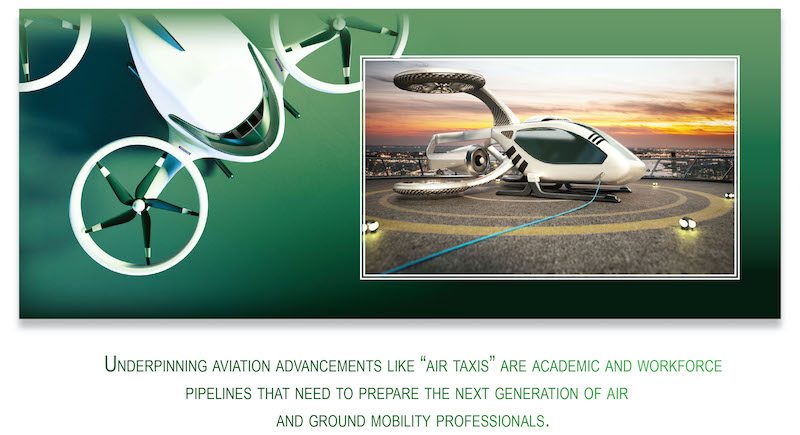
The “air taxi” plans of Boca Raton and of the Archer Aviation/Stephen Ross partnership are setting the stage for a new brand of regionalism. Their plans will effectively expand the commutable radius of major South Florida office hubs like Miami’s Brickell Financial District, Boca Raton’s Innovation Campus and West Palm Beach’s CityPlace. This expansion will allow a company to plant its flag in one of these popular office hubs while confidently recruiting top talent from as far north as Jupiter or as far south as Key West. While the impact of air taxis in the U.S. will start in South Florida, look for other major office markets like New York, Houston and Los Angeles to quickly follow suit. Major developers in these markets are already integrating landing pads into the blueprints of flagship office towers and luxury high-rise condos.
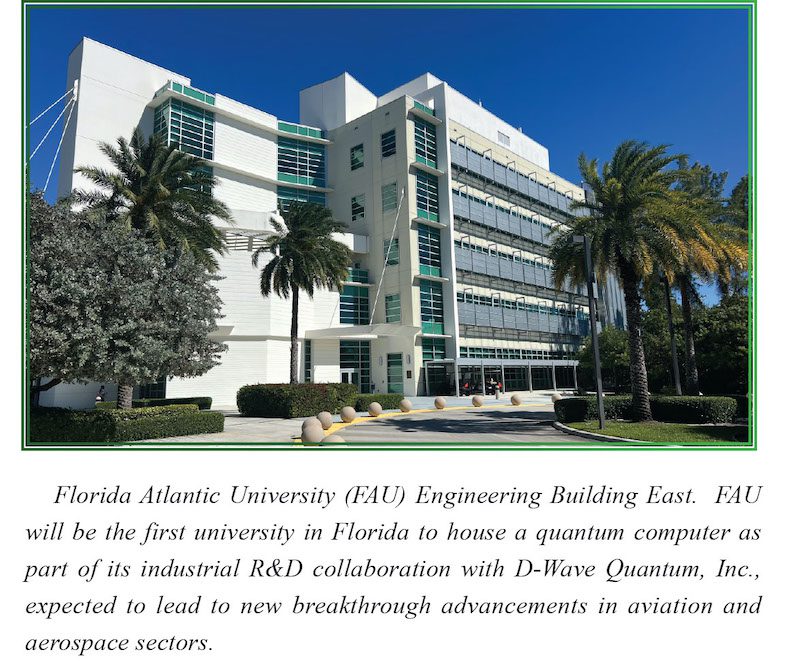
Underpinning aviation advancements like “air taxis” are academic and workforce pipelines that need to prepare the next generation of air and ground mobility professionals. Lynn University’s Burton D. Morgan College of Aeronautics operates at the Boca Raton Airport training students in aviation and pilot disciplines destined to play out in new advanced air mobility fields like “air taxis”. Florida Atlantic University (FAU) houses a noted graduate program in aerospace and related engineering fields. In late 2026, FAU will be the first university in Florida to house a quantum computer on its Boca Raton campus as part of a broader collaboration between FAU and D-Wave Quantum, Inc. of Palo Alto, California, to advance R&D in numerous industries, including aviation and aerospace by tackling design, simulation, and optimization problems that are extremely hard for today’s classical computers. Quantum computers can simulate molecular and atomic interactions directly enabling faster research into advanced composites, high-temperature alloys for engines, heat-shield materials, corrosion-resistant coatings, optimization of aircraft structural layouts, supply-chain and production optimization and other vital R&D fields.
Planes – Breakfast in the Big Apple, Lunch in LA: The Return of Supersonic
While “Los Angeles to New York in an hour” remains a dream for the hypersonic future, the next generation of supersonic travel is set to slash current flight times in half. Aviation company Boom Technology, Inc., is currently building a new supersonic aircraft in Greensboro, North Carolina, that will make a cross-country flight in roughly three to 3.5 hours, a massive improvement from today’s six-hour slog. The supersonic movement has gained significant momentum through the Trump administration’s deregulation focus, specifically a 2025 executive order that directed the FAA to lift the 50-year-old ban on civil supersonic flight over land. Supersonic travel is poised to revolutionize business travel and tourism by making same-day international trips a reality. For professional sports, the implications are a total game-changer. The NFL, which has long toyed with a permanent European expansion, could finally overcome the hurdle of player fatigue. With flight times cut in half, a London-based franchise could travel to the U.S. East Coast as easily as a West Coast team does today, making a truly global sports league a feasible reality by the end of the decade.
Trains – Redefining Regionalism through High-Speed Connectivity
As with “air taxis,” rail transportation is also becoming an equalizer for regionalism. For too long, economic development has been a zero-sum game between a central city and its suburbs. We are now advising site-seeking clients to view candidate locations through the prism of “MegaRegions.”
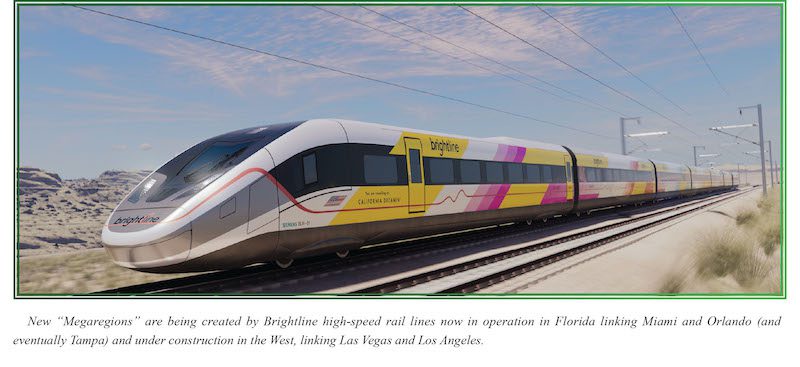
A good example is Brightline, America’s only private, higher-speed passenger train system, connecting South and Central Florida between Miami and Orlando, with stops in Aventura, Fort Lauderdale, Boca Raton, and West Palm Beach, offering a sustainable alternative to driving or flying, featuring modern amenities like Wi-Fi, charging ports, and comfortable seating, and with plans for future expansion to Tampa. A Los Angeles to Las Vegas “Megaregion” is also being formed as a Brightline West line between these two markets is under construction. Brightline Florida is generally classified as higher-speed rail (up to 125 mph) but its upcoming Brightline West project (scheduled for late 2029) is designed to be a true high-speed system, aiming for speeds over 186 mph between Las Vegas and Southern California.
Amtrak, the country’s national passenger railroad, is also undergoing a historic transformation in 2026, driven by record federal funding to modernize its fleet, expand service to new cities and overhaul century-old infrastructure. The new high-speed Acela trains are currently being phased into the Northeast Corridor between Boston and Washington, DC. These American-built trains reach speeds up to 160 mph and feature more seating, 5G Wi-Fi and contactless technology. Amtrak is also procuring its first new long-distance fleet in over 40 years to replace aging Superliner and Viewliner cars on overnight routes. The new Mardi Gras service recently launched, restoring passenger rail between New Orleans and Mobile for the first time in 20 years.
Major rail infrastructure projects include the $6 billion undertaking to replace the 150-year-old B&P Tunnel in Baltimore, a major Northeast Corridor bottleneck. The Gateway Program in New York and New Jersey will see the construction of two new tubes under the Hudson River. Transformative renovations are taking place at New York’s Penn Station that double rail capacity and transform the facility into a world-class terminal. Renovations at Philadelphia’s 30th Street Station are also underway to improve passenger flow and add new retail.
Automobiles – Autonomous Mobility Redefining Auto Travel
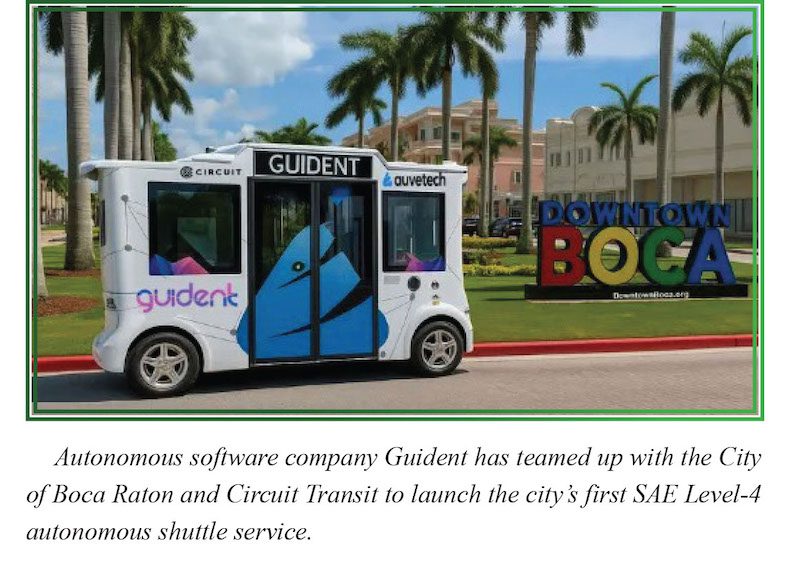
The race for autonomous dominance is no longer a futuristic concept—it is a live commercial battle being fought in the streets of the U.S. and China. Industry titans like Waymo (Alphabet) have already surpassed millions of rider-only miles, while Baidu’s Apollo Go has scaled to become the world’s largest robotaxi network by volume. The MiCa autonomous shuttle is a pioneering, free, electric, self-driving shuttle service launched in late 2025 in Boca Raton operating in a 0.6-mile loop within Mizner Park – the city’s high-end downtown shopping, residential, and entertainment district. The service, was formed by a partnership between the City of Boca Raton and Guident, Circuit and Auve Tech, an Estonian technology company that specializes in the development of autonomous, driverless shuttles. The service features a 6-passenger, bright-colored vehicle that augments downtown mobility while reducing traffic congestion using AI-powered remote monitoring. The autonomous service in Boca Raton is part of a larger trend in Florida, with similar, though separate, initiatives in West Palm Beach and Jacksonville.
At the 2026 Consumer Electronics Show in Las Vegas, the partnership between Uber, Lucid, and Nuro signaled a new era of “Driver as a Service,” moving away from individual ownership toward integrated mobility platforms. Meanwhile, companies like Aurora Innovation and Kodiak AI are revolutionizing long-haul logistics, proving that the first wave of true economic disruption is happening in the freight corridors of Texas and the Southwest.
Beyond the technology itself, the widespread adoption of autonomous vehicles (AVs) acts as a massive mobility multiplier for economic development. By automating the movement of goods and services, businesses can drastically reduce last-mile delivery costs and mitigate the ongoing shortage of commercial drivers. This autonomous shift has the potential to spur new urban redevelopment as shared autonomous fleets reduce the need for private car ownership enabling cities to reclaim the enormous amount of real estate currently devoted to just parking ‒ estimated at up to eight spaces for every car in the U.S.
Automobiles – Right & Left Coast Ferry Expansions
New York City’s controversial congestion pricing scheme has driven up alternative transit usage, including a huge rebound in Staten Island Ferry ridership and the launch of increased commuter ferry service from New Jersey. New York’s congestion pricing ‒ a program charging vehicles a toll to enter Manhattan south of 60th Street to reduce traffic ‒ has resulted in some 10 million fewer cars entering Manhattan.
Regional connectivity, especially serving commuters, is being enhanced in the New York City/New Jersey market with NYC Ferry launching new service between Staten Island and Brooklyn and Manhattan’s West Side. NY Waterway recently expanded South Amboy, New Jersey, service to Manhattan with potential service from Carteret and Bayonne – home to 1888 Studios, one of the largest film and TV production sites in the Northeast and expected to house as many as 3,000 workers.
On the West Coast, the San Francisco Bay ferry system is experiencing record ridership levels, largely driven by return-to-office mandates and service expansions. It is also undergoing a major green transformation with new zero-emission technologies, including all-electric vessels and hydrogen pilots. Boyd Co. client Tritium was recently awarded the contract to provide fast-charging stations to the system, including innovative “charging floats” with docks, chargers and battery storage to support the San Francisco Bay ferries.
Automobiles – The Rise of Smart Corridors
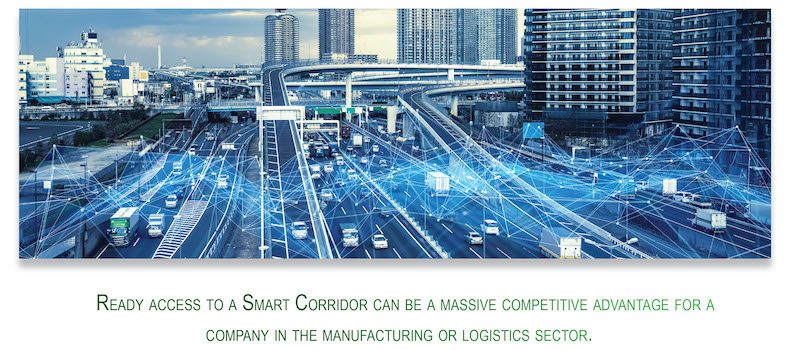
As we analyze the shifting transportation landscape of 2026, we are also tracking the rise of “Smart Corridors.” These are not your grandfather’s highways. We are seeing states like Texas, Ohio, Michigan, North Carolina, Florida and others lead the way in embedding sensors and dedicated short-range communications (DSRC) into the very pavement of their key industrial arteries. In Florida, FAU’s Department of Civil, Environmental & Geomatics Engineering offers a growing Ph.D. program in Transportation Engineering, including focuses on infrastructure, intelligent transportation, geospatial intelligence, smart cities and other civil engineering aspects dealing with transportation.
Ready access to a Smart Corridor can be a massive competitive advantage for a company in the manufacturing or logistics sector. The Smart Corridor allows for autonomous truck platooning—where a lead truck “pulls” several driverless trailers in a tight, fuel-efficient draft. This technology reduces fuel costs by up to 15 percent and significantly increases the throughput of existing road networks without the need for additional lanes. A site located on a Smart Corridor suddenly carries a lower shipping cost profile than a site on a traditional interstate. This “Road as a Service” model is one of the next frontiers of public infrastructure, where the digital layer of the road is just as important as the physical layer.
Conclusion: The Sky is No Longer the Limit
Transportation has always been the great enabler of commerce. From U.S. Route 1 in Princeton, NJ (which went from a stretch of sod farms and cheap motels in the 1970s to now a global tech hub) to the burgeoning “Silicon Tropics” of I-95 in South Florida, the ability to move people and ideas efficiently is ultimate test of a great business location.
As we embrace the era of supersonic flight, air taxis, autonomous vehicles, electric propulsion and hyper-connected megaregions ‒ the map of the “ideal” business location is being redrawn. The “flight to quality” now includes a “flight to connectivity.” Those cities, states and private developers that recognize that Archer, Boom and Auve Tech aren’t just building flying taxis, supersonic aircraft and driverless shuttles but are building the infrastructure of economic opportunity, will be the ones that best capture the next generation of global corporate investment.