U.S. Ports Continue Investing Amid Global Supply Chain Challenges
Global stresses have national, regional, and local consequences — a reality that is especially evident in how ports, a critical link in the global supply chain, operate and plan for future development.
Conflict in the Middle East, impactful tariffs, shifts in long-established shipping routes, an overall decline in import volumes, and routine seasonal cargo fluctuations created immense challenges for the nation’s ports over the past year.
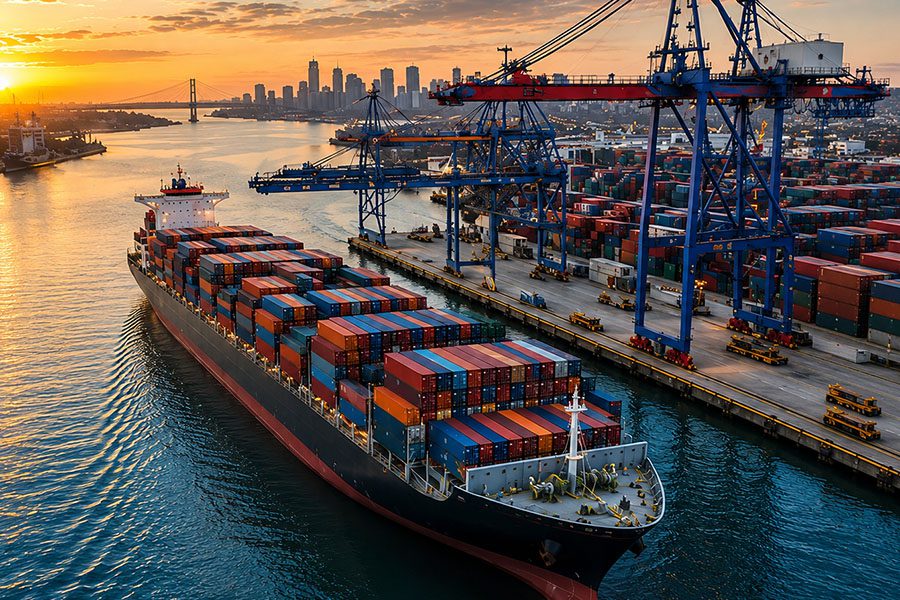
Despite these hurdles, U.S. ports are seeing signs of growth and continue advancing strategic plans to attract new business. Across the country, ports are expanding infrastructure, enhancing terminal capabilities, and deepening channels to accommodate the newest generation of ocean-going vessels.
U.S. East Coast Ports
Port of New York and New Jersey
The Port Authority of New York and New Jersey announced a landmark 33-year lease extension at Maher Terminals in Port Newark/Elizabeth, the largest and busiest container terminal at the Port of New York and New Jersey.
Maher Terminals operates the largest and busiest of the port’s five container terminals, spanning approximately 450 acres in Elizabeth, New Jersey. The terminal handled approximately 35 percent of the port’s container traffic in 2024.
The Port Authority also announced a 33-year lease extension with APM Terminals, operator of the Port of New York and New Jersey’s second-largest container terminal.
The agreement includes $500 million in major investments and capacity enhancements at the 350-acre container terminal in Port Newark/Elizabeth, New Jersey.
Port of Philadelphia
PhilaPort capped off a milestone year in 2025, posting record container throughput by handling 889,300 twenty-foot equivalent units, or TEUs. The total represented a six percent year-over-year increase in container volume.
A key driver of the increased performance “remains PhilaPort’s specialization in temperature-controlled cargo,” the port says.
In 2025, 64 percent of the port’s containerized imports were refrigerated, reinforcing its role as a premier East Coast hub for perishable goods and cold-chain cargo.
Georgia Ports Authority
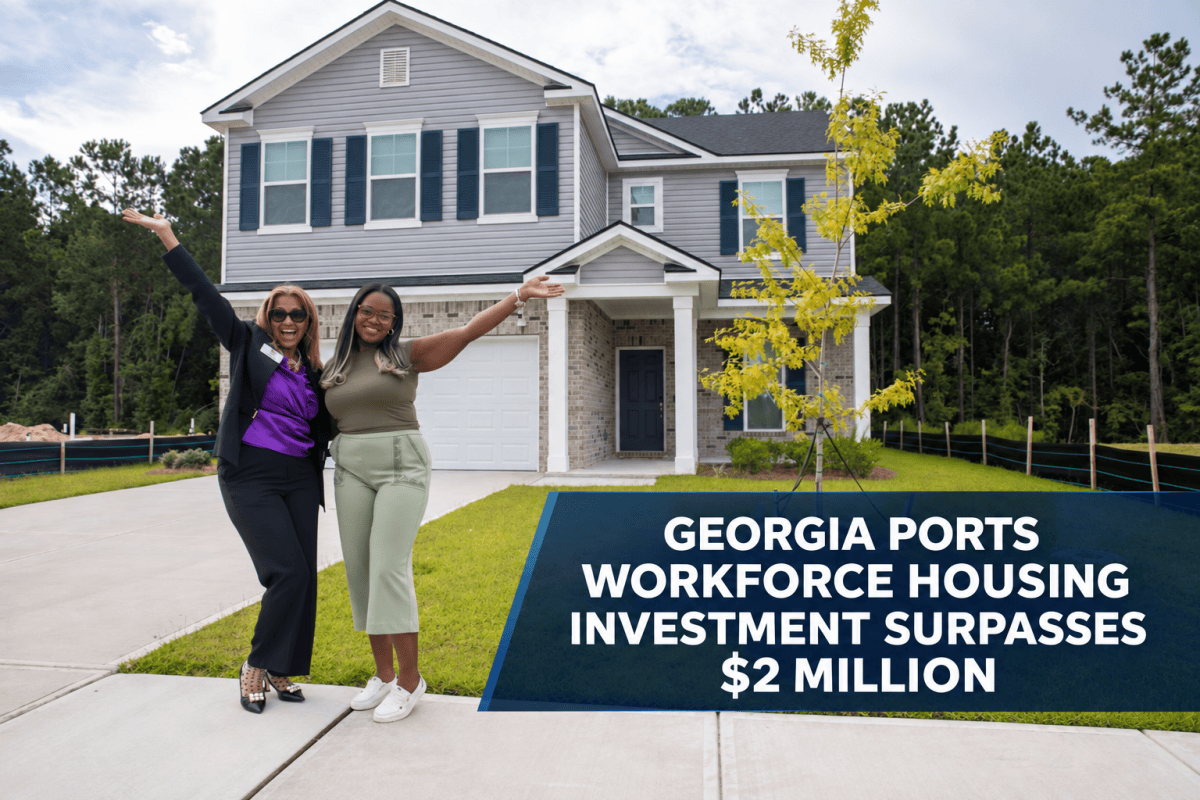
Last fall, the Georgia Ports Authority announced it would invest $1.54 billion to expand its 200-acre Ocean Terminal. The project includes renovating the terminal’s two berths to serve newer-generation container vessels simultaneously, expanding truck gates, and constructing a new truck exit ramp.
The GPA achieved its second-busiest year ever in 2025, handling nearly 5.7 million twenty-foot equivalent container units of cargo. That represented an increase of 2.6 percent, or 146,000 TEUs, compared to 2024.
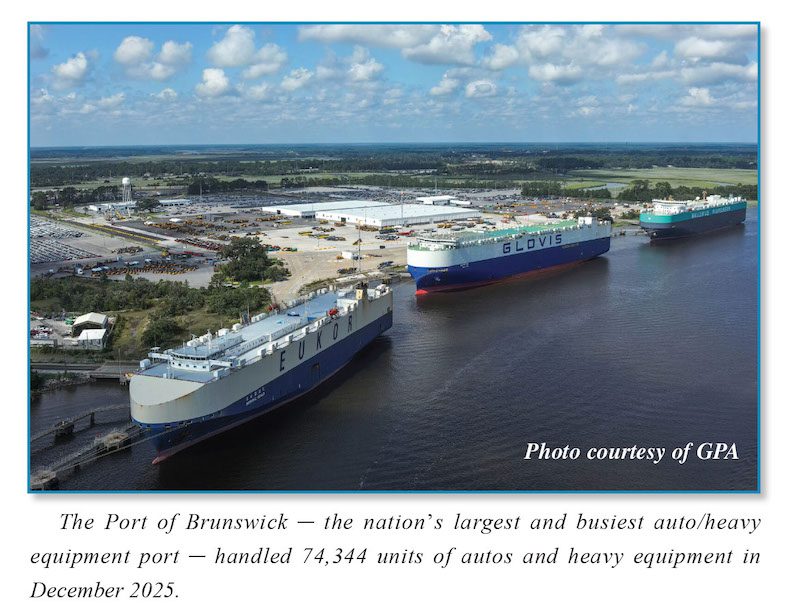
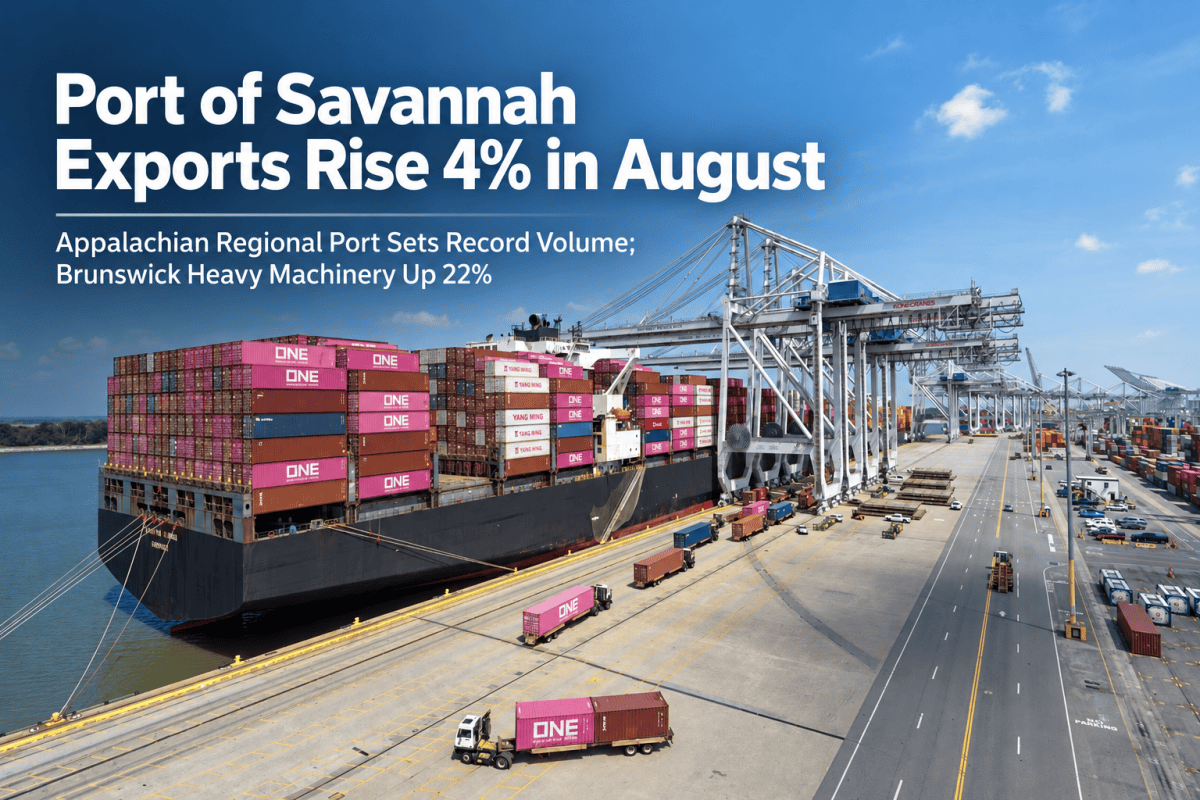
At the nearby Port of Brunswick — the nation’s largest and busiest auto and heavy equipment port — the GPA handled 74,344 units of autos and heavy equipment in December 2025. That was an increase of 5,659 roll-on/roll-off units, or 8.2 percent. Heavy equipment accounted for 2,715 units of the total volume.
Port of Virginia
The Port of Virginia is continuing to modernize and expand its operations. The port recently debuted additional capacity to safely handle simultaneous calls of ultra-large container vessels.
In late January, the port put four new all-electric, Suez-class ship-to-shore container cranes into service at its Norfolk International Terminals facility. The port now has the capacity to accommodate four ultra-large container vessels at once.
Dredging of the shipping channel and harbor to 55 feet was completed in February, with additional maintenance work currently underway.
The two-year dredging project also included widening areas of the channel, allowing for two-way traffic of ultra-large container vessels.
U.S. Gulf Coast Ports
Port of New Orleans
The Port of New Orleans, Ports America, and Terminal Investment Limited have incorporated Louisiana International Terminal Holdings LLC in a joint venture that will serve as the operating group for the new Louisiana International Terminal project.
Port NOLA’s existing container terminal is limited to ships with an air draft of 166 feet or shorter, depending on the Mississippi River stage.
The planned Louisiana International Terminal is in its preliminary permitting phase and will be able to handle much larger New Panamax- and Post-New Panamax-generation containerships.
Port Freeport
Texas’ Port Freeport cut the ribbon at its multi-use Velasco Container Terminal, marking the completion of several infrastructure projects that support continued expansion and connectivity at the facility.
Completed projects include Storage Area 5, the Terminal Access Project, and the East 5th Street Reconstruction and Truck Queuing Project.
The Freeport Harbor Channel Improvement Project is also underway. The project will deepen and widen the port’s main channel to depths ranging from 51 feet to 56 feet and is expected to be completed this year in time for the port’s 100th anniversary.
Port of Mobile
Work has begun on the reconstruction of Pier B South at the Port of Mobile, launching a multi-year, multi-phase program to modernize the port’s oldest general cargo and breakbulk facility.
When completed, the new Pier B South terminal will feature 1,500 linear feet of modern dock structure built to handle 1,500 pounds per square foot. It will also accommodate mobile harbor cranes and other advanced cargo-handling equipment.
The facility will be rail-served, shore-power capable, and designed for seamless integration with the port’s general cargo complex.
Port Houston
In the first two months of the year, loaded exports at Port Houston increased five percent, while loaded imports rose three percent compared to the previous year.
In February, the Port Commission approved the start of construction of Wharf 1 at the Bayport Container Terminal. The new wharf will add 1,300 linear feet of wharf space when it becomes operational in 2028. In addition, the new Wharf 7 at Bayport is now operational.
A new pair of 120-ton harbor cranes are online at the port’s Care Terminal, which is operated by Gulf Stream Marine.
The cranes “enhance Care Terminal’s capabilities for heavy-lift, project, and specialized cargo, supporting global supply chains and Gulf Coast access,” the port says.
U.S. West Coast Ports
Port of Los Angeles
APM Terminals at the Port of Los Angeles is electrifying its terminal operations, “cutting truck dwell times from 90 minutes to 35 minutes and significantly reducing emissions,” the terminal operator says.
Additional investments at the APM facilities include hybrid straddle carriers, electric vehicles, and increased battery charging capacity.
Port of Long Beach
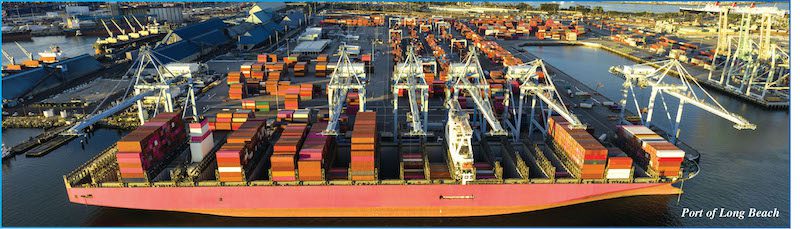
Work is ongoing on the $365 million South Slip Fill Project to expand the size of the International Transportation Service terminal at the Port of Long Beach.
Designed to give the port “improved access for some of the world’s largest container vessels,” the project is slated for completion in December 2028 and will boost the ITS facility’s container capacity by as much as 50 percent.
The Dutra Group has also converted its Long Beach-based dredging barge, Morty, to all-electric power with the installation of a new electric crane that can be charged directly from the port’s shoreside electric power grid.
Port of Portland
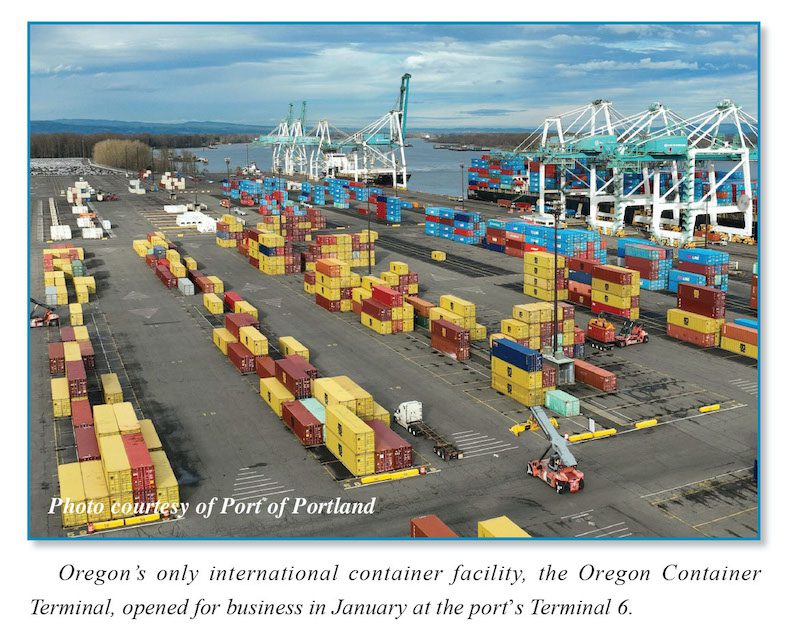
The Oregon Container Terminal officially began operations in January at the Port of Portland’s Terminal 6 facility.
The terminal, Oregon’s only international container terminal, is operated by Harbor Industrial Services under a long-term lease with the Port of Portland. It supports agriculture, manufacturing, technology, and retail shippers.
Weekly container service is available for shippers, with the Oregon Container Terminal providing direct vessel services, dual-rail connectivity via BNSF and Union Pacific, and future barge services connecting with inland locations.
Port of Oakland
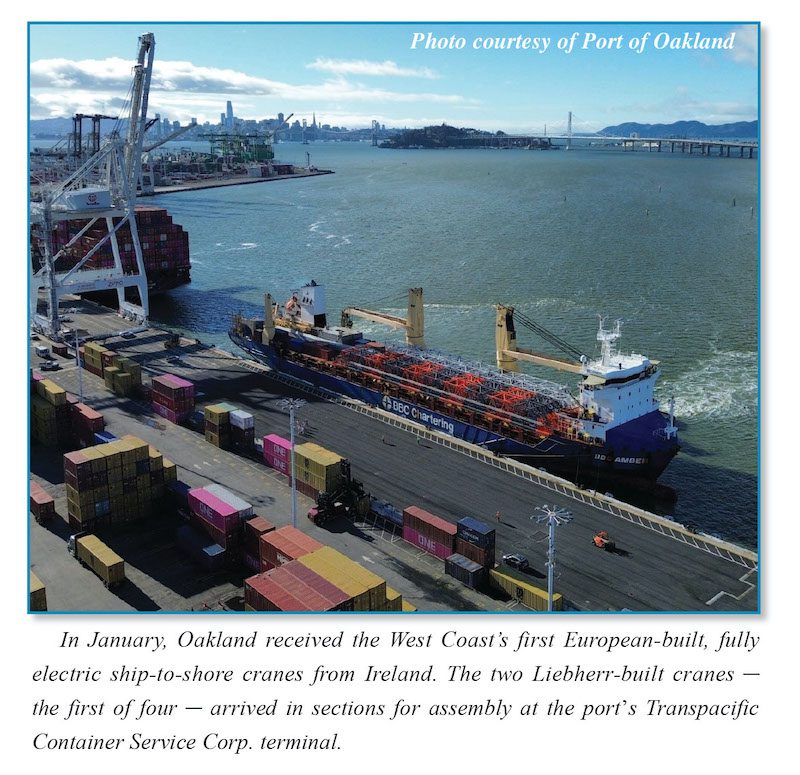
In January, Oakland received the West Coast’s first European-built, fully electric ship-to-shore cranes from Ireland.
The two cranes arrived for installation at the port’s Transpacific Container Service Corp. terminal. The Liebherr-built cranes arrived in sections, were assembled at the port, and will stand more than 440 feet tall.
A second pair of Liebherr cranes is expected to arrive in Oakland later this year.
Northwest Seaport Alliance
The Northwest Seaport Alliance and terminal operator SSA Terminals completed two strategic infrastructure projects at Terminal 5.
A modernized gate complex expanded capacity and added advanced technology designed to increase truck throughput into the terminal. The improved traffic flow design allows trucks to move more efficiently while doubling the number of vehicles that can queue on terminal.
The installation of additional refrigerated container plugs brings the total at Terminal 5 to more than 1,500. This adds capacity to handle more temperature-sensitive cargo, including apples, cherries, potatoes, seafood, and other products.
Great Lakes and Inland Waterways
Ports of Indiana
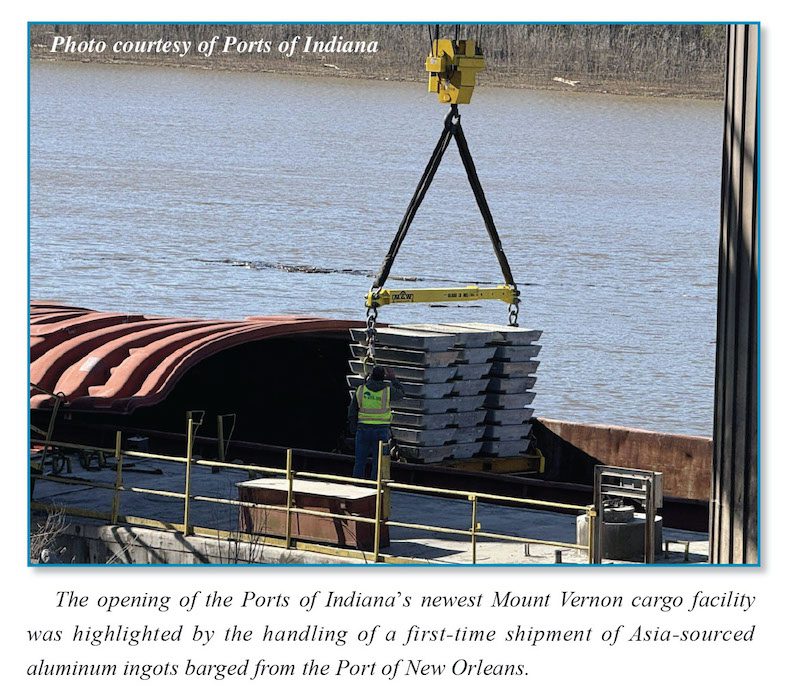
In March, Ports of Indiana opened a new federally approved bonded combination warehouse and storage facility at its Mount Vernon port.
Built in just six weeks, the new Mount Vernon facility includes a 20,000-square-foot warehouse and a one-acre storage yard. The facility is operated by Indiana River & Rail Terminals.
The first shipment, totaling approximately 1,650 tons of aluminum, arrived after traveling by ocean vessel from Asia to New Orleans and then by barge to Indiana for distribution to Midwest manufacturers of automotive, construction, and packaging materials.
Port of Monroe
The Port of Monroe, Michigan, will activate the first SAFE Port Act-compliant international container terminal on the Great Lakes later this year.
Along with a new roll-on/roll-off ramp that complements the port’s existing vessel berths, dual Class I rail access, proximity to interstate highways, and access to Midwest manufacturing, Monroe is positioning itself as “a fully integrated inland gateway for containerized trade and high-value industrial logistics,” according to a report released by the port.
Last fall, the port saw the movement of several large equipment modules for a data center under construction in Toronto, Canada.
The module units were fabricated in Texas, trucked to Monroe, and loaded aboard three barges. The barges were then towed to Hamilton, Ontario, before the modules were forwarded to Toronto.
Henderson County Riverport Authority
In Kentucky, the Henderson County Riverport Authority reopened its bulk dock earlier this year following completion of a two-year, $2.2 million infrastructure improvement project.
The effort was designed to ease seasonal bottlenecks and reduce demurrage costs for customers.
The facility has been upgraded through the acquisition of a new $2.03 million electric material handler capable of offloading dry bulk cargo at the liquid bulk dock rather than the main dock. The improvement allows the riverport to unload two barges simultaneously.
The refurbishment and expansion of the inland port’s infrastructure also included the construction of a concrete staging pad and upgrades to its electrical grid.
U.S. Ports Position for Long-Term Competitiveness
Despite global trade disruptions, tariffs, shifting shipping routes, and fluctuating cargo volumes, U.S. ports are continuing to invest in long-term competitiveness.
From channel deepening and terminal modernization to electrification, cold-chain capacity, inland connectivity, and new cargo-handling equipment, ports across the East Coast, Gulf Coast, West Coast, Great Lakes, and inland waterways are preparing for the next phase of global logistics.
These investments reflect a clear strategy: strengthen supply chain resilience, improve speed and efficiency, and position U.S. ports to serve larger vessels, specialized cargo, and evolving customer needs.
About the Author
Michael D. White is a published author with four nonfiction books and more than 1,700 bylined articles on international transportation and trade to his credit.