
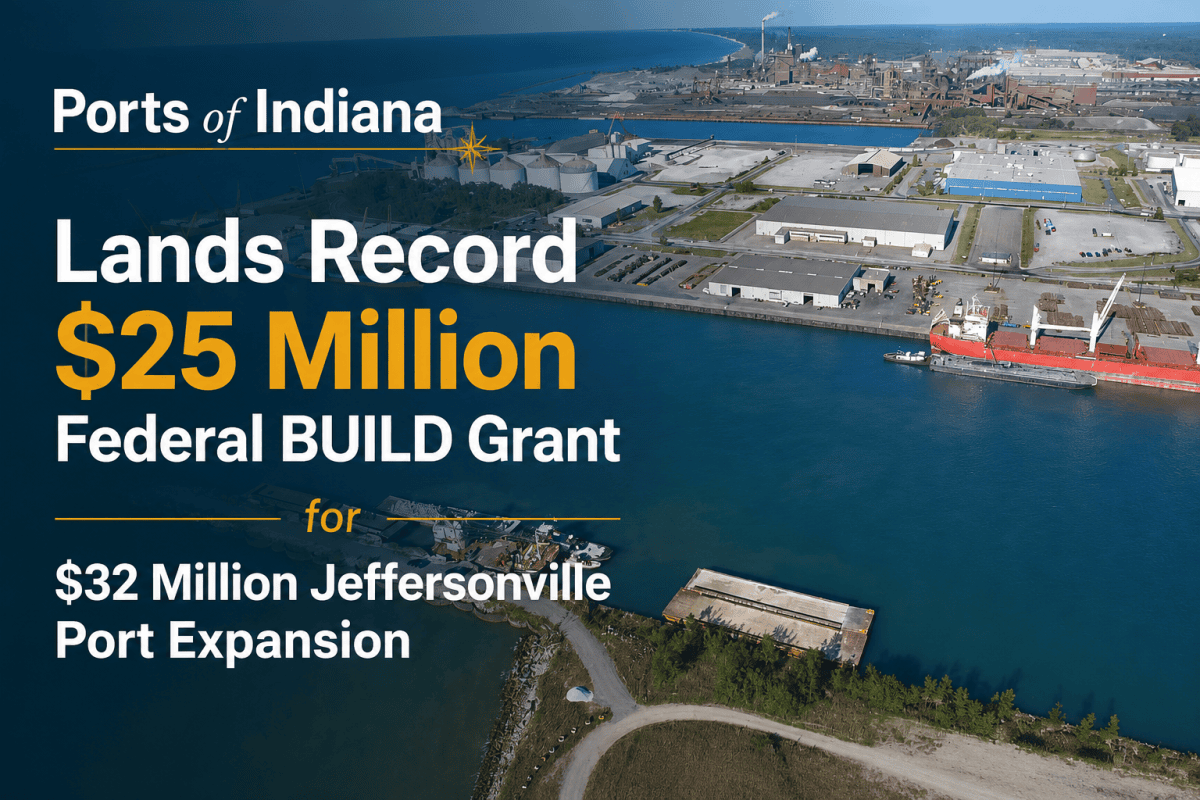
Historic Investment Will Add 300-Ton Crane, New Barge Dock and Warehouse to Transform Ohio River Multimodal Hub
JEFFERSONVILLE, Ind. (July 9, 2026) — Ports of Indiana has secured the largest federal grant in its 65-year history, receiving a $25 million U.S. Department of Transportation BUILD grant to support a $32 million expansion of its Jeffersonville port along the Ohio River.
The transformational project will more than double the port’s general cargo footprint, increase heavy-lift capacity from 35 tons to 300 tons, and establish one of the Midwest’s premier multimodal freight facilities.
Largest Federal Investment in Port History
The award marks several historic milestones for Ports of Indiana:
- $25 million BUILD grant from the U.S. Department of Transportation
- Largest federal grant in Ports of Indiana’s 65-year history
- More than double the previous largest federal award received by any Indiana port
- Largest single infrastructure investment at Jeffersonville since the port opened in 1985
- Total project value of $32 million
The funding comes through the U.S. Department of Transportation’s Better Utilizing Investments to Leverage Development (BUILD) program, which awarded $1.73 billion to 127 transportation infrastructure projects nationwide.
Expansion Will Transform Jeffersonville into Heavy-Lift Gateway
The project will redevelop an underutilized section of the Ohio River waterfront into a modern, high-volume multimodal cargo terminal featuring:
- 300-ton heavy-lift crane system
- 6,500-square-foot barge dock
- 22,000-square-foot warehouse
- Expanded breakbulk cargo capabilities
- Improved multimodal cargo handling
- Enhanced operational efficiency
Once completed, the expansion will significantly strengthen the port’s ability to serve manufacturers, project cargo operators and heavy industry throughout the Midwest.
Capacity Increases Will Drive Regional Growth
Upon completion, the Jeffersonville expansion will deliver major operational improvements, including:
- Lift capacity increasing from 35 tons to 300 tons
- More than 800% increase in heavy-lift capability
- Double the port’s barge-to-rail transloading capacity
- First general cargo facility located outside the floodplain
- Increased cargo storage and handling efficiency
- Lower transportation costs for regional industries
Construction is expected to be completed in 2028.
CEO: Project Will Transform Southern Indiana Logistics
Ports of Indiana CEO Jody Peacock described the investment as transformational for both Jeffersonville and the surrounding region.
According to Peacock, the expansion will dramatically increase the port’s ability to handle larger steel shipments and project cargo while improving operational efficiencies, expanding storage capacity and strengthening Jeffersonville’s role as a premier multimodal freight hub for decades to come.
State Leaders Applaud Historic Investment
Indiana Gov. Mike Braun said the investment reinforces the critical role Indiana’s ports play in supporting economic growth.
The governor noted the expanded cargo capabilities across river, rail and truck transportation will create new opportunities for Indiana manufacturers, agricultural producers and businesses while supporting high-quality jobs throughout Southern Indiana.
Federal Support Highlights National Logistics Importance
Members of Indiana’s congressional delegation praised the award as a major investment in the state’s transportation infrastructure and manufacturing economy.
Supporters emphasized the project will:
- Strengthen regional supply chains
- Improve freight efficiency
- Support American manufacturing
- Create and retain quality jobs
- Enhance Indiana’s position as a national logistics leader
Strengthening Midwest Supply Chains
The Jeffersonville expansion positions the port to better serve industries requiring heavy-lift and breakbulk transportation, including:
- Steel manufacturing
- Industrial equipment
- Project cargo
- Construction materials
- Advanced manufacturing
- Energy infrastructure
The upgraded multimodal terminal will improve connectivity between river, rail and highway transportation while expanding cargo-handling capacity for businesses throughout the Ohio River Valley and Midwest.