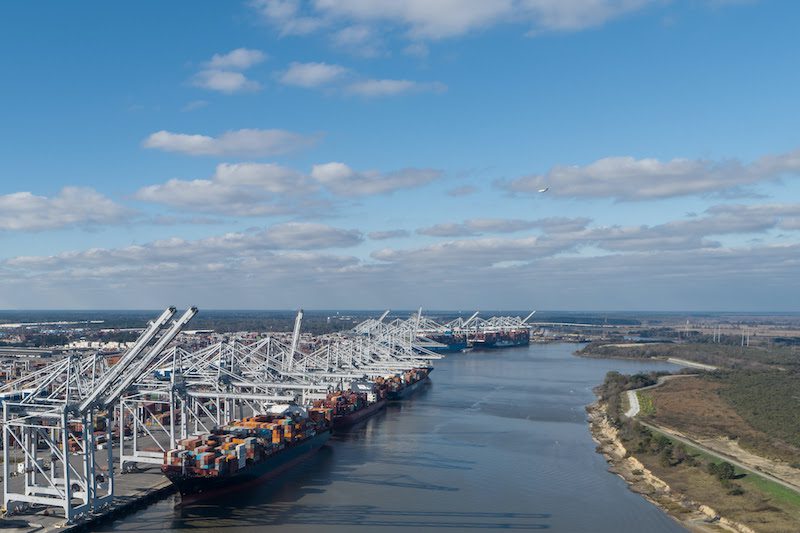

Logistics refers to the process of moving inputs and outputs within our economy. It is a complex interplay of industries, infrastructure, workers, and knowledge that supports all our economic activity. This includes not only manufacturing, wholesale, and retail goods, but all other sectors that rely on obtaining supplies for the production of goods and services and the movement of their products to customers (see Figure 1). In this article, we examine economic performance, recent investment, and emerging trends in logistics and provide takeaways for supporting business expansion in the U.S. For this article, we take a broad view of logistics, encompassing industries within transportation, warehousing, and supply chain logistics, which we refer to as TWL.
The industry data for this article is associated with:
- NAICS codes 48-49: Transportation and Warehousing,
- NAICS 541614: Process, Physical Distribution, and Logistics Consulting Services, and
- NAICS 561910: Packaging and Labeling Services.
These NAICS comprise activities that span the full transportation, warehousing, and logistics ecosystem, including:
- Transportation Services – Movement of passengers and freight across air, rail, water, road, and pipeline modes, as well as related support activities. These industries rely on specialized equipment and infrastructure matched to each mode.
- Warehousing & Storage – Facilities that store general merchandise, refrigerated products, and other goods. Operators are responsible for security, inventory management, and frequently provide value-added logistics services that support distribution.
- Process, Physical Distribution & Logistics Consulting – Firms that provide strategic and operational guidance on production planning, process optimization, quality control, inventory management, distribution network design, transportation efficiency, and materials handling.
- Packaging & Labeling Services – Establishments that package client-owned materials and provide labeling or imprinting services to prepare goods for distribution.

Industry Economics
In 2024, TWL industries employed 6.6 million workers across the country within 319,944 establishments and contributed more than $900 billion to the U.S. Gross Domestic Product. Historically, between 2001 and 2007, the TWL industries experienced modest growth followed by a decline in 2008 related to the U.S. recession (see Figure 2). Recovery was slow but gained momentum in 2013 and continued through 2019, when COVID-19 led to a decline as production and supply chains were significantly constrained. Recovery from COVID-19 occurred from 2022 through 2024. Lightcast projects that growth in TWL employment will continue through 2034, but at a lower rate than the recent post-COVID-19 years. The projected slow growth is based on multiple factors, including the impact of U.S. Tariffs, slowing overall global economic growth, and the reduction of hiring needs due to technology and automation.

Between 2000 and 2024, the total employment in the TWL industry grew by 17.3 percent, outpacing the overall economy’s employment growth of 10.1 percent (see Figure 3).

Across the country, Virginia, Tennessee, and Indiana have the highest concentrations of TWL employment, followed by Alabama, South Carolina, and Delaware (see Figure 4).

Within TWL, General Warehousing and Storage is the largest industry sector, employing 1.8 million people in the U.S. as of 2024, which reflects 31 percent growth since 2020. The next largest subsector, General Freight Trucking, Long-Distance, Truckload, employs 667,000 workers in 2024 after experiencing 2.5 percent growth over the same period. As TWL becomes increasingly reliant on data, analytics, modeling, and AI, the Process, Physical Distribution, and Logistics Consulting Services subsector is also expanding. In 2024, it employed 179,000 workers, reflecting 21 percent growth since 2020 (see Figure 5).

Workforce Characteristics of TWL
Workforce pressures continue to challenge the TWL sector, where persistent hiring difficulties and rising retirements are pushing employers to increase wages. Heavy and Tractor-Trailer Truck Drivers remain the dominant occupation, employing 1.3 million workers in 2024, about 20 percent of all TWL jobs (see Figure 6). This segment is particularly affected by an aging workforce, with retirements outpacing the number of new entrants willing or prepared to take on roles characterized by long hours and extended time away from home. While automation and autonomous vehicle technologies may eventually ease these pressures, widespread adoption remains years away.
Across the broader TWL workforce, many roles remain accessible through on-the-job training and industry certifications. However, as data and analytics play a larger role in TWL operations, demand has accelerated for higher-skilled positions such as management analysts, software developers, and logisticians. Together, these occupations currently account for about 96,000 jobs, after adding 38,000 since 2020, and typically require at least a bachelor’s degree (see Figure 6).

Trends Shaping the Future
The TWL sector is being reshaped by a convergence of forces, including advances in technology, shifting geopolitical dynamics, rising service expectations, and an urgent need for stronger, more resilient supply chains. Supply chain transparency has emerged as one of the most influential trends. Companies are looking beyond their immediate suppliers to better understand where the greatest risks and dependencies lie along national and global supply chains.1 Geopolitical tensions and extreme weather events have underscored the fragility of global networks, prompting executives to reassess every link in the chain and invest in greater contingency planning. This demand for visibility is increasingly enabled by the Internet of Things (IoT), where sensors provide real-time tracking of goods and allow for predictive modeling that can identify route interruptions before they occur.2
As consumer demand for near-immediate delivery intensifies, the rapid growth of warehousing and advancements in real-time tracking are enabling faster fulfillment across a wider range of communities, including suburban and rural markets. These expectations have led to increased investments and innovations for “last mile” delivery and overall efficiency in the supply chain. “According to a 2025 survey by Autostore, 34 percent of warehouses are making order tracking a central performance metric over the next year. This trend points to a broad technological shift, as companies seek to enhance efficiency, strengthen customer relationships, and remain competitive through greater transparency.3”
Applications of artificial intelligence (AI) and automation also continue to reshape warehousing and logistics operations. AI-powered tools are improving inventory management, demand forecasting, and product sourcing decisions. This is creating opportunities for venture funding to enable growth. In April 2025, 1Logtech Inc., out of Westerville, Ohio closed on a $1.5 million seed funding round to accelerate the growth of its AI-powered iPaaS (integration platform as a service).4
Robotics and “cobots” are now standard in many distribution centers, and adoption is expected to grow significantly as labor markets tighten and customer expectations for speed of delivery rise. This is leading to new investment in the U.S., including foreign direct investment. In September 2025, TVS Supply Chain Solutions, an India-based multinational company that pioneered the development of the supply chain solutions market in India, inaugurated a 225,000-square-foot facility with state-of-the-art, highly-automated robotics in Waterloo, Iowa, to support local manufacturing.5
With the investments and funding for substantial technology comes a seemingly endless range of analytics to help diagnose and identify issues in operations. Predictive maintenance, supported by real-time data analytics, is also essential. As digital tools become more integral, cybersecurity has become a top priority to safeguard sensitive operational systems and protect the gains achieved through technology integration.6 All of these shifts also have major implications for the workforce. With an aging labor pool and rapidly changing skill requirements, companies must invest in training and upskilling to ensure employees can effectively collaborate with advanced technologies. The roles within logistics look markedly different today than they did a decade ago, and workforce capacity will increasingly determine a company’s ability to grow.7

The industry is also being shaped by broader pressures for sustainability. Electrification of fleets, adoption of alternative fuels, and investments in cleaner technologies are accelerating, not only because of regulatory or environmental commitments but because they can improve long-term performance and cost efficiency. In the case of electric vehicles, the availability of charging infrastructure remains a significant limitation to building out entire fleets. Without strategically located charging stations, trucks are forced to deviate from their routes, adding time and cost that counteract the efficiencies electrification is meant to deliver.8 Even so, major players like Maersk (targeting net-zero GHG emissions by 20409) and DHL (net-zero by 2050, supported by sustainable aviation fuels and electric vehicles10) are setting the pace for an industry that will redefine operational excellence in the year ahead.
In addition to technological advancement, TWL industries are being impacted by U.S. and global trade relations and policies. Regarding the U.S. warehousing and storage market, IBIS World reports:
“Elevated tariffs introduced by the US in 2025 are prompting industry-wide concerns about the rising costs of imported goods and long-term demand from key retail markets. In reaction, companies are actively seeking ways to mitigate financial strain, most notably by reorganizing warehouse operations for cost savings. This trend points toward a shifting supply chain landscape, where a multi-node network of warehouses becomes essential to accommodate goods arriving from a broader array of suppliers and to keep products flowing to market efficiently.”11
Industry Real Estate
Real estate demand within the TWL sector is increasingly shaped by evolving retail strategies and the ongoing impacts of tariffs. As companies confront unexpected and frequent supply-chain disruptions, many are adopting leaner inventory models and diversifying sourcing, which in turn is driving the need for multi-node distribution networks and more space-efficient warehouse facilities. A recent investment by DP World, a global logistics and supply chain leader headquartered in Dubai, illustrates this trend toward flexible, automated space. In August 2025, the company expanded its Central Pennsylvania footprint with a new 249,600-square-foot, multi-customer warehouse in Middletown designed for maximum flexibility and scalability, particularly for small and mid-sized clients. “The warehouse will support business-to-business, direct-to-consumer, and eCommerce distribution models, offering cost-effective third-party logistics (3PL) services without the burden of dedicated infrastructure”12.
Conclusion and Takeaways
With an understanding and continued monitoring for trends and projections in TWL, economic and business developers will be able to find investment and expansion opportunities in their regions. Key support by economic developers includes:
• Making sure there is an inventory of sites to meet real estate needs and marketing those sites.
• Supporting investments and partnerships in the realm of workforce development, particularly around emerging tech and automation tools that complement traditional skills.
• Supporting companies in research and development through grants, tax credits, and other incentives, as well as securing R&D partners such as universities.
Jim has more than 25 years of experience using research and analysis to preparing professionals, communities, regions, states, and public and private organizations prepare for an emerging economic future. He is affiliated with Communities of the Future and the World Future Society and takes a holistic and innovative approach to economic development.
As a Senior Project Manager, Alex leads complex strategic planning efforts in geographies ranging from bustling urban centers to pastoral villages. She harnessed the power of collaboration in Los Angeles County, the country’s most populous county, where she managed a multi-disciplinary team to develop a strategic plan that was swiftly approved by the US Economic Development Administration. Alex works with clients to balance the competing interests of stakeholders while helping the client develop a plan that is ambitious yet achievable under their existing organizational capacity.
Sources:
1 A.P. Moller-Maersk, The Logistics Trend Map 2025, PDF report (2025)
2 A.P. Moller-Maersk, The Logistics Trend Map 2025, PDF report (2025),
3 IBISWorld Transportation and Warehousing. 49311 General Warehousing & Storage in the US
4 https://www.accessnewswire.com/newsroom/en/transportation/1logtech-closes-1.5m-seed-round-to-accelerate-ai-driven-no-code-integration-platform-1011846
5 https://www.tvsscs.com/tvs-scs-north-america-grows-at-20-cagr-aims-to-achieve-500-million-in-revenue/
6 Association for Supply Chain Management, Top 10 Supply Chain Trends 2025 (2024), PDF.
7 Association for Supply Chain Management, Top 10 Supply Chain Trends 2025 (2024), PDF.
8 Maersk. (2025, June 4). The shift to electric fleet vehicles in logistics. https://www.maersk.com/insights/sustainability/2025/06/04/transitioning-to-electric-vehicles-in-logistics
9 https://www.maersk.com/sustainability/all-the-way-to-net-zero
10 https://group.dhl.com/en/sustainability/environment.html
11 IBISWorld Transportation and Warehousing. 49311 General Warehousing & Storage in the US
12 https://www.dpworld.com/usa/news/latest-news/dpw-expands-pennsylvania-ops-with-mcw